
In this guide
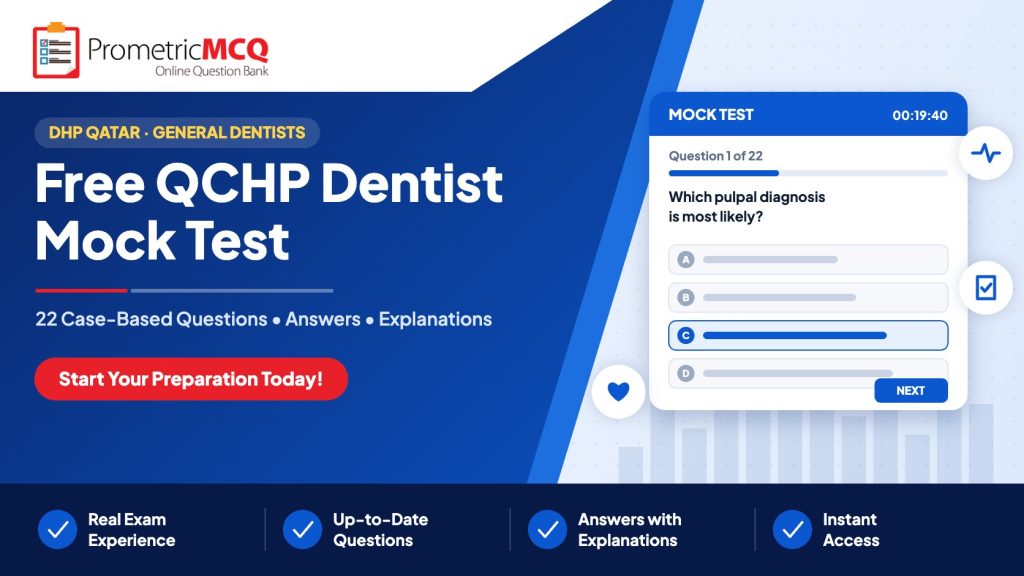
General dentists who want to practise in Qatar must pass the Department of Healthcare Professions (DHP, formerly QCHP) qualifying exam, a computer-based Prometric exam. This free QCHP general dentist mock test gives you 22 case-based questions with answers and explanations, the official 150-question format, the 60% pass mark and a 4-week study plan.
Reviewed by Dr Samer Hadad · Last reviewed 4 November 2026 · Exam facts checked against the DHP Qatar qualifying examination page and Prometric's DHP Qatar page.
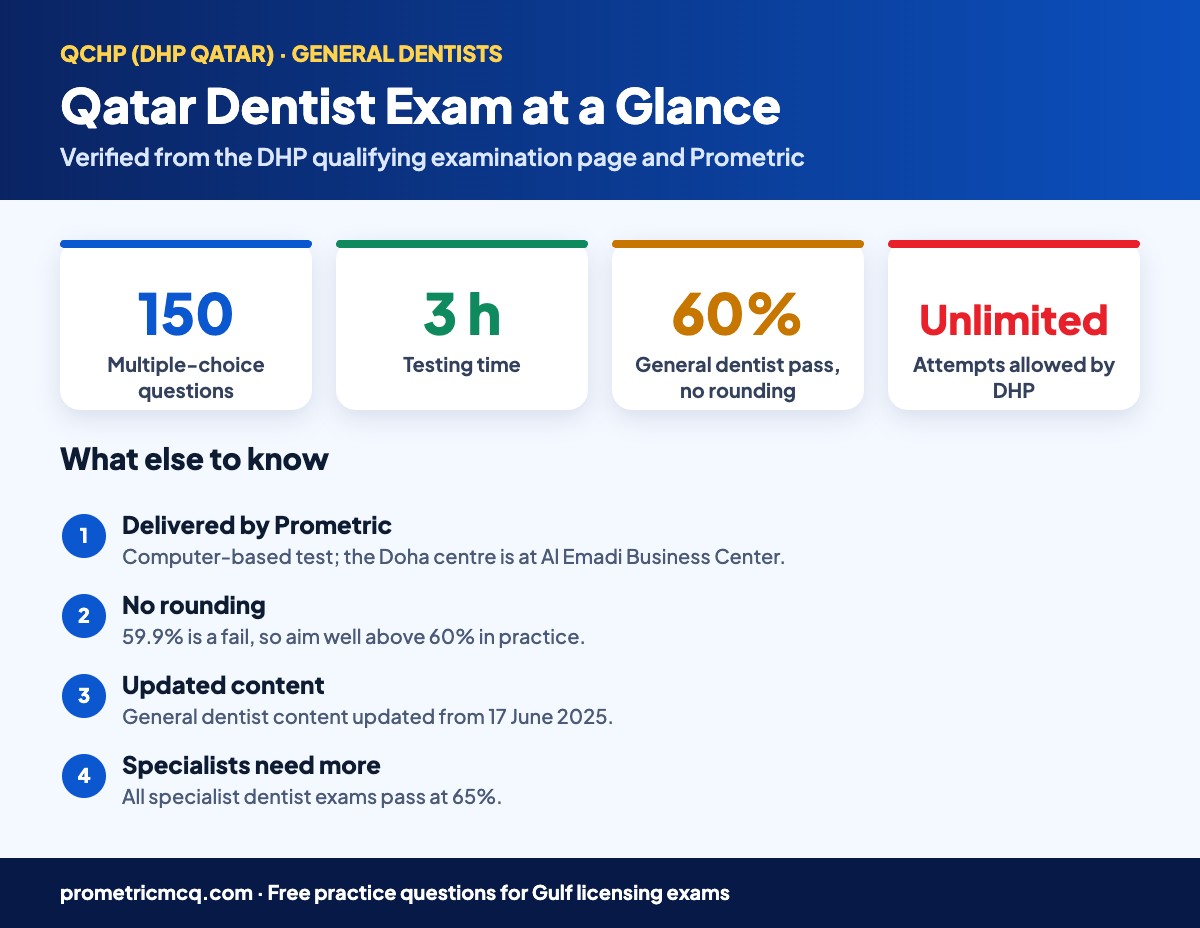
QCHP General Dentist Exam at a Glance
| Item | General Dentist |
|---|---|
| Delivered by | Prometric, computer-based |
| Questions | 150 MCQs |
| Time | 3 hours |
| Cut score | 60%, no rounding |
| Attempts | Unlimited, according to DHP |
| Test centre in Qatar | Prometric Doha, Al Emadi Business Center |
| Content update | Prometric notes updated General Dentist content from 17 June 2025, with an updated reference list from DHP |
Note the bar: general dentists need 60%, while all specialist dentist exams pass at 65% and most nursing and allied exams at 50%. DHP applies no rounding, so 59.9% is a fail.
What the Qatar Dental Exam Covers
- Restorative dentistry and endodontics: caries, materials, pulp diagnosis and root canal treatment.
- Periodontics and oral medicine: classification, treatment and oral lesions.
- Oral surgery and pharmacology: extractions, local anaesthesia, antibiotics and emergencies.
- Prosthodontics, orthodontics and paediatric dentistry.
- Infection control, radiology and ethics.
[pmcq_cta title="Thousands of dental MCQs with explanations" text="Practise Gulf-style dentistry questions in timed mocks. Instant access after payment." button="Get the Dentistry MCQs Package" url="https://www.prometricmcq.com/dentistry-mcqs/"]
Free QCHP Dentist Mock Test: 22 Case-Based Questions with Answers
The questions cover endodontics, local anaesthesia, medical emergencies, oral surgery, periodontics, oral medicine, paediatric dentistry, orthodontics, radiology and infection control. Choose Practice mode to see the explanation after each question, or Exam mode to answer all 22 against a 26-minute timer. The pass line is the same 60% DHP uses for general dentists; the real exam gives you 150 questions in 3 hours, about 72 seconds each.
[pmcq_quiz title="Free QCHP Dentist Mock Test – 22 Questions" pass="60" minutes="26" button="Get Dentistry MCQs – Instant Access" url="https://www.prometricmcq.com/dentistry-mcqs/"]
Question 1
A 34-year-old man has a deep carious lower molar. Cold causes severe pain that lingers for over a minute, and the tooth has woken him at night. Percussion is normal. Which pulpal diagnosis is most likely?
- A. Reversible pulpitis
- B. Pulp necrosis
- C. Irreversible pulpitis
- D. Normal pulp
Answer: C
Explanation: Lingering pain after a cold stimulus and spontaneous night pain indicate irreversible pulpitis, treated by pulp extirpation and root canal treatment or extraction. Reversible pulpitis gives short, sharp pain that stops when the stimulus is removed, and a necrotic pulp does not respond to cold.
High-yield takeaway: Lingering and spontaneous pain: irreversible pulpitis.
Question 2
A 25-year-old woman has a moderate occlusal cavity in a lower premolar. Cold causes a short, sharp pain that stops within seconds of removing the stimulus. There is no spontaneous pain. Which diagnosis and management are most appropriate?
- A. Reversible pulpitis; remove caries and restore
- B. Irreversible pulpitis; start root canal treatment
- C. Pulp necrosis; extract the tooth
- D. Acute apical abscess; incise and drain
Answer: A
Explanation: Short, sharp pain that resolves quickly with no spontaneous pain indicates reversible pulpitis. Removing the caries and placing a sound restoration usually allows the pulp to recover. Endodontic treatment or extraction is not indicated.
High-yield takeaway: Short pain that stops when the stimulus stops: reversible pulpitis.
Question 3
A dental student is calculating local anaesthetic doses. How many milligrams of lidocaine are there in each millilitre of a 2% solution?
- A. 2 mg
- B. 0.2 mg
- C. 200 mg
- D. 20 mg
Answer: D
Explanation: 2% w/v means 2 g per 100 mL, which is 20 mg/mL. Multiplying by the cartridge volume gives the dose per cartridge, which must be kept within the maximum recommended dose for the patient's weight.
High-yield takeaway: A % solution × 10 = mg/mL.
Question 4
After a successful inferior alveolar nerve block, a patient feels sharp pain when the buccal gingiva of the lower first molar is elevated for extraction. Which additional injection is needed?
- A. Mental nerve block
- B. Long buccal nerve block
- C. Greater palatine nerve block
- D. Nasopalatine nerve block
Answer: B
Explanation: The buccal gingiva of the lower molars is supplied by the long buccal nerve, which is not reliably anaesthetised by an inferior alveolar nerve block. The mental nerve supplies the premolar and anterior buccal gingiva and lip, and the palatine nerves supply the palate.
High-yield takeaway: Lower molar buccal gingiva: long buccal nerve.
Question 5
During local anaesthetic injection, a 22-year-old anxious patient becomes pale, sweaty and light-headed and briefly loses consciousness. His pulse is slow but present and he is breathing normally. What is the first action?
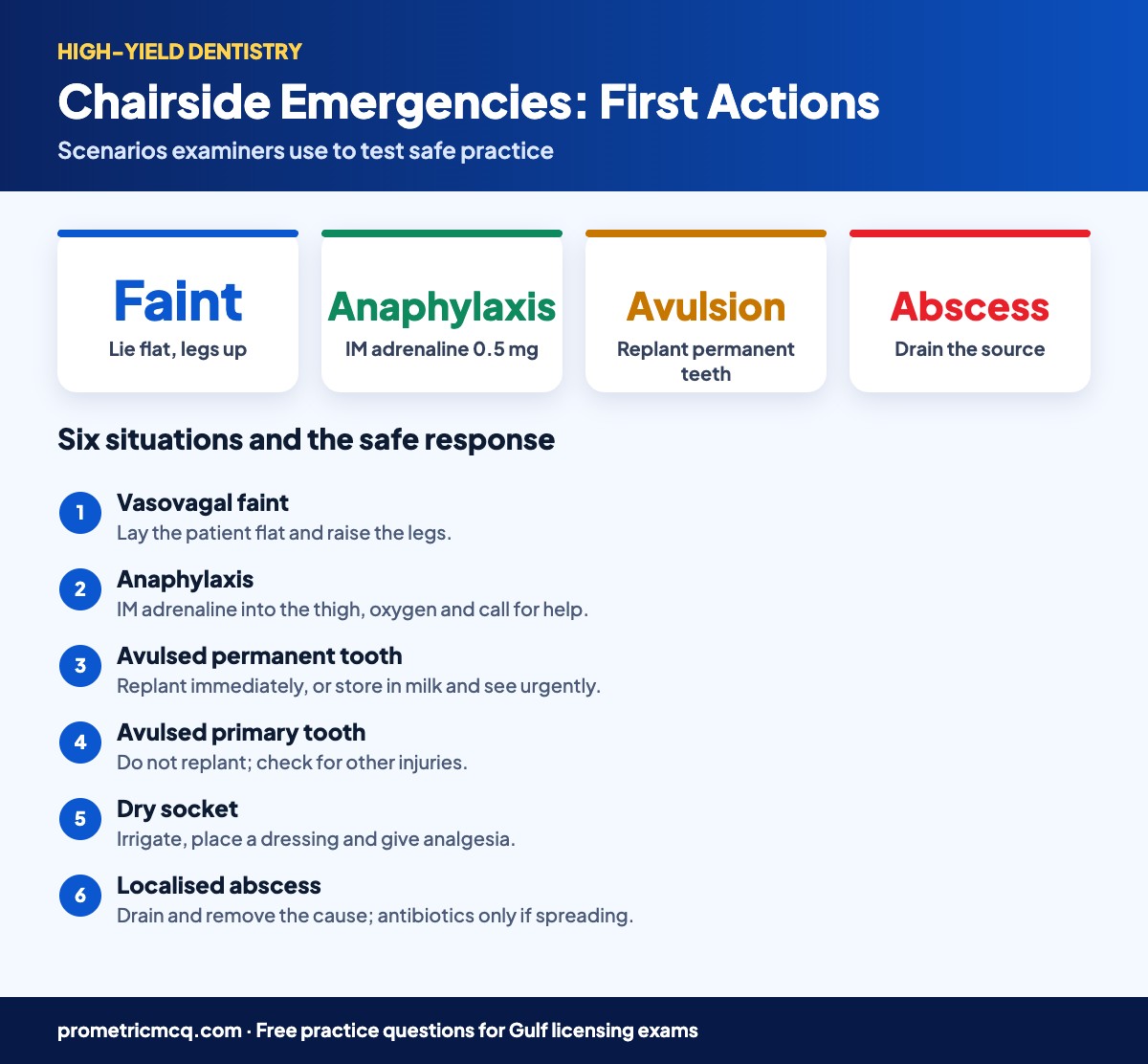
- A. Lay him flat and raise his legs
- B. Sit him fully upright
- C. Give oral glucose
- D. Give IM adrenaline
Answer: A
Explanation: This is a vasovagal faint. Lying the patient flat with the legs raised restores blood flow to the brain, and recovery is usually quick. Sitting upright worsens cerebral perfusion, glucose is for hypoglycaemia, and adrenaline is for anaphylaxis.
High-yield takeaway: Faint in the chair: lie flat, raise the legs.
Question 6
Minutes after a procedure, a 40-year-old woman develops widespread hives, wheeze, lip swelling and a BP of 80/50 mmHg. Help has been called. What is the first drug to give?
- A. Oral chlorphenamine
- B. IV hydrocortisone
- C. IM adrenaline 0.5 mg (0.5 mL of 1 mg/mL)
- D. Inhaled salbutamol alone
Answer: C
Explanation: This is anaphylaxis, and IM adrenaline 0.5 mg into the anterolateral thigh is the first-line adult treatment, repeated after 5 minutes if needed, with oxygen and airway support. Antihistamines and steroids are not first line, and salbutamol does not treat shock or airway swelling.
High-yield takeaway: Anaphylaxis: IM adrenaline first.
Question 7
Three days after extraction of a lower first molar, a 45-year-old smoker has severe throbbing pain radiating to the ear and bad breath. The socket appears empty with exposed bone. She has no fever or swelling. Which is the most likely diagnosis?
- A. Acute osteomyelitis
- B. Alveolar osteitis (dry socket)
- C. A retained root
- D. Pericoronitis
Answer: B
Explanation: Severe pain starting 2–4 days after extraction with an empty socket, exposed bone and halitosis is dry socket, more common after lower molar extractions and in smokers. It is managed by gentle irrigation, a socket dressing and analgesia; antibiotics are not routinely needed. Osteomyelitis causes systemic illness and spreading infection.
High-yield takeaway: Dry socket: day 2–4 pain, empty socket; irrigate and dress.
Question 8
A 24-year-old student who smokes and is stressed before exams has very painful, bleeding gums, punched-out ulcers of the interdental papillae covered with grey slough, and halitosis. Which is the most likely diagnosis?
- A. Chronic gingivitis
- B. Primary herpetic gingivostomatitis
- C. Desquamative gingivitis
- D. Necrotising gingivitis
Answer: D
Explanation: Painful bleeding gums with punched-out, sloughing interdental papillae and halitosis in a stressed smoker is necrotising gingivitis. Treatment is debridement, oral hygiene advice and chlorhexidine, with metronidazole if there is systemic involvement. Chronic gingivitis is usually painless, and herpetic infection causes vesicles.
High-yield takeaway: Punched-out papillae, pain and halitosis: necrotising gingivitis.
Question 9
A 3-year-old child has fever, irritability and refuses to eat. The gingivae are swollen and red, with multiple small vesicles and ulcers on the gums, tongue and lips. There are no lesions on the hands or feet. Which is the most likely diagnosis?
- A. Hand, foot and mouth disease
- B. Recurrent aphthous ulceration
- C. Primary herpetic gingivostomatitis
- D. Oral candidiasis
Answer: C
Explanation: Fever with acutely inflamed gingivae and widespread oral vesicles that rupture into ulcers is primary herpetic gingivostomatitis (HSV-1). Management is supportive (fluids, analgesia), with aciclovir if started early. Hand, foot and mouth disease affects the hands and feet, aphthae do not cause fever or gingivitis, and candidiasis causes white plaques.
High-yield takeaway: Child with fever and gingivostomatitis: primary herpes.
Question 10
A parent phones the clinic: her 10-year-old son knocked out a permanent upper central incisor 15 minutes ago. The tooth is intact. What is the best advice?
- A. Hold it by the crown, rinse briefly if dirty and replant it now; if not possible, store it in milk and come in at once
- B. Scrub the root clean before bringing it in
- C. Wrap it in a dry tissue and come tomorrow
- D. Do not replant; permanent teeth cannot be saved
Answer: A
Explanation: Immediate replantation gives the best chance of periodontal ligament survival. The tooth is held by the crown, rinsed briefly if dirty (never scrubbed) and replanted, or stored in milk or saline if replanting is not possible, with urgent dental review. Drying the root kills ligament cells.
High-yield takeaway: Avulsed permanent tooth: replant immediately or store in milk.
Question 11
A 3-year-old child fell and avulsed an upper primary central incisor. There are no other injuries. What is the correct management of the tooth?
- A. Replant it and splint for 2 weeks
- B. Store it in milk and replant later
- C. Perform root canal treatment, then replant
- D. Do not replant it; check for other injuries and monitor
Answer: D
Explanation: Avulsed primary teeth are not replanted, because replantation can damage the developing permanent tooth germ. Check for soft tissue and other injuries, give advice and review.
High-yield takeaway: Avulsed primary tooth: do not replant.
Question 12
A 30-year-old patient needs radiographs to check for early interproximal caries between the posterior teeth. Which view is most appropriate?
- A. Periapical
- B. Bitewing
- C. Panoramic (OPG)
- D. Occlusal
Answer: B
Explanation: Bitewing radiographs are the view of choice for detecting interproximal caries and assessing crestal bone levels in posterior teeth. Periapicals show the root and apex, panoramics have lower detail for early caries, and occlusal views are used for other indications.
High-yield takeaway: Interproximal caries: bitewings.
Question 13
During caries removal in a vital, symptom-free lower molar of a 19-year-old, a pinpoint mechanical pulp exposure occurs in a clean field. Which material is most appropriate for direct pulp capping?
- A. MTA or another calcium silicate cement
- B. Zinc phosphate cement
- C. Amalgam placed directly on the pulp
- D. Formocresol
Answer: A
Explanation: For a small, clean exposure in a healthy pulp, a calcium silicate material such as MTA (or calcium hydroxide) is placed directly over the exposure, followed by a well-sealed restoration. Zinc phosphate and amalgam are not pulp-capping materials, and formocresol is a pulpotomy medicament.
High-yield takeaway: Direct pulp cap: calcium silicate (MTA) and a good seal.
Question 14
A dentist applies 5% sodium fluoride varnish to a high-caries-risk 7-year-old. What is the fluoride concentration of this varnish?
- A. 1,000 ppm
- B. 5,000 ppm
- C. 22,600 ppm
- D. 1,450 ppm
Answer: C
Explanation: 5% sodium fluoride varnish contains 22,600 ppm fluoride. Standard adult toothpaste is typically around 1,450 ppm, and high-fluoride prescription toothpaste around 5,000 ppm.
High-yield takeaway: 5% NaF varnish = 22,600 ppm fluoride.
Question 15
A 12-year-old has a Class II molar relationship, an overjet of 9 mm and proclined upper incisors. How is this malocclusion classified?
- A. Class I
- B. Class III
- C. Class II division 2
- D. Class II division 1
Answer: D
Explanation: Class II division 1 has proclined upper incisors with an increased overjet. Class II division 2 has retroclined upper central incisors, often with a deep bite, and Class III has the lower arch forward of the upper.
High-yield takeaway: Class II div 1: increased overjet; div 2: retroclined incisors.
Question 16
A 58-year-old smoker has a white patch on the lateral border of his tongue that cannot be wiped off. It has been present for 2 months and is not explained by trauma. What is the most appropriate management?
- A. Reassure him and review in 2 years
- B. Refer for biopsy
- C. Prescribe an antifungal and discharge
- D. Advise a softer toothbrush only
Answer: B
Explanation: A persistent white patch that cannot be wiped off and has no clear cause is leukoplakia, a potentially malignant disorder, especially on the lateral tongue in a smoker. It needs referral for biopsy, plus smoking cessation advice. Antifungals treat candidiasis, which usually wipes off.
High-yield takeaway: Unexplained persistent white patch: biopsy.
Question 17
A 62-year-old heavy smoker and drinker has a painless ulcer on the lateral border of the tongue that has not healed for 4 weeks. It feels firm at the base. What is the most appropriate action?
- A. Reassure him that it is a traumatic ulcer
- B. Treat it as an aphthous ulcer with a steroid paste
- C. Urgent referral for suspected oral cancer
- D. Prescribe antibiotics and review in 3 months
Answer: C
Explanation: A non-healing, indurated ulcer lasting more than 3 weeks in a high-risk patient must be referred urgently to exclude squamous cell carcinoma. Labelling it traumatic or aphthous, or delaying with antibiotics, risks missing a cancer.
High-yield takeaway: Ulcer over 3 weeks, especially if indurated: urgent referral.
Question 18
A 70-year-old woman receiving IV zoledronic acid for bone metastases needs a lower molar extracted. What is the main specific risk to plan for?
- A. Medication-related osteonecrosis of the jaw
- B. Excessive bleeding
- C. Allergy to local anaesthetic
- D. Damage to the inferior alveolar nerve
Answer: A
Explanation: IV bisphosphonates for cancer carry a significant risk of medication-related osteonecrosis of the jaw after extractions. Non-surgical options should be considered first, and any extraction should be planned carefully, often with specialist input. The other risks are not specific to this drug.
High-yield takeaway: IV bisphosphonates or denosumab: plan extractions for MRONJ risk.
Question 19
A 66-year-old man on warfarin for atrial fibrillation needs a single simple extraction. His INR has been stable. What is the most appropriate approach?
- A. Stop warfarin for 5 days before the extraction
- B. Give vitamin K the day before
- C. Extract without checking the INR
- D. Check the INR shortly before (ideally within 24 hours), continue warfarin and use local haemostatic measures if it is in the safe range
Answer: D
Explanation: For simple extractions, warfarin is usually continued if the INR is within the safe range (commonly below 4), checked shortly before treatment, and bleeding is controlled with local measures such as sutures and haemostatic packing. Stopping warfarin or reversing it raises the risk of thrombosis.
High-yield takeaway: Warfarin and simple extractions: check INR, continue warfarin, local haemostasis.
Question 20
How should a dental handpiece be reprocessed between patients?
- A. Wipe with alcohol only
- B. Clean and sterilise in an autoclave
- C. Place in an ultraviolet cabinet
- D. Rinse under running water
Answer: B
Explanation: Handpieces enter the mouth and can be contaminated internally, so they are cleaned and heat-sterilised in an autoclave between patients, following the manufacturer's instructions. Wiping, UV light or rinsing do not sterilise them.
High-yield takeaway: Handpieces: clean and autoclave between patients.
Question 21
A 35-year-old man has a lower premolar with a necrotic pulp and a localised fluctuant swelling in the buccal sulcus. He is systemically well, with no fever or spreading swelling. What is the most appropriate management?
- A. Antibiotics alone, with no other treatment
- B. Analgesics only and review in a month
- C. Drainage through the root canal, incision or extraction
- D. A course of oral steroids
Answer: C
Explanation: Dental abscesses are treated by removing the source and draining pus, by pulpectomy, incision or extraction. Antibiotics are reserved for spreading infection or systemic involvement and are not a substitute for drainage.
High-yield takeaway: Localised dental abscess: drain and remove the cause; antibiotics only if spreading or systemic.
Question 22
A 21-year-old woman has pain around a partially erupted lower third molar. The overlying gum flap is red, swollen and tender, and she has mild trismus but no fever. Which is the most likely diagnosis?
- A. Pericoronitis
- B. Dry socket
- C. Submandibular sialadenitis
- D. Temporomandibular joint dysfunction
Answer: A
Explanation: Inflammation of the soft tissue flap over a partially erupted tooth is pericoronitis. Management includes irrigation under the operculum, oral hygiene and warm saline rinses, with antibiotics if there is systemic involvement or spreading infection. Dry socket follows an extraction.
High-yield takeaway: Partially erupted third molar with an inflamed flap: pericoronitis.
[/pmcq_quiz]
How to Score Your Mock Test
| Score (out of 22) | Meaning | Next step |
|---|---|---|
| 18–22 | Strong | Move to full 150-question timed mocks. |
| 14–17 | At or just above 60% | Too close with no rounding; revise every topic you missed. |
| 0–13 | Below the pass line | Follow the 4-week plan before booking. |
With no rounding, 60% is a floor, not a target. Emergency, oral medicine and paediatric trauma questions are worth getting right first, because the safe answer is usually clear once you know the rule.
[pmcq_cta title="Practise full-length dental mocks" text="Timed 150-question mocks with explanations, so the 60% cut score feels safe." button="Start Practising Now" url="https://www.prometricmcq.com/dentistry-mcqs/"]
4-Week Study Plan for the QCHP Dentist Exam
- Week 1: restorative, materials and endodontics.
- Week 2: periodontics, oral medicine and pharmacology.
- Week 3: oral surgery, prosthodontics, orthodontics and paediatrics. Check the updated DHP reference list.
- Week 4: infection control, radiology and ethics, then full timed mocks.
Related: Qatar Prometric exam tips for dentists, the QCHP registration guide and the QCHP preparation tips.
FAQs: QCHP Dentist Exam
How many questions are in the Qatar dental exam?
The General Dentist exam has 150 MCQs in 3 hours, according to DHP and Prometric.
What is the passing score for dentists in Qatar?
General dentists need 60%, with no rounding. All specialist dentist exams pass at 65%.
Has the QCHP dentist exam changed?
Yes. Prometric notes updated General Dentist content from 17 June 2025, with an updated DHP reference list.
Are these real exam questions?
No. Real questions are confidential. These are written by PrometricMCQ in the style of the Qatar dental exam.
How many attempts do I get?
DHP states that attempts are unlimited. Each attempt still costs time and fees, so book when your timed mock scores are comfortably above 60%.
Where is the Prometric test centre in Qatar?
The Prometric centre in Doha is at Al Emadi Business Center. Check your confirmation for the exact address and arrival instructions.
Is QCHP the same as DHP?
Yes. The Qatar Council for Healthcare Practitioners (QCHP) is now the Department of Healthcare Professions (DHP) at the Ministry of Public Health.
Which topics should general dentists prioritise?
Endodontic diagnosis, local anaesthesia, medical emergencies, oral medicine red flags and dental trauma, alongside restorative and periodontal basics.
How much time do I have per question?
150 questions in 3 hours gives about 72 seconds per question, so practise reading cases quickly and flagging hard ones.
Do I need to know the DHP reference list?
Yes. DHP publishes the reference list the exam is based on; check it when you plan your revision.
Conclusion
The Qatar dental exam needs 60%, so broad, steady revision beats cramming one subject. Use this mock to find your gaps and finish with full timed mocks.
[pmcq_cta title="Ready to pass the QCHP dentist exam?" text="Instant access to thousands of dentistry MCQs with explanations and timed mocks." button="Get Dentistry MCQs – Instant Access" url="https://www.prometricmcq.com/dentistry-mcqs/"]

The PrometricMCQ editorial team writes independent guides for healthcare professionals preparing for Gulf licensing exams. Editorial policy