In this guide
- QCHP (DHP Qatar) Nursing Exam at a Glance
- What the Qatar Nursing Exam Tests
- Free QCHP Nursing Mock Test: 25 Case-Based Questions with Answers
- How to Score Your Mock Test
- 4-Week Study Plan for the Qatar Nursing Prometric Exam
- Common Mistakes Qatar Nursing Candidates Make
- FAQs: QCHP (DHP Qatar) Nursing Mock Test
- Conclusion: Use This Mock Test as Your Starting Point
The Qatar nursing Prometric exam decides whether you can start your nursing career in Qatar. This free QCHP (now DHP Qatar) nursing mock test gives you 25 case-based, exam-style questions with answers and explanations, the official exam format, and a simple plan to turn your mock score into a pass.
Reviewed by Dr Samer Hadad · Last reviewed 4 November 2026 · Exam facts checked against the DHP Qatar qualifying examination page.
QCHP (DHP Qatar) Nursing Exam at a Glance
The Department of Healthcare Professions (DHP) at Qatar's Ministry of Public Health replaced the old QCHP name, but most candidates still search for "QCHP exam". The exam itself is a computer-based test delivered by Prometric.
| Item | Registered General Nurse | Registered Midwife |
|---|---|---|
| Exam type | Computer-based MCQs (Prometric) | Computer-based MCQs (Prometric) |
| Number of questions | 150 MCQs | 150 MCQs |
| Time allowed | 3 hours | 3 hours |
| Pass mark (cut score) | 50% | 50% |
| Score rounding | None | None |
| Booking | Prometric DHP Qatar booking page | |
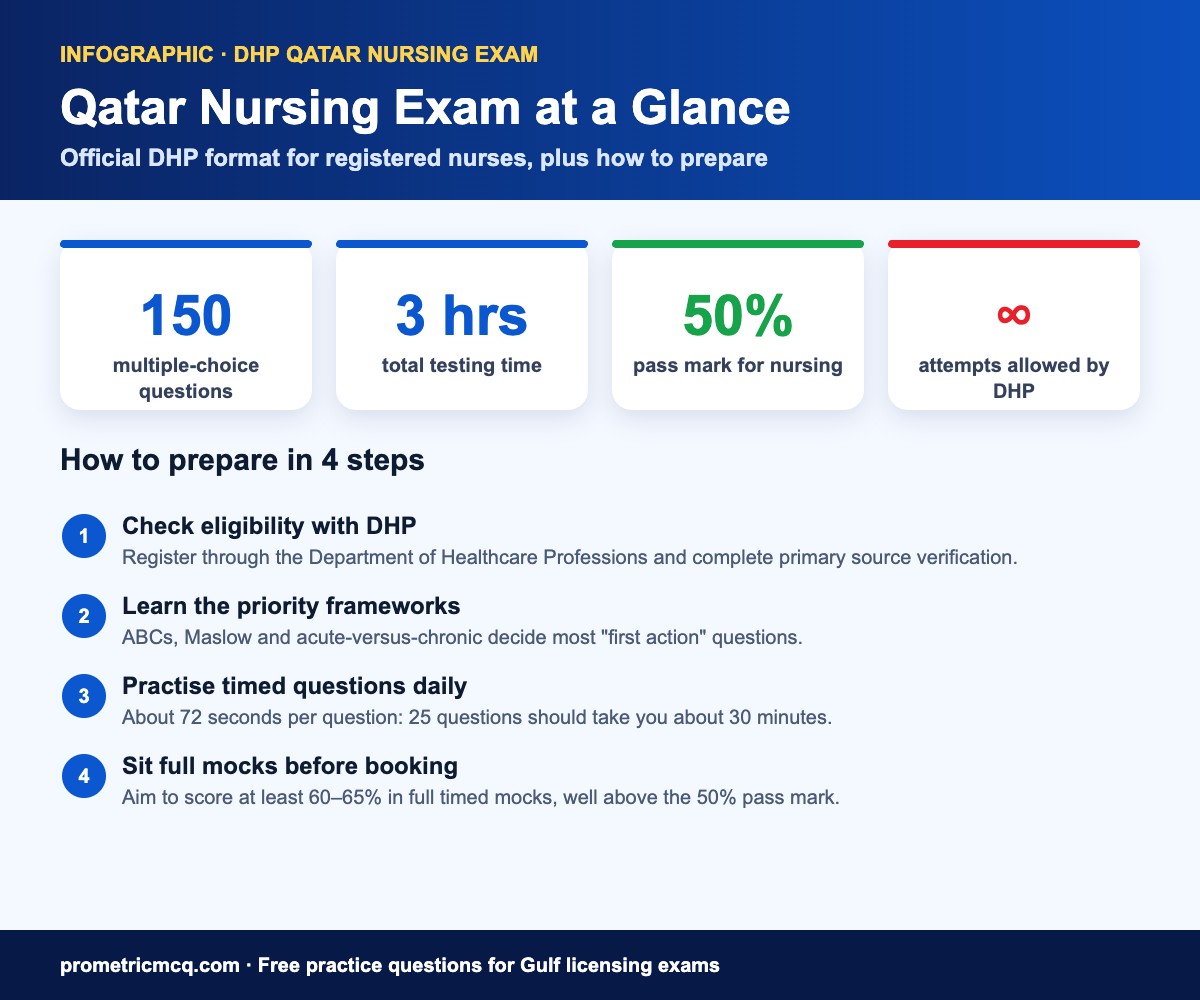
Source: DHP Qatar – Qualifying Examination. DHP states that applicants may attempt the qualifying exam an unlimited number of times, while some agencies still quote older limits, so always confirm the current rule in your DHP account before booking.
What the Qatar Nursing Exam Tests
DHP publishes a nursing and midwifery blueprint and reference list. In practice, questions focus on safe, prioritised nursing care rather than memorised definitions. Expect clinical scenarios from these areas:
- Fundamentals of nursing: infection control, patient safety, documentation, vital signs, medication administration and ethics.
- Adult (medical-surgical) nursing: cardiac, respiratory, renal, endocrine and post-operative care, the largest share of most papers.
- Maternal and child health: antenatal and postnatal care, labour, newborn assessment and paediatric emergencies.
- Leadership and unit management: delegation, prioritisation, communication and quality improvement.
Read each question for the safest first action. Words like "first", "priority", "most appropriate" and "immediately" decide the answer far more often than the clinical facts alone.
Free QCHP Nursing Mock Test: 25 Case-Based Questions with Answers
These 25 questions are written in the style of the real exam: a short clinical case, four plausible options and one best answer. Choose Practice mode to see the answer and explanation after each question, or Exam mode to answer all 25 against the clock and see your score at the end. The real exam gives you about 72 seconds per question, so the timer is set to 30 minutes.
Question 1
A 68-year-old man is 2 days post right hemicolectomy. At 02:00 he is newly confused. Vital signs: temperature 38.6 °C, pulse 118/min, BP 88/50 mmHg, respiratory rate 26/min, SpO₂ 93% on room air. Urine output has been 15 mL/h for the last 2 hours. What is the nurse's priority action?
Answer: B
Explanation: Fever, tachycardia, hypotension, tachypnoea, new confusion and oliguria after bowel surgery point to sepsis, possibly from an anastomotic leak. This is time-critical: escalate immediately and start the sepsis bundle (blood cultures, lactate, IV antibiotics, IV fluids, oxygen, urine output monitoring). Paracetamol treats only the fever, oral fluids are inadequate for shock, and 4-hourly observations are far too infrequent.
High-yield takeaway: New confusion plus hypotension after surgery means sepsis until proven otherwise; act within the first hour.
Question 2
A 55-year-old woman with type 2 diabetes reports epigastric discomfort and nausea for 30 minutes. She is pale and sweaty. BP 142/90 mmHg, pulse 96/min. What should the nurse do first?
Answer: B
Explanation: Women and people with diabetes often present with atypical symptoms of acute coronary syndrome, such as epigastric pain, nausea and sweating. A 12-lead ECG within 10 minutes of first contact is the standard. Checking glucose is reasonable, but it must not delay the ECG. Antacids or waiting could miss an evolving myocardial infarction.
High-yield takeaway: Atypical chest pain in women, older adults and people with diabetes still means ECG first.
Question 3
A 72-year-old man suddenly develops right-sided weakness and slurred speech. His family says he was last seen well 50 minutes ago. Capillary glucose is 6.2 mmol/L. What is the most important nursing action?
Answer: B
Explanation: This is a suspected acute stroke within the thrombolysis window. Activate the stroke pathway and arrange an urgent CT; time is brain. Aspirin is never given before haemorrhage is excluded on imaging. Swallowing must be screened formally before any oral intake. Waiting to see if it is a TIA wastes treatment time.
High-yield takeaway: Note the last-known-well time, check glucose, then go: imaging before aspirin, and nil by mouth until the swallow screen.
Question 4
A client with type 1 diabetes is admitted with vomiting, abdominal pain and deep, rapid breathing. Blood glucose is 28 mmol/L, ketones 5.2 mmol/L and potassium 5.6 mmol/L. An IV insulin infusion has started. Which assessment is most important over the next few hours?
Answer: B
Explanation: Insulin drives potassium into the cells. A high potassium at presentation often hides a total-body potassium deficit, so the level can fall dangerously during treatment and cause arrhythmias. DKA protocols require frequent potassium checks and replacement once it drops into the normal range. Temperature, weight and pain matter less in the first hours.
High-yield takeaway: In DKA, the potassium that looks high at the start falls once insulin begins. Monitor it closely.
Question 5
A 30-year-old man with asthma is in the emergency department. He was wheezing loudly 20 minutes ago, but now his chest is almost silent, he can only say single words, and his SpO₂ is 89%. How should the nurse interpret this?
Answer: B
Explanation: A silent chest means so little air is moving that no wheeze is produced. With exhaustion, inability to speak in sentences and hypoxia, this is life-threatening asthma. Call for senior help immediately; he needs oxygen, back-to-back bronchodilators, steroids and possibly IV magnesium and critical care review.
High-yield takeaway: Wheeze that disappears without improvement is a red flag, not a recovery.
Question 6
A 2-year-old with gastroenteritis has had 8 watery stools today. She is lethargic, has sunken eyes, a capillary refill of 4 seconds, and has not passed urine for 10 hours. Which action is the priority?
Answer: B
Explanation: Lethargy, prolonged capillary refill and no urine for 10 hours indicate severe dehydration with possible shock. She needs urgent IV or IO fluids. Oral rehydration suits mild to moderate dehydration in an alert child. Antidiarrhoeals are not recommended for young children, and delaying 4 hours is unsafe.
High-yield takeaway: Lethargy plus poor perfusion in a child means severe dehydration, which needs IV fluids.
Question 7
A woman who gave birth vaginally 1 hour ago has a soft, boggy uterus 2 cm above the umbilicus and heavy vaginal bleeding. Pulse is 112/min. What is the nurse's first action?
Answer: A
Explanation: A boggy uterus with heavy bleeding is postpartum haemorrhage from uterine atony, the most common cause. Fundal massage stimulates contraction while help is summoned for uterotonics such as oxytocin, IV access and fluid resuscitation. Emptying the bladder also helps. Packing is not first line, and iron does nothing in the acute phase.
High-yield takeaway: Boggy uterus plus bleeding means rub the fundus, call for help and give a uterotonic.
Question 8
A patient at 34 weeks' gestation with pre-eclampsia is receiving an IV magnesium sulphate infusion. Her respiratory rate is 9/min, patellar reflexes are absent and urine output is 20 mL/h. What should the nurse do first?
Answer: B
Explanation: Loss of reflexes, respiratory depression and oliguria are signs of magnesium toxicity, made worse by poor renal clearance. Stop the infusion, call the doctor and prepare calcium gluconate, the antidote, while supporting breathing.
High-yield takeaway: Before every magnesium check: reflexes, respiratory rate and urine output. Calcium gluconate reverses toxicity.
Question 9
Ten minutes into a red cell transfusion, a patient develops fever, rigors, low back pain and a BP of 84/50 mmHg. What is the nurse's first action?
Answer: B
Explanation: These signs suggest an acute haemolytic transfusion reaction, often from ABO incompatibility. Stop the blood immediately, disconnect the giving set, maintain IV access with saline using a new line, call the doctor, and return the bag and samples to the blood bank. Identity checks follow; they must not delay stopping the transfusion.
High-yield takeaway: Suspected transfusion reaction: stop it first, then investigate.
Question 10
A patient on a heparin infusion for DVT has a platelet count that has fallen from 260 to 95 × 10⁹/L on day 6, and a new swollen, painful left leg. What should the nurse suspect?
Answer: B
Explanation: A platelet drop of more than 50% 5–10 days after starting heparin, with new thrombosis, suggests HIT, an immune reaction that paradoxically causes clots. Stop all heparin, including flushes, inform the doctor, and expect a non-heparin anticoagulant.
High-yield takeaway: Falling platelets plus new clots on heparin means HIT. Stop all heparin.
Question 11
Which client should the charge nurse assign to a newly qualified registered nurse on a medical ward?
Answer: B
Explanation: The stable client with predictable needs suits a newly qualified nurse. The others are unstable or at high risk of rapid deterioration and need an experienced nurse.
High-yield takeaway: Assign stable, predictable clients to the least experienced staff; unstable clients go to the most experienced.
Question 12
A client with COPD has an SpO₂ of 86% on room air. ABG shows pH 7.36, PaCO₂ 7.8 kPa and HCO₃⁻ 33 mmol/L. What is the most appropriate oxygen target?
Answer: B
Explanation: Chronic CO₂ retention (high PaCO₂ with a high bicarbonate that keeps the pH normal) puts this client at risk of hypercapnic respiratory failure with high-flow oxygen. Use controlled oxygen, such as a Venturi mask, targeting 88–92%. Withholding oxygen from a hypoxaemic patient is never correct.
High-yield takeaway: COPD with CO₂ retention: give oxygen, but target 88–92%.
Question 13
A patient with chronic kidney disease has a serum potassium of 6.8 mmol/L and the ECG shows peaked T waves. Which medicine should the nurse expect to give first?
Answer: B
Explanation: With ECG changes, the first step is to stabilise the myocardium with IV calcium gluconate (or chloride), which acts within minutes but does not lower potassium. Insulin with dextrose and salbutamol then shift potassium into cells, and resins or dialysis remove it.
High-yield takeaway: Hyperkalaemia with ECG changes: calcium protects the heart first, then shift and remove potassium.
Question 14
Six hours after a cardiac catheterisation via the right femoral artery, the patient reports numbness of the right foot. The foot is cool and pale, and the pedal pulse is weaker than on the left. What should the nurse do first?
Answer: B
Explanation: Pain or numbness with a cool, pale limb and a reduced pulse suggests arterial occlusion or a thrombus at the puncture site, which threatens the limb. Notify the doctor immediately. Elevating the leg reduces arterial flow, heat can burn insensate skin, and walking may worsen bleeding at the site.
High-yield takeaway: After femoral access, check the 6 Ps distal to the site; a new deficit is an emergency.
Question 15
A client receiving 4-hourly IV morphine has a sedation score showing he is difficult to rouse and a respiratory rate of 8/min. The next dose is due now. What should the nurse do?
Answer: B
Explanation: Excess sedation precedes opioid respiratory depression. Withhold the opioid, rouse the client, support oxygenation, inform the doctor and give naloxone as prescribed. Giving any opioid now is unsafe.
High-yield takeaway: Sedation is the early warning for opioid toxicity. Assess it before every dose.
Question 16
A patient's medication chart lists a severe penicillin allergy (anaphylaxis). The doctor prescribes IV piperacillin–tazobactam. What should the nurse do?
Answer: B
Explanation: Piperacillin is a penicillin. A known anaphylaxis history is an absolute contraindication. The nurse must withhold the dose and clarify with the prescriber. Premedication or test doses do not make it safe.
High-yield takeaway: Know which drugs are penicillins (amoxicillin, co-amoxiclav, piperacillin, flucloxacillin) and always check allergies against the class.
Question 17
A nurse prepares to give a medication to a confused older patient whose identity band is missing. The patient answers 'yes' to their name. What is the correct action?
Answer: B
Explanation: Positive identification requires at least two identifiers checked against the chart, normally from an identity band. A confused patient may agree to any name, and room or bed numbers are not identifiers.
High-yield takeaway: Two identifiers, every time. Never use room or bed numbers.
Question 18
An 80-year-old woman with dementia keeps trying to get out of bed at night and has fallen once. Which intervention is most appropriate?
Answer: B
Explanation: Least-restrictive measures come first: a low bed, alarms, closer observation, regular toileting, good lighting and non-slip footwear. Restraints and full bed rails increase injury risk and agitation, and routine sedation increases falls and delirium.
High-yield takeaway: Fall prevention means least restrictive first; restraints are a last resort.
Question 19
A 45-year-old patient is newly diagnosed with type 2 diabetes and started on metformin. Which statement shows he needs more teaching?
Answer: C
Explanation: Metformin alone rarely causes hypoglycaemia because it does not stimulate insulin release. The other statements are correct: take it with meals to reduce GI upset, and pause it during dehydrating illness ('sick day rules') because of the lactic acidosis risk.
High-yield takeaway: Metformin: GI upset is common, hypoglycaemia is rare on its own, and pause it when dehydrated.
Question 20
A patient has a stage 3 sacral pressure injury. Which nursing measure is most important to prevent it from worsening?
Answer: B
Explanation: Pressure relief is the foundation: regular repositioning plus pressure-redistributing surfaces, nutrition and moisture management. Massage damages tissue, raising the head of the bed above 30° increases sacral shear, and heat lamps dry the wound bed and impair healing.
High-yield takeaway: Relieve pressure, reduce shear (head of bed at 30° or less), manage moisture and support nutrition.
Question 21
A client 1 day after abdominal surgery has a sudden onset of shortness of breath, pleuritic chest pain, a heart rate of 124/min and an SpO₂ of 88%. What should the nurse suspect first?
Answer: B
Explanation: Sudden dyspnoea, pleuritic pain, tachycardia and hypoxia after surgery are classic for pulmonary embolism. Sit the client up, give oxygen, call for urgent review, and expect anticoagulation and CT pulmonary angiography.
High-yield takeaway: Sudden breathlessness and tachycardia after surgery: think PE.
Question 22
A 6-month-old infant is due for routine vaccines. The mother says the baby had a mild cold with a runny nose and a temperature of 37.6 °C yesterday. What should the nurse do?
Answer: B
Explanation: Minor illness with or without low-grade fever is not a contraindication to vaccination. Postponing only leaves the infant unprotected for longer. Defer for moderate or severe acute illness or a true contraindication such as previous anaphylaxis.
High-yield takeaway: A mild cold is not a reason to delay vaccines.
Question 23
A patient tells the nurse, "Please do not tell my family that I have cancer. I will tell them when I am ready." A relative later asks the nurse about the diagnosis. What is the most appropriate response?
Answer: B
Explanation: A competent adult's confidentiality must be respected. The nurse should not disclose, misdirect or mislead, but can support communication by encouraging the relative to talk with the patient.
High-yield takeaway: Confidentiality belongs to the competent patient, not the family.
Question 24
A patient with a new colostomy says, "I cannot even look at it. Nobody will want to be near me." What is the most therapeutic response?
Answer: B
Explanation: Reflecting the feeling and inviting the patient to say more is therapeutic and helps explore body-image concerns. False reassurance, minimising and changing the subject block communication. Teaching can follow once the emotional concerns are acknowledged.
High-yield takeaway: Acknowledge feelings first; skills teaching comes later.
Question 25
A nurse finds a colleague drawing up an opioid alone and later sees the controlled drug register signed with a second signature that appears to be forged. What should the nurse do?
Answer: C
Explanation: Possible falsification of controlled drug records is a patient-safety and professional-conduct issue that must be escalated through the proper channel, usually the nurse in charge or manager, according to policy. Ignoring it or handling it privately puts patients at risk and breaches the nurse's own professional duty.
High-yield takeaway: Controlled drug discrepancies are always escalated, never handled informally.
How to Score Your Mock Test
| Your score (out of 25) | What it means | What to do next |
|---|---|---|
| 20–25 | Strong. You are reasoning like a safe Qatar nurse. | Move to full 150-question timed mocks. |
| 13–19 | Close to the 50% pass mark, but with gaps. | Review every wrong answer and the topic behind it. |
| 0–12 | You need more topic revision first. | Study by system for 2–3 weeks, then retake mocks. |
4-Week Study Plan for the Qatar Nursing Prometric Exam
- Week 1 – Fundamentals and safety: infection control, medication safety, drug calculations, ethics and documentation. Do 40 questions a day.
- Week 2 – Adult nursing: cardiac, respiratory, renal, endocrine and post-operative care. Add one 50-question timed set every second day.
- Week 3 – Maternal, child and leadership: labour, postpartum, newborn, paediatric emergencies, delegation and prioritisation.
- Week 4 – Full mocks: two to three 150-question mocks under real timing, then revise only your weak topics.
New to the process? Read our QCHP exam study guide for nurses, the step-by-step guide to applying for the Qatar Prometric exam and the QCHP registration guide.
Common Mistakes Qatar Nursing Candidates Make
- Choosing the "nice" answer instead of the safe one. Airway, breathing, circulation and patient safety always come first.
- Skipping calculations. Drip rates and dose calculations are easy marks if you practise the formulas.
- Not practising under time. 72 seconds per question feels fast on exam day without timed practice.
- Starting the licence paperwork late. Primary source verification and DHP evaluation can take weeks, so start them while you study.
- Relying only on free questions. A free mock shows your level; passing comes from steady practice across all topics.
FAQs: QCHP (DHP Qatar) Nursing Mock Test
How many questions are in the Qatar nursing Prometric exam?
The DHP Qatar exam for Registered General Nurses has 150 multiple-choice questions and a 3-hour time limit, according to the official DHP qualifying examination page.
What is the passing score for the QCHP nursing exam?
The cut score is 50%, and DHP states that no rounding of exam scores is applied.
Is QCHP the same as DHP?
Yes. The Qatar Council for Healthcare Practitioners (QCHP) is now the Department of Healthcare Professions (DHP) at the Ministry of Public Health. Candidates still commonly call it the QCHP exam.
How many times can I take the Qatar nursing exam?
The DHP qualifying examination page says applicants may attempt the exam an unlimited number of times. Rules can change, so confirm the current policy in your DHP account before booking.
Where do I book the exam?
After DHP approves your eligibility, you schedule the exam through Prometric's DHP Qatar booking page. The exam is computer-based at Prometric test centres.
Are these the real Qatar exam questions?
No. Real exam questions are confidential. These questions are written by PrometricMCQ to match the style, topics and difficulty of the Qatar nursing exam.
How long should I study for the Qatar nursing exam?
Most working nurses need 6–10 weeks of steady study: 30–50 questions a day, a weekly timed block, and two full-length mocks before booking. Start earlier if you have been out of clinical practice.
Can I take the Qatar nursing exam online?
No. Prometric lists only the DHP Dietician exam for remote testing; the nursing exam is taken at a Prometric test centre.
What score on this mock test means I am ready?
Aim for at least 20 out of 25 (80%) in Exam mode, and 60–65% or more in full 150-question timed mocks, before you book. That gives you a safe margin over the 50% pass mark.
Which topics should I focus on?
Prioritisation and patient safety, medical-surgical nursing, pharmacology and medication safety, maternal and child health, infection control and mental health come up repeatedly. Use the questions you get wrong here to decide where to start.
Conclusion: Use This Mock Test as Your Starting Point
The Qatar nursing exam rewards safe, prioritised decisions under time pressure. Use this free QCHP mock to find your weak areas, follow the 4-week plan, and build exam stamina with full timed mocks. For more exams across the Gulf, visit our QCHP exam hub or try the free DHA nursing mock test.

The PrometricMCQ editorial team writes independent guides for healthcare professionals preparing for Gulf licensing exams. Editorial policy