In this guide
Pharmacists who want to practise in Qatar must pass the Department of Healthcare Professions (DHP, formerly QCHP) qualifying exam, a computer-based Prometric exam. This free QCHP pharmacist mock test gives you 24 case-based questions with answers and explanations, the official 150-question format, the 60% pass mark and a 4-week study plan.
Reviewed by Dr Samer Hadad · Last reviewed 4 November 2026 · Exam facts checked against the DHP Qatar qualifying examination page and Prometric's DHP Qatar page.
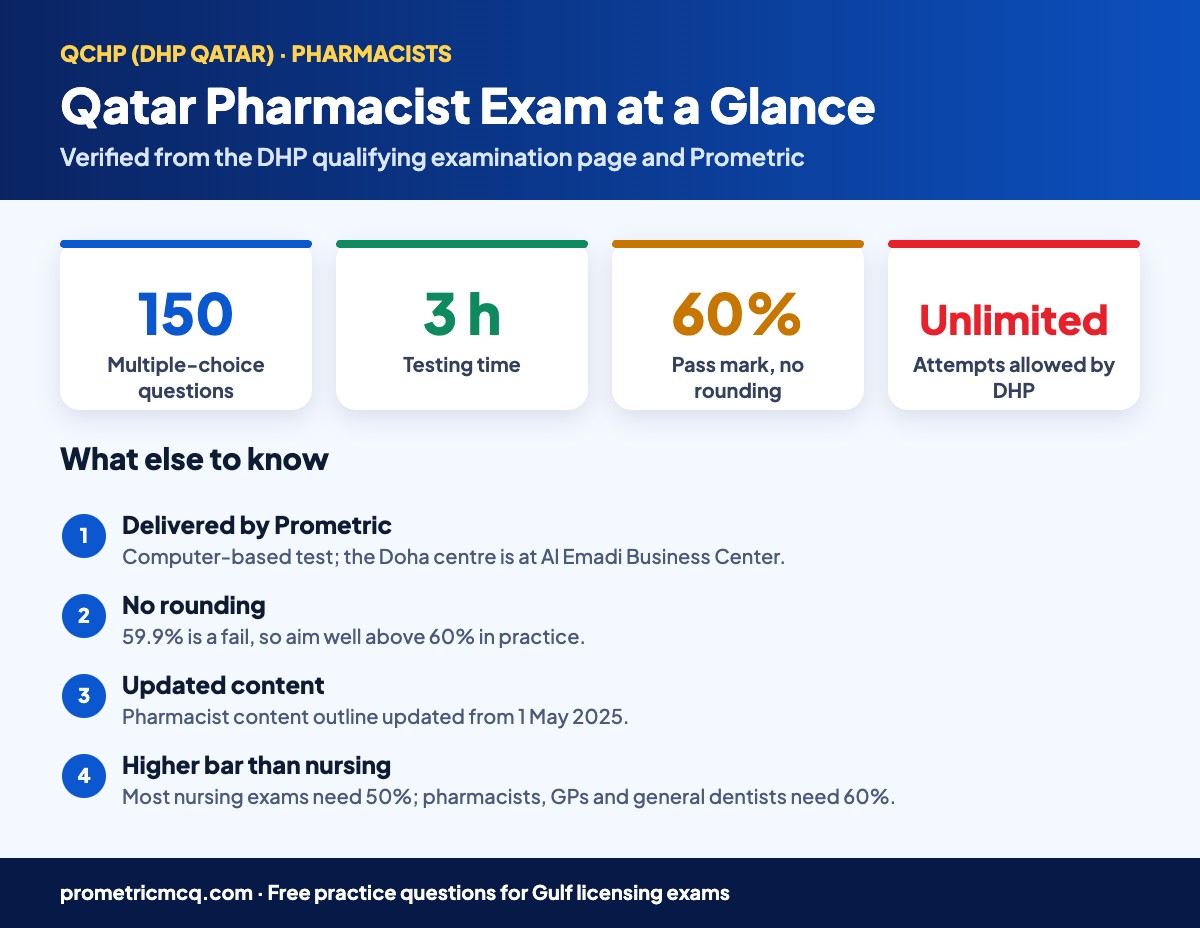
QCHP Pharmacist Exam at a Glance
| Item | Pharmacist |
|---|---|
| Delivered by | Prometric, computer-based |
| Questions | 150 MCQs |
| Time | 3 hours |
| Cut score | 60% |
| Attempts | Unlimited, according to DHP |
| Test centre in Qatar | Prometric Doha, Al Emadi Business Center |
| Content update | Prometric notes updated pharmacist content from 1 May 2025, with an updated reference list on the DHP site |
Note the higher bar: nurses need 50%, but pharmacists, GPs and general dentists need 60%. DHP says no rounding is applied, so 59.9% is a fail.
What the Qatar Pharmacist Exam Covers
- Pharmacology and therapeutics: cardiovascular, endocrine, infectious diseases, CNS, respiratory and oncology drugs.
- Clinical pharmacy: dose adjustment in renal and hepatic impairment, drug interactions, adverse effects and monitoring.
- Pharmaceutics and calculations: dosage forms, stability, compounding, concentrations and infusion rates.
- Pharmacy practice: dispensing, counselling, medication safety, ethics and law.
[pmcq_cta title="Thousands of pharmacist MCQs with explanations" text="Practise Qatar-style pharmacy questions in timed mocks with a progress tracker. Instant access after payment." button="Get the Pharmacy MCQs Package" url="https://www.prometricmcq.com/pharmacy-mcqs/"]
Free QCHP Pharmacist Mock Test: 24 Case-Based Questions with Answers
Each question is a short practice scenario with one best answer, covering drug interactions, renal dosing, calculations, counselling, adverse effects and antidotes. Choose Practice mode to see the explanation after each question, or Exam mode to answer all 24 against a 29-minute timer. The real exam gives you 150 questions in 3 hours, about 72 seconds per question, and the pass line here is the same 60% DHP uses for pharmacists.
[pmcq_quiz title="Free QCHP Pharmacist Mock Test – 24 Questions" pass="60" minutes="29" button="Get Pharmacy MCQs – Instant Access" url="https://www.prometricmcq.com/pharmacy-mcqs/"]
Question 1
A 70-year-old man with type 2 diabetes takes metformin 1 g twice daily. His latest eGFR is 24 mL/min/1.73 m², down from 48 six months ago. What should the pharmacist recommend?
- A. Stop metformin and review alternative glucose-lowering therapy
- B. Continue metformin at the same dose
- C. Increase metformin to improve glucose control
- D. Switch to modified-release metformin at the same dose
Answer: A
Explanation: Metformin is contraindicated when eGFR falls below 30 mL/min/1.73 m² because of the risk of lactic acidosis, so it should be stopped and an alternative chosen. Continuing, increasing or switching formulation does not remove the risk.
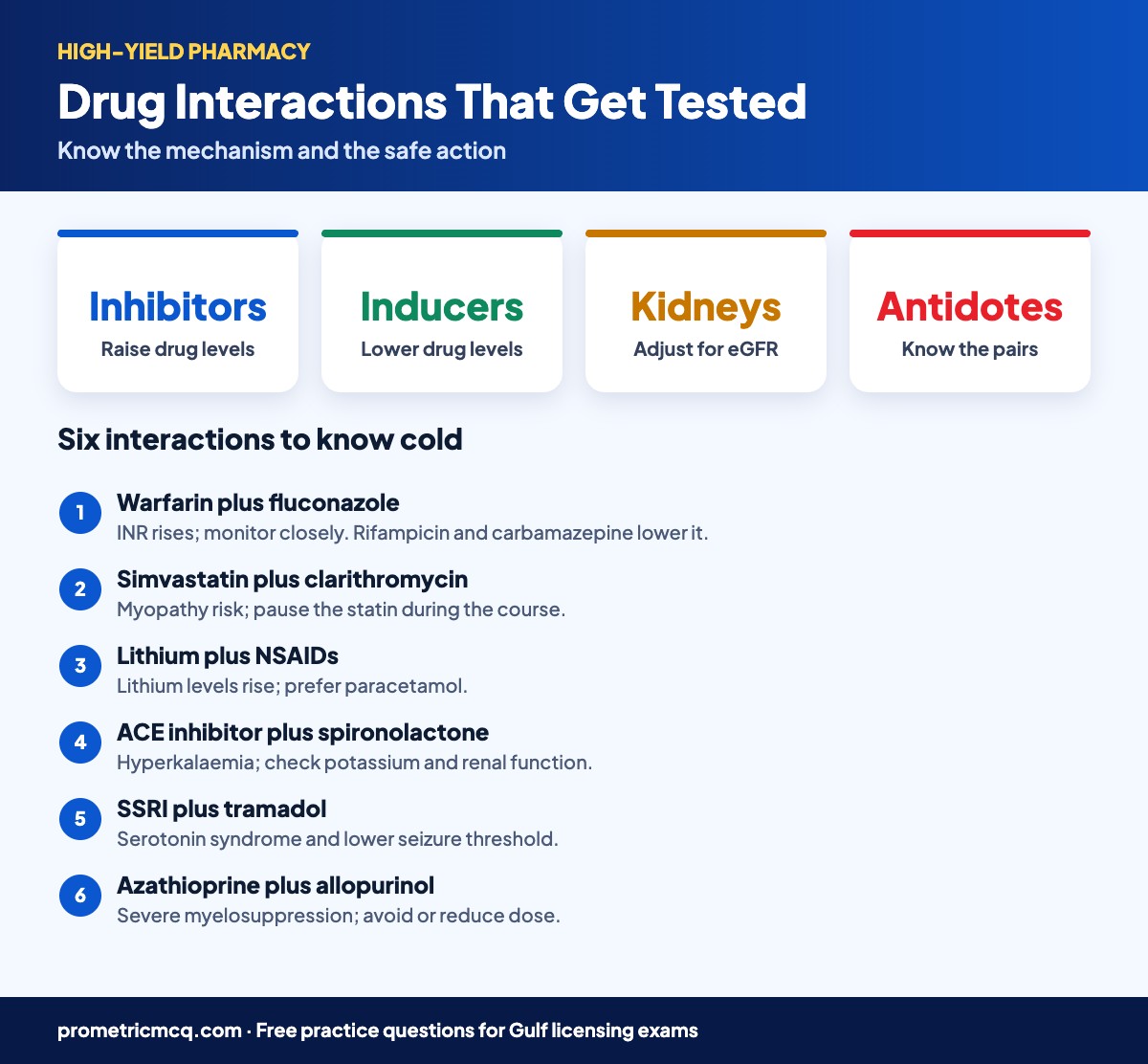
High-yield takeaway: Metformin: review dose as eGFR falls; stop below 30.
Question 2
A 64-year-old woman stabilised on warfarin (INR 2.5) is prescribed a new medicine. Which one is most likely to raise her INR?
- A. Rifampicin
- B. Carbamazepine
- C. Fluconazole
- D. A diet high in green leafy vegetables
Answer: C
Explanation: Fluconazole inhibits CYP2C9, which metabolises warfarin, so the INR rises and bleeding risk increases. Rifampicin and carbamazepine induce liver enzymes and lower the INR, and vitamin K-rich foods also reduce warfarin's effect.
High-yield takeaway: Enzyme inhibitors raise INR; enzyme inducers lower it.
Question 3
A 58-year-old man taking simvastatin 40 mg daily is prescribed a 7-day course of clarithromycin for a chest infection. What is the best advice?
- A. Take both medicines as normal
- B. Withhold simvastatin until the clarithromycin course is finished
- C. Double the simvastatin to protect the heart
- D. Add gemfibrozil to reduce cholesterol further
Answer: B
Explanation: Clarithromycin strongly inhibits CYP3A4 and sharply raises simvastatin levels, increasing the risk of myopathy and rhabdomyolysis. Simvastatin should be withheld during the short course. Doubling the dose or adding gemfibrozil increases the myopathy risk further.
High-yield takeaway: Simvastatin plus clarithromycin: pause the statin during the course.
Question 4
A 45-year-old woman stable on lithium for bipolar disorder asks for something for back pain. Which advice is most appropriate?
- A. Ibuprofen is safe with lithium
- B. Diclofenac is safer than ibuprofen with lithium
- C. Naproxen is preferred because it is long-acting
- D. Paracetamol is preferred; NSAIDs can raise lithium levels
Answer: D
Explanation: NSAIDs reduce renal lithium clearance and can cause lithium toxicity, so paracetamol is the safer choice. If an NSAID is unavoidable, lithium levels must be monitored closely. All the listed NSAIDs share this interaction.
High-yield takeaway: Lithium: avoid NSAIDs where possible; ACE inhibitors and diuretics also raise levels.
Question 5
An 80-year-old woman taking digoxin for atrial fibrillation was started on furosemide a week ago. She now has nausea, blurred yellow-tinged vision and a pulse of 48/min. Which electrolyte disturbance most likely contributed?
- A. Hypernatraemia
- B. Hypoglycaemia
- C. Hypokalaemia
- D. Hypophosphataemia
Answer: C
Explanation: Loop diuretics cause potassium loss, and hypokalaemia increases digoxin binding to the sodium-potassium pump, predisposing to toxicity. Her nausea, visual change and bradycardia fit digoxin toxicity. The other disturbances do not have this effect.
High-yield takeaway: Hypokalaemia (often from diuretics) predisposes to digoxin toxicity.
Question 6
A 19-year-old woman presents 6 hours after taking a large overdose of paracetamol. Her plasma paracetamol level is above the treatment line. Which antidote is indicated?
- A. Acetylcysteine
- B. Naloxone
- C. Flumazenil
- D. Protamine sulfate
Answer: A
Explanation: Acetylcysteine replenishes glutathione and prevents paracetamol-induced liver injury; it is most effective when started early. Naloxone reverses opioids, flumazenil reverses benzodiazepines and protamine reverses heparin.
High-yield takeaway: Paracetamol overdose: acetylcysteine, guided by a timed level.
Question 7
A child weighing 18 kg is prescribed paracetamol 15 mg/kg per dose. The stock is paracetamol oral suspension 120 mg in 5 mL. What volume should be given per dose?
- A. 9 mL
- B. 11.25 mL
- C. 12.5 mL
- D. 22.5 mL
Answer: B
Explanation: Dose = 15 mg × 18 kg = 270 mg. Volume = (270 ÷ 120) × 5 mL = 11.25 mL. In practice, check the dose against the child's age and weight and measure it with an oral syringe.
High-yield takeaway: Weight-based dose first, then volume = dose ÷ strength × volume.
Question 8
An infusion contains dopamine 400 mg in 250 mL of 5% glucose and is running at 15 mL/h. How many milligrams per hour is the patient receiving?
- A. 16 mg/h
- B. 20 mg/h
- C. 30 mg/h
- D. 24 mg/h
Answer: D
Explanation: Concentration = 400 mg ÷ 250 mL = 1.6 mg/mL. Dose per hour = 1.6 mg/mL × 15 mL/h = 24 mg/h. Working out the concentration first avoids most infusion calculation errors.
High-yield takeaway: mg/h = concentration (mg/mL) × rate (mL/h).
Question 9
A ward pharmacist is checking a bag of 500 mL of glucose 5% w/v. How many grams of glucose does the bag contain?
- A. 25 g
- B. 2.5 g
- C. 50 g
- D. 5 g
Answer: A
Explanation: 5% w/v means 5 g in every 100 mL. So 500 mL contains 5 × 5 = 25 g. Percentage strength questions are quick marks if you remember that w/v means grams per 100 mL.
High-yield takeaway: % w/v = grams per 100 mL.
Question 10
A 56-year-old man started ramipril 2 months ago for hypertension. His BP is now controlled, but he has a persistent dry, tickly cough with a normal chest examination. What is the best recommendation?
- A. Add codeine linctus and continue ramipril
- B. Switch to an angiotensin II receptor blocker such as losartan
- C. Increase the ramipril dose
- D. Switch to enalapril
Answer: B
Explanation: A dry cough is a common ACE inhibitor side effect caused by bradykinin accumulation. Switching to an ARB keeps the same benefit without the cough. Changing to another ACE inhibitor such as enalapril will not help, and treating the cough with codeine masks the cause.
High-yield takeaway: ACE inhibitor cough: switch to an ARB, not another ACE inhibitor.
Question 11
A 32-year-old woman taking lisinopril for hypertension has a positive pregnancy test at 7 weeks. What is the most appropriate advice?
- A. Continue lisinopril, as it is safe in the first trimester
- B. Switch to losartan
- C. Stop lisinopril and change to a pregnancy-suitable antihypertensive such as labetalol
- D. Double the dose to protect against pre-eclampsia
Answer: C
Explanation: ACE inhibitors and ARBs can harm fetal kidneys and development and should be stopped as soon as pregnancy is confirmed. Labetalol, nifedipine and methyldopa are commonly used alternatives, chosen by the prescriber. Losartan carries the same risk.
High-yield takeaway: Pregnancy: stop ACE inhibitors and ARBs; labetalol is a common alternative.
Question 12
A pharmacist receives a new prescription for a 60-year-old woman with rheumatoid arthritis: methotrexate 10 mg orally once daily. What should the pharmacist do?
- A. Dispense as written
- B. Dispense and advise her to take it with food
- C. Dispense half the quantity to reduce risk
- D. Contact the prescriber, as methotrexate for RA is taken once weekly
Answer: D
Explanation: Oral methotrexate for rheumatoid arthritis is given once weekly, and daily dosing has caused fatal toxicity. The prescription must be clarified with the prescriber before supply. Folic acid is usually given on a different day of the week.
High-yield takeaway: Methotrexate for RA or psoriasis: once weekly; daily dosing is a never-miss error.
Question 13
A 72-year-old man with heart failure is reviewed in clinic. Which combination of his medicines carries the greatest risk of hyperkalaemia?
- A. Ramipril and spironolactone
- B. Furosemide and bendroflumethiazide
- C. Amlodipine and atorvastatin
- D. Salbutamol and insulin
Answer: A
Explanation: ACE inhibitors and potassium-sparing diuretics such as spironolactone both raise potassium, so the combination needs regular monitoring of potassium and renal function. Loop and thiazide diuretics lower potassium, amlodipine and atorvastatin do not affect it, and salbutamol and insulin shift potassium into cells.
High-yield takeaway: ACE inhibitor or ARB plus spironolactone: monitor potassium closely.
Question 14
A 48-year-old woman taking sertraline for depression is prescribed tramadol after a fracture. Which interaction is the main concern?
- A. No clinically important interaction
- B. Hypoglycaemia
- C. Serotonin syndrome
- D. Hyperkalaemia
Answer: C
Explanation: Tramadol has serotonergic activity, so combining it with an SSRI raises the risk of serotonin syndrome (agitation, tremor, clonus, sweating, fever) and can also lower the seizure threshold. An alternative analgesic or close monitoring is needed.
High-yield takeaway: SSRI plus tramadol: risk of serotonin syndrome and seizures.
Question 15
A 52-year-old man taking azathioprine after a kidney transplant is prescribed allopurinol for gout. What is the concern?
- A. Allopurinol becomes less effective
- B. Azathioprine toxicity with bone marrow suppression
- C. Hyperkalaemia
- D. No interaction
Answer: B
Explanation: Allopurinol inhibits xanthine oxidase, which breaks down azathioprine's active metabolite, so azathioprine levels rise and can cause severe myelosuppression. The combination is best avoided or the azathioprine dose greatly reduced with close blood count monitoring, as decided by the specialist.
High-yield takeaway: Allopurinol plus azathioprine: risk of serious myelosuppression.
Question 16
A 40-year-old woman with a documented anaphylactic reaction to penicillin is prescribed co-amoxiclav for sinusitis. What should the pharmacist do?
- A. Dispense it, as the allergy was to a different penicillin
- B. Dispense it with an oral antihistamine
- C. Dispense a test dose first
- D. Withhold it and contact the prescriber, as co-amoxiclav contains a penicillin
Answer: D
Explanation: Co-amoxiclav contains amoxicillin, a penicillin, so it must not be given to a patient with penicillin anaphylaxis. The prescriber should choose a non-penicillin alternative. Antihistamines and test doses do not make it safe.
High-yield takeaway: Penicillin anaphylaxis: avoid all penicillins, including co-amoxiclav.
Question 17
A 35-year-old woman starting levothyroxine also takes ferrous sulfate and calcium carbonate. Which counselling is correct?
- A. Empty stomach before breakfast, 4 hours apart from iron and calcium
- B. Take it together with calcium to improve absorption
- C. Take it with the iron tablet to make the routine easier
- D. Take it only on days when she feels tired
Answer: A
Explanation: Iron and calcium bind levothyroxine and reduce its absorption, so doses should be separated by about 4 hours, and levothyroxine is best taken on an empty stomach. It must be taken every day, regardless of symptoms.
High-yield takeaway: Levothyroxine: empty stomach, separate from iron and calcium.
Question 18
A 68-year-old woman is starting alendronic acid 70 mg once weekly for osteoporosis. Which counselling is correct?
- A. Take it with breakfast and a glass of milk
- B. Take it lying down at bedtime
- C. Swallow it whole on an empty stomach with a full glass of plain water and stay upright for 30 minutes
- D. Take it with orange juice to improve absorption
Answer: C
Explanation: Alendronic acid is poorly absorbed and can cause oesophageal ulceration. It should be taken first thing in the morning with plain water on an empty stomach, and the patient should stay upright and wait at least 30 minutes before food, drink or other medicines. Milk and juice reduce absorption.
High-yield takeaway: Bisphosphonates: plain water, empty stomach, upright for 30 minutes.
Question 19
A patient collecting a 3-month supply of insulin pens asks how to store the unopened pens at home. What is the correct advice?
- A. In a sunny place so they stay warm
- B. In the freezer to keep them fresh
- C. In the car glovebox for convenience
- D. In the refrigerator at 2–8 °C, never frozen
Answer: D
Explanation: Unopened insulin should be kept in the refrigerator at 2–8 °C and never frozen, as freezing and heat damage the insulin. The pen in use can usually be kept at room temperature for the period stated in the product information.
High-yield takeaway: Unopened insulin: fridge at 2–8 °C, never frozen; in-use pen per product leaflet.
Question 20
A 50-year-old man takes co-codamol 30/500, two tablets four times a day. He asks to buy paracetamol 500 mg tablets for a headache and plans to take two. What is the correct advice?
- A. It is safe, as co-codamol is a different medicine
- B. Do not take extra paracetamol: he already takes the maximum 4 g a day
- C. It is safe if he takes it with food
- D. Take extra co-codamol instead of plain paracetamol
Answer: B
Explanation: Each co-codamol 30/500 tablet contains 500 mg paracetamol, so eight tablets a day already provide 4 g, the usual adult maximum. Any extra paracetamol, with or without food, risks liver toxicity, and extra co-codamol adds both paracetamol and codeine.
High-yield takeaway: Count all paracetamol sources; the usual adult maximum is 4 g a day.
Question 21
A 66-year-old man is started on IV gentamicin for a severe infection. Which adverse effects make drug-level and renal function monitoring essential?
- A. Nephrotoxicity and ototoxicity
- B. Hepatotoxicity and pancreatitis
- C. Hyperglycaemia and weight gain
- D. Gingival hyperplasia and hirsutism
Answer: A
Explanation: Aminoglycosides such as gentamicin can damage the kidneys and the inner ear, and toxicity is linked to high levels and prolonged courses. Levels, renal function and hearing or balance symptoms are monitored. The other options belong to other drugs.
High-yield takeaway: Gentamicin: monitor levels and renal function; watch for ototoxicity.
Question 22
Twenty minutes into an IV vancomycin infusion, a 59-year-old woman develops flushing and itching of the face, neck and upper chest. Her BP is 128/76 mmHg and she has no wheeze or swelling. What is the most likely cause?
- A. Anaphylaxis requiring IM adrenaline
- B. Stevens-Johnson syndrome
- C. An infusion-rate reaction; pause and restart more slowly
- D. Acute kidney injury
Answer: C
Explanation: Flushing and itching of the upper body during vancomycin, with normal BP and no airway signs, is the infusion-related reaction (often called red man syndrome) caused by infusing too fast. Pause the infusion, give an antihistamine if prescribed, and restart at a slower rate. Anaphylaxis would cause airway or circulatory compromise.
High-yield takeaway: Vancomycin flushing: usually a rate reaction; slow the infusion.
Question 23
A 61-year-old man has taken prednisolone 20 mg daily for 3 months for polymyalgia rheumatica. He feels well and wants to stop it today. What is the correct advice?
- A. Stop it today, as he feels well
- B. Do not stop suddenly; the dose needs gradual reduction under his prescriber
- C. Double the dose for 2 days and then stop
- D. Change to alternate-day dosing on his own
Answer: B
Explanation: Long-term corticosteroids suppress the adrenal glands, so stopping suddenly can cause adrenal insufficiency and relapse of the disease. Any reduction should be gradual and planned with the prescriber. Self-adjusting the dose is unsafe.
High-yield takeaway: Long-term steroids: never stop abruptly; taper under supervision.
Question 24
A 76-year-old man taking dabigatran for atrial fibrillation is admitted with a life-threatening gastrointestinal bleed. Which specific reversal agent is used for dabigatran?
- A. Vitamin K
- B. Protamine sulfate
- C. Andexanet alfa
- D. Idarucizumab
Answer: D
Explanation: Idarucizumab is a monoclonal antibody fragment that specifically binds and reverses dabigatran. Andexanet alfa reverses factor Xa inhibitors such as apixaban and rivaroxaban, vitamin K reverses warfarin and protamine reverses heparin.
High-yield takeaway: Dabigatran: idarucizumab; factor Xa inhibitors: andexanet alfa.
[/pmcq_quiz]
How to Score Your Mock Test
| Score (out of 24) | Meaning | Next step |
|---|---|---|
| 20–24 | Strong | Move to full 150-question timed mocks. |
| 15–19 | At or just above 60% | Too close for comfort with no rounding; revise every topic you missed. |
| 0–14 | Below the pass line | Follow the 4-week plan before booking. |
Because DHP applies no rounding, treat 60% as the floor, not the target. Calculation and interaction questions are quick marks once the method is automatic, so they are the best place to build a safety margin.
[pmcq_cta title="Practise full 150-question pharmacist mocks" text="Timed mocks with explanations so the 60% cut score feels safe on exam day." button="Start Practising Now" url="https://www.prometricmcq.com/pharmacy-mcqs/"]
4-Week Study Plan for the Qatar Pharmacist Exam
- Week 1: cardiovascular, renal dosing and calculations. Do 40 questions a day.
- Week 2: infectious diseases, endocrine and respiratory therapeutics.
- Week 3: CNS, oncology, pharmaceutics, law and ethics. Check the updated DHP reference list.
- Week 4: two or three full timed mocks, then revise weak areas only.
Read our QCHP pharmacist syllabus guide, the QCHP registration guide and the QCHP preparation tips.
FAQs: QCHP Pharmacist Exam
How many questions are in the QCHP pharmacist exam?
The DHP and Prometric pages list 150 multiple-choice questions in 3 hours for pharmacists.
What is the passing score for pharmacists in Qatar?
The pass mark is 60%, higher than the 50% used for most nursing exams. DHP applies no rounding, so 59.9% is a fail.
Has the QCHP pharmacist exam changed?
Yes. Prometric's DHP page notes updated pharmacist exam content from 1 May 2025, with an updated reference list published by DHP.
Are these real exam questions?
No. Real questions are confidential. These are written by PrometricMCQ to match the style and topics of the Qatar pharmacist exam.
How many times can I take the DHP pharmacist exam?
DHP states that attempts are unlimited. Even so, each attempt costs time and fees, so book only when your timed mock scores are comfortably above 60%.
Where is the Prometric test centre in Qatar?
The Prometric centre in Doha is at Al Emadi Business Center. Check your booking confirmation for the exact address and arrival instructions.
Is QCHP the same as DHP?
Yes. The Qatar Council for Healthcare Practitioners (QCHP) is now the Department of Healthcare Professions (DHP) at the Ministry of Public Health, but many candidates still search for "QCHP exam".
Which topics should pharmacists prioritise?
Drug interactions, renal dose adjustment, calculations, high-risk medicines and counselling points. These appear across every pharmacist licensing exam in the Gulf.
How long does each question take in the real exam?
150 questions in 3 hours gives about 72 seconds per question. Practise calculations until you can solve them within that time.
Do I need to memorise brand names?
Focus on generic names, mechanisms, key interactions and monitoring. Check the DHP reference list for the sources your exam is based on.
Conclusion
The Qatar pharmacist exam needs 60%, so calculation and interaction questions matter. Use this mock to find your gaps, follow the plan and build speed with full timed mocks. Also see our free QCHP nursing mock test.
[pmcq_cta title="Ready to pass the QCHP pharmacist exam?" text="Instant access to thousands of pharmacy MCQs with explanations and timed mocks." button="Get Pharmacy MCQs – Instant Access" url="https://www.prometricmcq.com/pharmacy-mcqs/"]

The PrometricMCQ editorial team writes independent guides for healthcare professionals preparing for Gulf licensing exams. Editorial policy