In this guide
- QCHP General Practitioner Exam at a Glance
- What the Qatar GP Exam Tests
- Free QCHP GP Mock Test: 22 Case-Based Questions with Answers
- How to Score Your Mock Test
- 6-Week Study Plan for the QCHP GP Exam
- Common Mistakes in QCHP GP Questions
- FAQs: QCHP (DHP Qatar) GP Exam
- Conclusion: Use This Mock as Your Starting Point
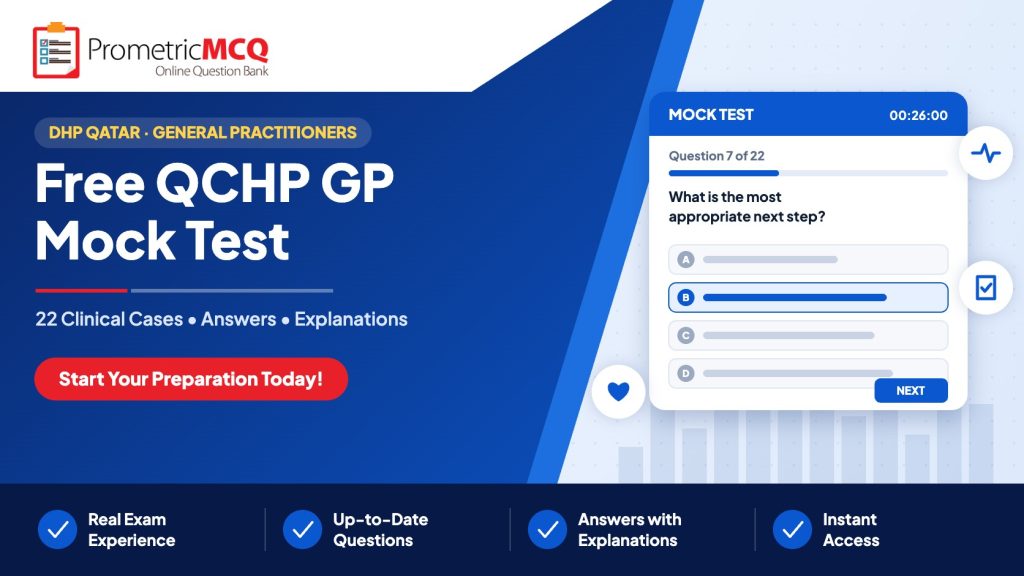
Doctors who want to work as general practitioners in Qatar must pass the DHP (formerly QCHP) qualifying exam, a computer-based Prometric exam. This free QCHP GP mock test gives you 22 case-based clinical vignettes with answers and explanations, the official exam format, and a practical plan to reach the 60% cut score.
Reviewed by Dr Samer Hadad · Last reviewed 4 November 2026 · Exam facts checked against the DHP Qatar qualifying examination page.
QCHP General Practitioner Exam at a Glance
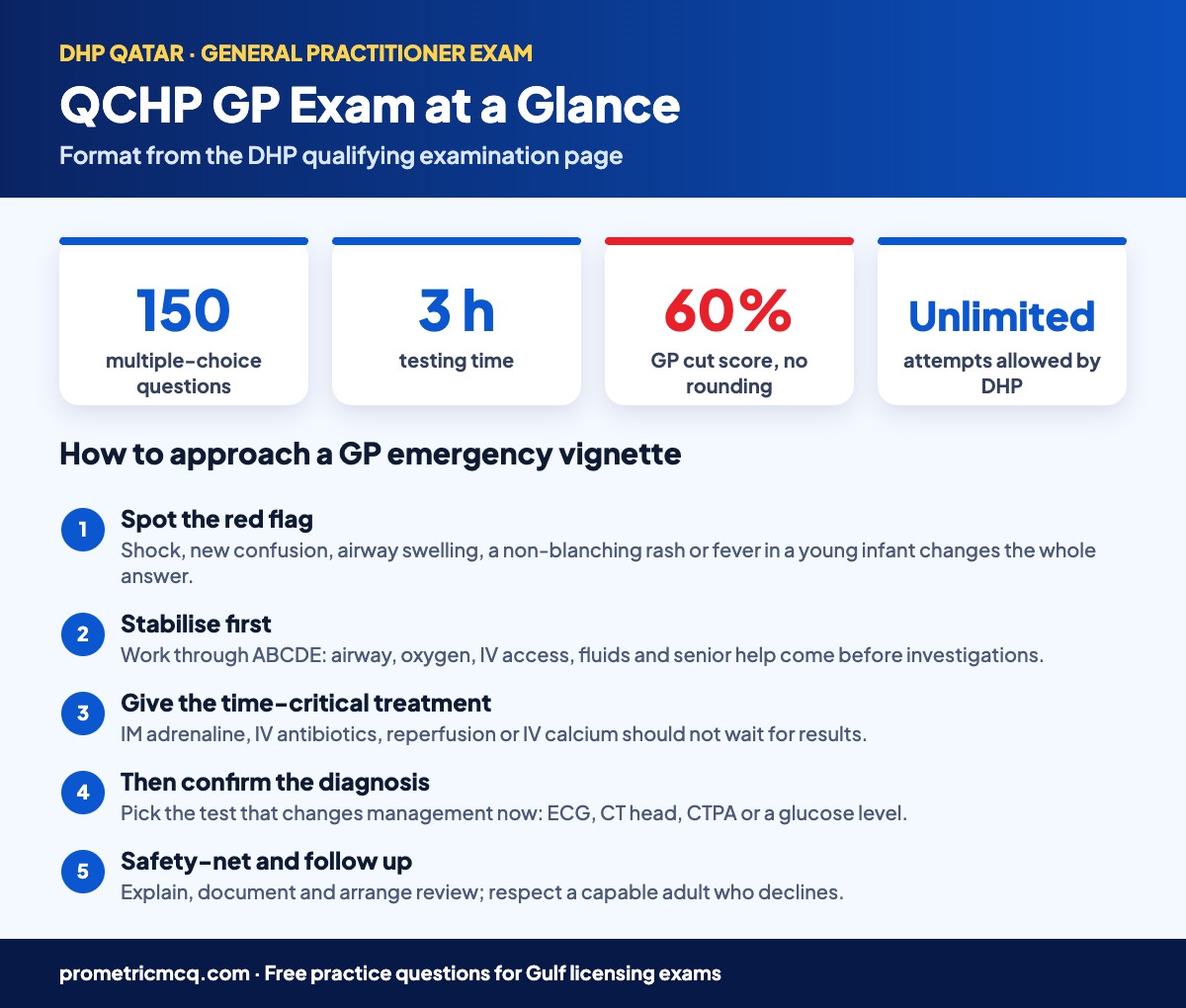
The Department of Healthcare Professions (DHP) at Qatar's Ministry of Public Health replaced the old QCHP name, but most doctors still search for the "QCHP exam". The format below comes from the DHP qualifying examination page.
| Item | General Practitioner |
|---|---|
| Delivered by | Prometric, computer-based (Prometric booking page) |
| Questions | 150 multiple-choice questions |
| Time | 3 hours |
| Cut score | 60%, with no rounding |
| Attempts | Unlimited, according to DHP |
| Test centre in Doha | Prometric, Al Emadi Business Center |
"No rounding" matters: 59.9% is a fail. Specialist physicians sit separate specialty exams with a higher cut score (65% for most specialties), so this mock is only for the general practitioner exam. Fees and booking windows change, so confirm them with DHP before you pay.
What the Qatar GP Exam Tests
The GP exam covers the whole of general medicine at the level of a safe first-contact doctor. Most questions are short clinical vignettes that ask for the most likely diagnosis, the best next investigation or the most appropriate first step in management.
- Internal medicine: cardiology, respiratory, endocrinology, gastroenterology, nephrology and infectious diseases.
- Emergencies: chest pain, sepsis, anaphylaxis, stroke, poisoning and electrolyte emergencies.
- Paediatrics, obstetrics and gynaecology: the febrile infant, foreign bodies, pre-eclampsia and early pregnancy bleeding.
- Psychiatry, surgery and preventive medicine: depression, cancer red flags and screening.
- Ethics and communication: consent, capacity and confidentiality.
Examiners reward the safest correct sequence. When several options are reasonable, the answer is usually the one that treats the immediate threat to life first, then confirms the diagnosis with the test that changes management.
[pmcq_cta title="Thousands of GP MCQs with explanations" text="Practise Gulf-style clinical vignettes in timed mocks with a progress tracker. Instant access after payment." button="Get the GP MCQs Package" url="https://www.prometricmcq.com/general-practitioner-mcqs/"]
Free QCHP GP Mock Test: 22 Case-Based Questions with Answers
Each question below is an original clinical vignette written in the style of the Qatar GP exam. The real exam gives about 72 seconds per question, so the timer here is set to 26 minutes for 22 questions. Choose one answer for each question, then read every explanation, including the ones you got right. Because DHP does not round, you need 14 out of 22 (64%) to clear 60%: 13 out of 22 is 59%.
[pmcq_quiz title="Free QCHP GP Mock Test – 22 Questions" pass="60" minutes="26" button="Get the GP MCQs Package" url="https://www.prometricmcq.com/general-practitioner-mcqs/"]
Question 1
A 58-year-old man with diabetes presents to the emergency department with 40 minutes of crushing central chest pain and sweating. BP 132/80 mmHg, pulse 96/min, SpO₂ 97% on air. The ECG shows 3 mm ST elevation in leads II, III and aVF. The cardiac catheterisation lab can take him within 60 minutes. What is the most appropriate next step?
- A. Wait for the high-sensitivity troponin result before deciding
- B. Give aspirin 300 mg and refer immediately for primary PCI
- C. Repeat the ECG in 1 hour and admit to a medical ward
- D. Give IV metoprolol and arrange an outpatient angiogram
Answer: B
Explanation: This is an inferior STEMI within 12 hours of onset, and primary PCI is the reperfusion of choice when it can be delivered promptly. Loading with aspirin and activating the PCI pathway should not wait for troponin, which only delays reperfusion. Repeating the ECG or arranging outpatient tests wastes myocardium, and routine IV beta-blockade is not the first priority.
High-yield takeaway: STEMI is diagnosed on the ECG: do not wait for troponin to start reperfusion.
Question 2
A 72-year-old woman has 2 days of dysuria and is now confused. Temperature 38.9 °C, pulse 122/min, BP 84/50 mmHg, respiratory rate 26/min, SpO₂ 95%. Venous lactate is 4.2 mmol/L. What is the most appropriate immediate management?
- A. Blood cultures, IV broad-spectrum antibiotics within 1 hour and an IV crystalloid bolus
- B. Oral nitrofurantoin and review in the clinic in 48 hours
- C. Wait for the urine culture result before starting any antibiotic
- D. Start noradrenaline before giving any IV fluid
Answer: A
Explanation: Hypotension with a lactate of 4 mmol/L or more means septic shock is likely, so cultures, IV antibiotics within the first hour and crystalloid resuscitation (commonly 30 mL/kg) are started together. Oral antibiotics and outpatient review are unsafe in a shocked patient. Waiting for culture results delays life-saving treatment, and vasopressors are added if hypotension persists after fluids, not used instead of them.
High-yield takeaway: Sepsis with hypotension or high lactate: cultures, antibiotics within 1 hour and fluids, all at once.
Question 3
A 30-year-old man is stung by a bee at a park. Within 10 minutes he has wheeze, swelling of the lips and an urticarial rash. BP 82/50 mmHg, pulse 128/min, SpO₂ 91%. What is the first drug to give?
- A. IV chlorphenamine 10 mg
- B. IV hydrocortisone 200 mg
- C. IM adrenaline 0.5 mg (1 mg/mL) into the anterolateral thigh
- D. Nebulised salbutamol 5 mg
Answer: C
Explanation: Airway swelling, bronchospasm and hypotension after an allergen exposure is anaphylaxis, and IM adrenaline 0.5 mg (500 micrograms) for an adult is the first-line treatment, repeated after 5 minutes if needed. Antihistamines and steroids do not treat airway obstruction or shock and must never delay adrenaline. Salbutamol may help residual wheeze but does nothing for hypotension.
High-yield takeaway: Anaphylaxis: IM adrenaline first; antihistamines and steroids are not first-line.
Question 4
A 19-year-old woman with type 1 diabetes has vomiting and abdominal pain for 1 day. Pulse 118/min, BP 100/64 mmHg. Capillary glucose 28 mmol/L, venous pH 7.12, bicarbonate 9 mmol/L, blood ketones 5.2 mmol/L, potassium 4.8 mmol/L. What is the first priority in management?
- A. A subcutaneous bolus of rapid-acting insulin
- B. IV sodium bicarbonate to correct the acidosis
- C. IV potassium chloride 40 mmol over 1 hour
- D. IV 0.9% sodium chloride fluid resuscitation
Answer: D
Explanation: Diabetic ketoacidosis causes major fluid loss, so IV 0.9% sodium chloride is started first, followed by an IV fixed-rate insulin infusion. Subcutaneous insulin is unreliable in a dehydrated, acidotic patient. Bicarbonate is not routinely used, and potassium is added to the fluids according to repeated levels rather than given as a rapid bolus while the level is normal.
High-yield takeaway: DKA: fluids first, then IV fixed-rate insulin, with close potassium monitoring.
Question 5
A 45-year-old man attends a health check. His clinic BP is 152/96 mmHg on two readings, and he has no symptoms. Urine dipstick, ECG and fundoscopy are normal. What is the most appropriate next step?
- A. Start amlodipine and two other drugs today
- B. Confirm the diagnosis with ambulatory or home BP monitoring
- C. Reassure him and recheck his BP in 5 years
- D. Request an urgent renal artery angiogram
Answer: B
Explanation: A raised clinic reading should be confirmed with out-of-office measurement (ambulatory or home monitoring) before labelling someone hypertensive, because white-coat hypertension is common. Starting triple therapy without confirmation and without evidence of an emergency is inappropriate. Ignoring a reading of 152/96 mmHg for 5 years is unsafe, and there is nothing to suggest renovascular disease.
High-yield takeaway: Confirm stage 1 hypertension with ambulatory or home readings before starting treatment.
Question 6
A 47-year-old woman with a BMI of 31 kg/m² has a routine HbA1c of 51 mmol/mol (6.8%) and a fasting plasma glucose of 7.3 mmol/L. She has no symptoms. Her eGFR is 88 mL/min/1.73 m² and she has no known cardiovascular, kidney or heart failure disease. What is the most appropriate management?
- A. Diagnose type 2 diabetes, give lifestyle advice and start metformin
- B. Repeat both tests in 1 year before making any diagnosis
- C. Diagnose prediabetes and give lifestyle advice only
- D. Start basal insulin to lower the HbA1c quickly
Answer: A
Explanation: Two different tests above the diagnostic thresholds (HbA1c 48 mmol/mol or 6.5% and above; fasting glucose 7.0 mmol/L and above) confirm type 2 diabetes in an asymptomatic person. With no cardiovascular, renal or heart failure indication for another drug class, lifestyle advice plus metformin is the standard first step. Waiting a year delays treatment, the values are above the prediabetes range, and insulin is not first-line here.
High-yield takeaway: Two abnormal diagnostic tests confirm diabetes; metformin plus lifestyle is the usual first step.
Question 7
A 34-year-old woman taking the combined oral contraceptive pill has sudden right-sided pleuritic chest pain and breathlessness. Pulse 112/min, BP 118/76 mmHg, SpO₂ 93% on air. There are no signs of DVT and no other diagnosis is more likely. What is the most appropriate next investigation?
- A. A D-dimer, discharging her if it is negative
- B. A chest X-ray alone, then discharge
- C. CT pulmonary angiography
- D. Immediate thrombolysis without imaging
Answer: C
Explanation: Her Wells score is 4.5 (heart rate over 100 and PE the most likely diagnosis), so PE is "likely" and she needs imaging with CT pulmonary angiography; interim anticoagulation is started if imaging is delayed. A D-dimer is used only when PE is "unlikely". A chest X-ray cannot exclude PE, and thrombolysis is reserved for haemodynamically unstable PE.
High-yield takeaway: PE likely on Wells: go straight to CTPA; D-dimer is for the "PE unlikely" group.
Question 8
A 25-year-old man with asthma has been short of breath for 6 hours. He speaks in short phrases. Respiratory rate 28/min, pulse 115/min, SpO₂ 94% on air, peak flow 45% of his best. What is the most appropriate initial treatment?
- A. IV aminophylline as the first drug
- B. Oral montelukast and discharge home
- C. IV magnesium sulfate before any bronchodilator
- D. Nebulised salbutamol 5 mg with oxygen and oral prednisolone
Answer: D
Explanation: A peak flow of 33–50%, respiratory rate of 25/min or more and pulse of 110/min or more indicate acute severe asthma. First-line treatment is high-dose nebulised short-acting beta-agonist (oxygen-driven), controlled oxygen to SpO₂ 94–98% and early oral prednisolone (40–50 mg). Aminophylline and magnesium are second-line add-ons after senior review, and discharge on montelukast ignores a severe attack.
High-yield takeaway: Acute severe asthma: oxygen, high-dose nebulised salbutamol and steroids first.
Question 9
A 3-year-old boy swallowed a coin-shaped button battery 1 hour ago. He is alert, drinking and breathing comfortably. A chest X-ray shows a round object with a double-ring (halo) outline in the mid-oesophagus. What is the most appropriate management?
- A. Discharge home and check his stools for the battery
- B. Arrange emergency endoscopic removal
- C. Give a laxative and repeat the X-ray in 24 hours
- D. Induce vomiting with an emetic
Answer: B
Explanation: A button battery lodged in the oesophagus can cause a full-thickness burn within hours, even in a child who looks well, so it needs emergency endoscopic removal. Waiting for it to pass or giving a laxative risks perforation and fistula. Inducing vomiting is contraindicated because it can cause further injury or aspiration.
High-yield takeaway: Button battery in the oesophagus is an emergency: remove endoscopically, do not wait.
Question 10
A 6-week-old baby is brought to the clinic because she has been feeding less for 12 hours. Temperature 38.4 °C, pulse 172/min, capillary refill 2 seconds. There is no obvious focus of infection. What is the most appropriate management?
- A. Give paracetamol and review in 24 hours
- B. Prescribe oral amoxicillin and review in 48 hours
- C. Arrange urgent hospital assessment for a septic screen
- D. Reassure the parents that this is a viral illness
Answer: C
Explanation: Any infant under 3 months with a temperature of 38 °C or more is at high risk of serious bacterial infection, even without a focus, and needs urgent hospital assessment, investigation and usually parenteral antibiotics. Paracetamol and watchful waiting can delay recognition of sepsis or meningitis. Oral antibiotics in the community and reassurance are unsafe at this age.
High-yield takeaway: Fever of 38 °C or more under 3 months of age always needs urgent hospital assessment.
Question 11
A 32-year-old primigravida at 34 weeks has a severe headache and flashing lights. BP 162/110 mmHg on repeat, urine protein 2+, brisk reflexes. Platelets 118 × 10⁹/L. What is the most appropriate immediate management?
- A. Admit, lower BP with labetalol or nifedipine and give IV magnesium sulfate
- B. Send her home with advice to rest and recheck BP in 1 week
- C. Give IV furosemide to lower the BP quickly
- D. Start aspirin 150 mg daily and review in the antenatal clinic
Answer: A
Explanation: Severe hypertension with headache, visual disturbance and proteinuria is pre-eclampsia with severe features. She needs admission, prompt control of BP with a first-line agent such as labetalol or nifedipine, and IV magnesium sulfate to prevent eclampsia, with planning for delivery. Diuretics worsen the reduced plasma volume, aspirin is for prevention earlier in pregnancy, and sending her home is dangerous.
High-yield takeaway: Severe pre-eclampsia: admit, control BP and give magnesium sulfate for seizure prevention.
Question 12
A 26-year-old woman has 7 weeks of amenorrhoea, left lower abdominal pain and shoulder-tip pain. She is pale and sweaty. BP 86/54 mmHg, pulse 124/min. Urine hCG is positive and there is tenderness with guarding in the left iliac fossa. What is the most appropriate next step?
- A. Book an outpatient transvaginal ultrasound for next week
- B. Give IM methotrexate and review in 4 days
- C. Repeat serum hCG in 48 hours to check the trend
- D. Resuscitate and arrange emergency surgery
Answer: D
Explanation: A positive pregnancy test with pain, shoulder-tip pain and shock points to a ruptured ectopic pregnancy with haemoperitoneum. She needs immediate resuscitation, cross-matched blood and emergency surgery. Methotrexate is only for stable, unruptured ectopics meeting strict criteria, and outpatient imaging or serial hCG measurements are for haemodynamically stable women.
High-yield takeaway: Positive hCG plus shock means ruptured ectopic until proven otherwise: resuscitate and operate.
Question 13
A 34-year-old woman has had low mood, loss of interest and poor sleep for 6 weeks, and she is struggling at work. Her PHQ-9 score is 16. She has no thoughts of self-harm, no psychotic symptoms and no history of mania. What is the most appropriate management?
- A. Long-term benzodiazepines for sleep
- B. Urgent admission to a psychiatric unit
- C. Offer psychological therapy and/or an SSRI, with early review
- D. No treatment and review in 6 months
Answer: C
Explanation: This is a moderate depressive episode, and evidence-based options are a psychological therapy (such as CBT), an SSRI or both, chosen with the patient, with safety-netting and early follow-up. Benzodiazepines do not treat depression and cause dependence. Admission is not needed without high risk, and doing nothing for 6 months leaves a treatable illness untreated.
High-yield takeaway: Moderate depression: psychological therapy and/or an SSRI, with safety-netting and early review.
Question 14
A 22-year-old woman weighing 60 kg says she took 40 paracetamol 500 mg tablets (20 g) about 10 hours ago. She feels nauseated but her observations are normal. What is the most appropriate immediate step?
- A. Give activated charcoal and wait for symptoms
- B. Start IV acetylcysteine now, then send paracetamol level and LFTs
- C. Wait until the 16-hour paracetamol level is available
- D. Discharge her because she has no signs of liver injury
Answer: B
Explanation: She has taken about 333 mg/kg, a potentially fatal dose, and presents more than 8 hours later, so IV acetylcysteine should be started immediately without waiting for the level; bloods are sent at the same time. Activated charcoal is only useful within about 1 hour of ingestion. Waiting for results or discharging her because she looks well ignores the delay before liver injury becomes apparent.
High-yield takeaway: Paracetamol overdose presenting after 8 hours: start acetylcysteine first, then check bloods.
Question 15
A 64-year-old man with type 2 diabetes on gliclazide is found drowsy at home and cannot follow commands or swallow safely. Capillary glucose is 2.1 mmol/L. He has IV access. What is the most appropriate immediate treatment?
- A. Oral glucose gel between the cheek and gum
- B. A dose of subcutaneous rapid-acting insulin
- C. Recheck the glucose in 30 minutes before treating
- D. IV glucose, then admit to monitor for recurrence
Answer: D
Explanation: Severe hypoglycaemia in a patient who cannot swallow safely is treated with IV glucose (for example 10% glucose over 15 minutes), or IM glucagon if there is no IV access. Sulfonylurea-induced hypoglycaemia can recur for many hours, so he needs admission and monitoring. Oral glucose risks aspiration, insulin would worsen hypoglycaemia, and delaying treatment risks brain injury.
High-yield takeaway: Sulfonylurea hypoglycaemia can recur: treat with IV glucose and observe in hospital.
Question 16
A 67-year-old man develops sudden weakness of the left arm and left facial droop. Symptoms started 90 minutes ago and are persisting. BP 168/94 mmHg, capillary glucose 6.2 mmol/L. What is the most appropriate next step?
- A. Urgent non-contrast CT head to assess suitability for thrombolysis
- B. Aspirin 300 mg immediately, before any imaging
- C. An MRI brain as an outpatient next week
- D. IV labetalol to bring his BP to 120/80 mmHg
Answer: A
Explanation: A suspected acute stroke within the thrombolysis window needs immediate brain imaging, usually non-contrast CT, to exclude haemorrhage before reperfusion treatment. Aspirin is not given until haemorrhage has been excluded. Delayed imaging wastes the treatment window, and lowering BP aggressively can reduce brain perfusion; his BP is below the level that blocks thrombolysis.
High-yield takeaway: Suspected stroke: image the brain urgently to exclude bleeding before any antithrombotic.
Question 17
An 18-year-old university student attends a clinic with 8 hours of fever, headache and leg pains. Temperature 39.2 °C, pulse 120/min, capillary refill 4 seconds. There is a non-blanching petechial rash on his legs. The ambulance is on its way. What is the most appropriate action now?
- A. Arrange a lumbar puncture before giving antibiotics
- B. Prescribe oral amoxicillin and review tomorrow
- C. Give parenteral benzylpenicillin now, without delaying transfer
- D. Wait for blood culture results before any antibiotic
Answer: C
Explanation: Fever with a non-blanching rash and poor perfusion is meningococcal sepsis until proven otherwise. A parenteral antibiotic such as benzylpenicillin should be given at the first opportunity in primary care, as long as it does not delay urgent transfer. Lumbar puncture and culture results must never delay antibiotics, and oral treatment is inadequate.
High-yield takeaway: Suspected meningococcal disease: give parenteral antibiotics immediately and transfer urgently.
Question 18
A 70-year-old man with chronic kidney disease has generalised weakness. Serum potassium is 7.1 mmol/L. The ECG shows peaked T waves and a QRS duration of 140 ms. What is the first drug to give?
- A. IV insulin with glucose
- B. IV calcium gluconate
- C. Oral calcium resonium
- D. IV furosemide
Answer: B
Explanation: Hyperkalaemia with ECG changes is an emergency, and IV calcium gluconate is given first to stabilise the myocardium within minutes. Calcium does not lower potassium, so insulin with glucose (with nebulised salbutamol if needed) follows to shift potassium into cells. Oral binders and diuretics act too slowly to be the first treatment.
High-yield takeaway: Hyperkalaemia with ECG changes: IV calcium first to protect the heart, then shift and remove potassium.
Question 19
A 72-year-old woman with hypertension and type 2 diabetes is found to have atrial fibrillation on a routine ECG. Her CHA₂DS₂-VASc score is 4. Her eGFR is 70 mL/min/1.73 m² and she has no history of bleeding. Which is the most appropriate stroke prevention?
- A. Aspirin 75 mg daily alone
- B. No antithrombotic treatment
- C. Aspirin plus clopidogrel
- D. A direct oral anticoagulant, such as apixaban
Answer: D
Explanation: Her stroke risk is well above the treatment threshold (score 4, or 3 if the sex criterion is not counted, as in newer guidelines), so oral anticoagulation is recommended, with a DOAC usually preferred over warfarin. Aspirin alone does not adequately prevent AF-related stroke and still causes bleeding. Dual antiplatelet therapy is less effective than anticoagulation, and no treatment leaves a high stroke risk.
High-yield takeaway: AF stroke prevention means anticoagulation, usually a DOAC; aspirin is not an alternative.
Question 20
A 38-year-old woman has weight loss, palpitations, heat intolerance and a fine tremor. She has a smooth diffuse goitre and bilateral proptosis. TSH is below 0.01 mU/L and free T4 is raised. What is the most likely diagnosis?
- A. Graves disease
- B. Toxic multinodular goitre
- C. Hashimoto thyroiditis
- D. Subacute (de Quervain) thyroiditis
Answer: A
Explanation: Hyperthyroidism with a diffuse goitre and thyroid eye disease (proptosis) is characteristic of Graves disease; TSH-receptor antibodies confirm it. Toxic multinodular goitre gives a nodular gland and no eye disease. Hashimoto thyroiditis usually causes hypothyroidism, and subacute thyroiditis causes a painful, tender thyroid after a viral illness.
High-yield takeaway: Hyperthyroidism plus eye disease points to Graves disease.
Question 21
A 55-year-old man with a positive faecal immunochemical test is advised to have a colonoscopy. After a clear discussion of the benefits and risks, he declines. He can understand, retain and weigh the information and communicate his decision. What is the most appropriate response?
- A. Book the colonoscopy anyway because it is in his best interests
- B. Ask his wife to consent on his behalf
- C. Respect his decision, document it and offer alternatives and follow-up
- D. Discharge him from the practice for refusing advice
Answer: C
Explanation: An adult with capacity has the right to refuse investigation, even if the doctor disagrees. The doctor should respect the decision, document the discussion, explore his concerns, offer alternatives and keep the door open. Proceeding without consent is assault, a relative cannot consent for an adult with capacity, and discharging him is unprofessional.
High-yield takeaway: A competent adult may refuse treatment: respect, document and keep the door open.
Question 22
A 68-year-old man reports tiredness. Hb 98 g/L, MCV 72 fL, ferritin 8 µg/L. He has no visible bleeding and takes no regular medicines. What is the most appropriate next step?
- A. Oral iron only and recheck the blood count in 3 months
- B. Urgent referral for upper and lower GI investigation
- C. Transfuse 2 units of red cells today
- D. Coeliac serology alone, with no further tests
Answer: B
Explanation: New iron-deficiency anaemia in an older man is gastrointestinal blood loss, including colorectal or gastric cancer, until proven otherwise. He needs urgent referral for upper and lower GI investigation, while starting iron replacement. Treating with iron alone can mask a cancer, transfusion is not needed at this Hb without symptoms of instability, and coeliac serology is part of the work-up, not a substitute for endoscopy.
High-yield takeaway: Iron-deficiency anaemia in an older adult: investigate the GI tract urgently.
[/pmcq_quiz]
How to Score Your Mock Test
| Your score (out of 22) | What it means | What to do next |
|---|---|---|
| 18–22 | Comfortably above the 60% cut score. | Move to full 150-question timed mocks. |
| 14–17 | Above 60%, but with little margin. | Review every miss by system and retest weak areas. |
| 0–13 | Below 60%. | Revise by system for 2–3 weeks before more mocks. |
One short mock is a snapshot, not a prediction. Look at the pattern of your mistakes: if most were emergencies, your problem is prioritisation; if most were diagnosis questions, you need more pattern recognition by system.
[pmcq_cta title="Train for the full 3-hour GP exam" text="Timed 150-question mocks with explanations and a progress tracker." button="Start Practising Now" url="https://www.prometricmcq.com/general-practitioner-mcqs/"]
6-Week Study Plan for the QCHP GP Exam
- Weeks 1–2: internal medicine by system, with 50 MCQs a day and a written note on every wrong answer.
- Week 3: emergency medicine and surgery: sepsis, chest pain, stroke, poisoning, electrolytes and the acute abdomen.
- Week 4: paediatrics, obstetrics and gynaecology, including the febrile child, pre-eclampsia and early pregnancy problems.
- Week 5: psychiatry, dermatology, ethics and preventive medicine.
- Week 6: three full timed mocks of 150 questions in 3 hours, then targeted revision of weak areas.
Doctors who have been out of acute practice for a while should spend more time on emergencies, because these questions carry the most "first step" traps. For more vignette practice, work through our Prometric questions for general practitioners and the GP diagnosis cases. If you have not yet applied, start with the QCHP registration guide, and if a colleague is a pharmacist, share our free QCHP pharmacist mock test.
Common Mistakes in QCHP GP Questions
- Investigating before stabilising. In shock, anaphylaxis or sepsis, the first step is treatment, not a scan.
- Waiting for a confirmatory test. STEMI is diagnosed on the ECG, and a late paracetamol overdose is treated before the level returns.
- Choosing the familiar drug instead of the first-line one. Antihistamines are not first-line in anaphylaxis, and aspirin is not stroke prevention in atrial fibrillation.
- Missing age-specific red flags. Fever in an infant under 3 months and new iron-deficiency anaemia in an older adult both need urgent action.
- Ignoring capacity and consent. A capable adult may refuse treatment, and a relative cannot consent for them.
FAQs: QCHP (DHP Qatar) GP Exam
How many questions are in the Qatar GP Prometric exam?
The DHP qualifying exam for general practitioners has 150 multiple-choice questions to be answered in 3 hours. That works out at about 72 seconds per question, so timed practice is essential.
What is the passing score for GPs in Qatar?
DHP sets the GP cut score at 60%, and scores are not rounded. A result of 59.9% is therefore a fail, so aim to score well above 60% in your practice mocks.
How many times can I take the QCHP GP exam?
DHP states that applicants may attempt the qualifying exam an unlimited number of times. Each attempt still needs a new booking and fee, so it pays to be ready before your first sitting.
Is the QCHP GP exam the same as the specialist exam?
No. Specialist physicians sit separate specialty exams listed by DHP, and most have a 65% cut score. This mock covers the general practitioner exam only.
Who delivers the exam, and where do I sit it?
Prometric delivers the DHP exams as a computer-based test. In Doha, the Prometric centre is at Al Emadi Business Center; check the Prometric booking page for available centres and dates.
Can I take the Qatar GP exam online from home?
DHP lists remote testing only for the dietician exam, so plan to sit the GP exam at a Prometric test centre. Confirm the current options with DHP before you book.
Are these real QCHP exam questions?
No. Real exam questions are confidential. These questions are written by PrometricMCQ to match the style, level and topics of the Qatar GP exam.
Which topics should I focus on first?
Start with emergencies and internal medicine, because they make up a large share of vignettes and test safe prioritisation. Then cover paediatrics, obstetrics, psychiatry and ethics, which are easy marks if revised.
How long should I prepare for the QCHP GP exam?
It depends on how recently you have worked in general or acute medicine. Many doctors follow a structured plan of around 6 weeks, like the one above, finishing with full timed mocks.
What score in practice mocks shows I am ready?
Look for consistent scores comfortably above 60% on full, timed 150-question mocks, not just short sets. If your scores vary widely between systems, close those gaps before booking.
Conclusion: Use This Mock as Your Starting Point
The Qatar GP exam rewards safe first steps and guideline-based management across the whole of general medicine. Use this mock to find your weak systems, follow the 6-week plan and finish with full timed mocks before you book. For the latest official rules, check the DHP qualifying examination page.
[pmcq_cta title="Ready to pass the QCHP GP exam?" text="Instant access to thousands of GP MCQs with explanations and timed mocks." button="Get GP MCQs – Instant Access" url="https://www.prometricmcq.com/general-practitioner-mcqs/"]

The PrometricMCQ editorial team writes independent guides for healthcare professionals preparing for Gulf licensing exams. Editorial policy