
In this guide
Pharmacists who want to work in Oman sit a computer-based licensing exam run by the Oman Medical Specialty Board (OMSB). Many candidates still call it the Oman Prometric exam, but OMSB now lists Pearson VUE as its test-delivery partner. This free OMSB pharmacist mock test gives you 22 case-based questions with answers and explanations, the exam facts we could verify and the registration steps.
Reviewed by Dr Samer Hadad · Last reviewed 4 November 2026 · Delivery details checked against the OMSB Occupational Classification Testing page.
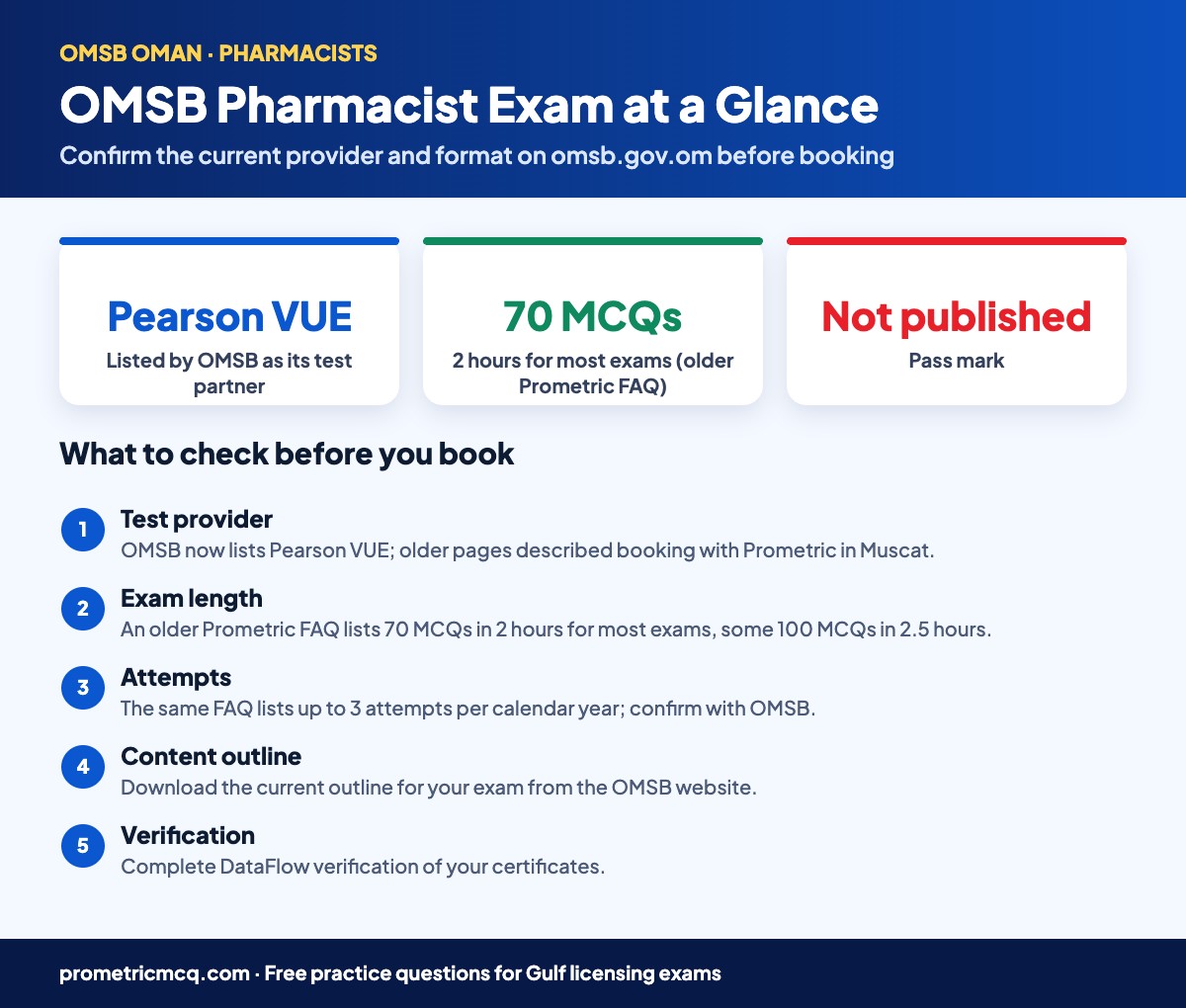
OMSB Pharmacist Exam at a Glance
| Item | What OMSB says |
|---|---|
| Exam type | Computer-based Occupational Classification (OC) exam used by the Ministry of Health and other health institutions |
| Test provider | OMSB's website lists Pearson VUE as its test-delivery partner. Older Prometric OMSB pages described booking with Prometric at a Muscat centre, so confirm the current provider on omsb.gov.om |
| Exam length | An older Prometric FAQ lists 70 MCQs in 2 hours for most exams and 100 MCQs in 2.5 hours for some; confirm your exam's format with OMSB |
| Attempts | Up to 3 per calendar year, according to the same older FAQ |
| Pass mark | Not published |
| Registration | Pearson VUE – OMSB |
| Verification | DataFlow – OMSB certificate verification |
| Content outline | Published per exam on the OMSB testing page; check the current outline, question count and pass mark before booking |
Pearson VUE note: many candidates still call this the "Oman Prometric exam", but OMSB now lists Pearson VUE as its test-delivery partner. Book through the provider shown on the OMSB website at the time you apply, and read our Pearson VUE vs Prometric guide for the differences on exam day.
What the Oman Pharmacist Exam Tests
- Pharmacotherapy: cardiovascular, diabetes, infections, respiratory, GI and mental health.
- Pharmacokinetics: half-life, loading doses, therapeutic drug monitoring.
- Pharmaceutics and calculations.
- Hospital and community practice: dispensing, counselling, medication errors and storage.
[pmcq_cta title="Pharmacist MCQs built for Gulf exams" text="Thousands of pharmacy questions with explanations and timed mocks. Instant access after payment." button="Get the Pharmacy MCQs Package" url="https://www.prometricmcq.com/pharmacy-mcqs/"]
Free OMSB Pharmacist Mock Test: 22 Case-Based Questions with Answers
The questions focus on pharmacokinetics, calculations, drug interactions, counselling and the safe use of high-risk medicines. Choose Practice mode to see the explanation after each question, or Exam mode to answer all 22 against a 26-minute timer. OMSB does not publish its pass mark, so the 60% pass line here is a practice benchmark only.
[pmcq_quiz title="Free OMSB Pharmacist Mock Test – 22 Questions" pass="60" minutes="26" button="Get Pharmacy MCQs – Instant Access" url="https://www.prometricmcq.com/pharmacy-mcqs/"]
Question 1
A hospital pharmacist starts a patient on a regular oral drug with a half-life of 6 hours and no loading dose. Roughly how long will it take to reach steady state?
- A. About 6 hours
- B. About 12 hours
- C. About 24–30 hours
- D. About 72 hours
Answer: C
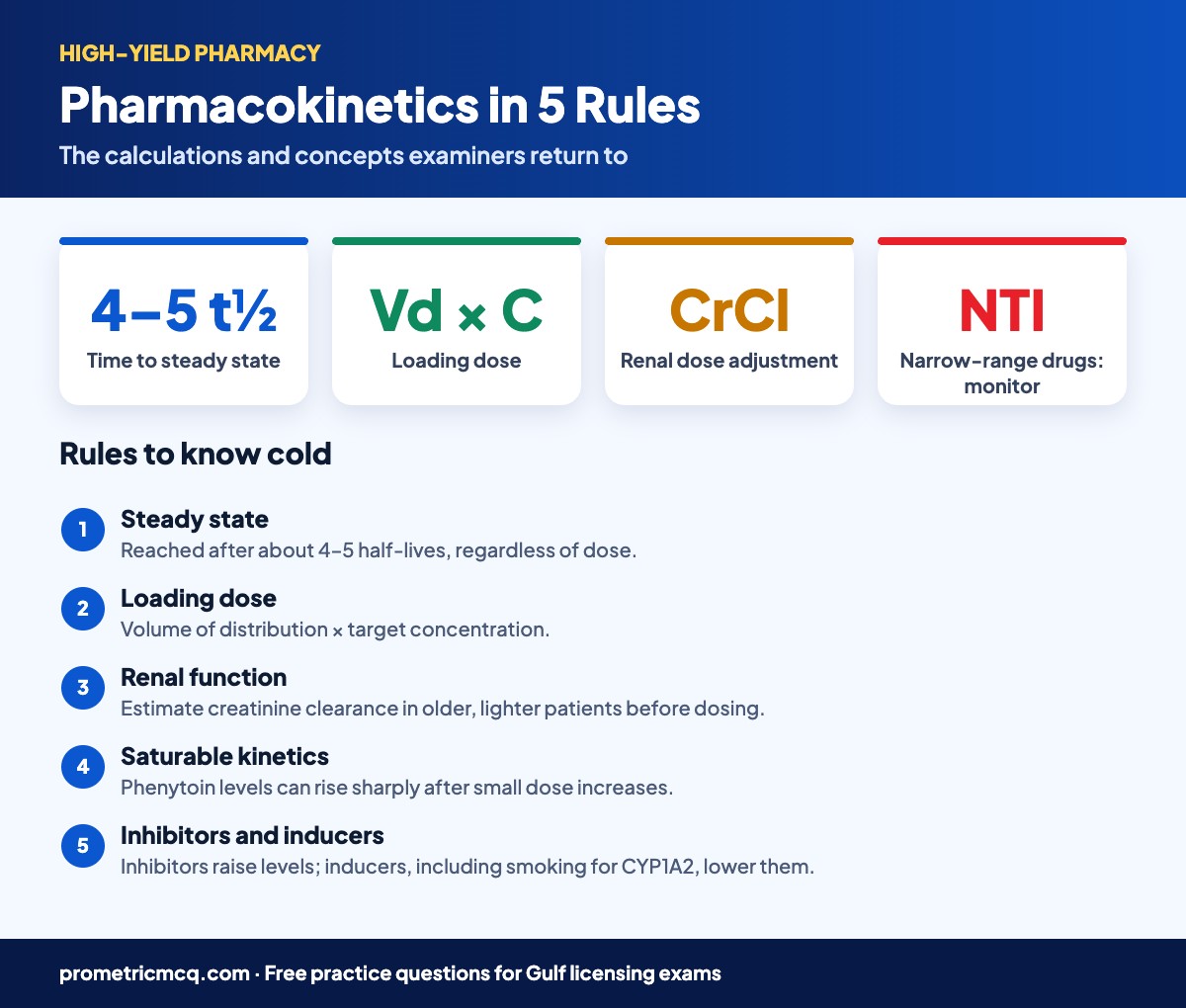
Explanation: Steady state is reached after about 4–5 half-lives, so 4–5 × 6 hours is about 24–30 hours. This is why a loading dose is used when a therapeutic level is needed quickly.
High-yield takeaway: Steady state takes about 4–5 half-lives, whatever the dose.
Question 2
A 70 kg patient needs a loading dose of a drug with a volume of distribution of 0.5 L/kg to reach a target plasma concentration of 10 mg/L. What loading dose is needed?
- A. 350 mg
- B. 700 mg
- C. 35 mg
- D. 175 mg
Answer: A
Explanation: Loading dose = Vd × target concentration. Vd = 0.5 L/kg × 70 kg = 35 L, so 35 L × 10 mg/L = 350 mg (assuming full bioavailability).
High-yield takeaway: Loading dose = volume of distribution × target concentration.
Question 3
An 80-year-old man weighing 60 kg has a serum creatinine of 120 µmol/L. Using the Cockcroft-Gault equation (with the factor 1.23 for men), what is his approximate creatinine clearance?
- A. 52 mL/min
- B. 25 mL/min
- C. 60 mL/min
- D. 37 mL/min
Answer: D
Explanation: CrCl = (140 − age) × weight × 1.23 ÷ creatinine = (60 × 60 × 1.23) ÷ 120 = 4,428 ÷ 120 ≈ 37 mL/min. His creatinine looks only mildly raised, but his clearance is reduced because of age and low body weight, so renally cleared drugs may need adjusting.
High-yield takeaway: Older, lighter patients: a near-normal creatinine can hide poor renal function.
Question 4
A 35-year-old man's phenytoin dose is increased from 300 mg to 400 mg daily because his level was slightly low. Two weeks later his level is well above the range and he has nystagmus and ataxia. What explains this?
- A. Phenytoin follows first-order kinetics at all doses
- B. Phenytoin metabolism is saturable, so levels rise disproportionately
- C. The dose increase reduced renal excretion
- D. Phenytoin undergoes enterohepatic recycling
Answer: B
Explanation: Phenytoin's liver metabolism saturates within the therapeutic range, shifting towards zero-order kinetics, so a small dose increase can cause a large rise in level and toxicity. Dose changes should be small, with level monitoring.
High-yield takeaway: Phenytoin: saturable kinetics; small dose changes, monitor levels.
Question 5
A 68-year-old man stable on theophylline for COPD is started on ciprofloxacin. Four days later he has nausea, palpitations and a tremor. What is the most likely explanation?
- A. Ciprofloxacin inhibits theophylline metabolism, raising its level
- B. Ciprofloxacin induces theophylline metabolism, lowering its level
- C. Ciprofloxacin blocks theophylline absorption
- D. There is no interaction; these are COPD symptoms
Answer: A
Explanation: Ciprofloxacin inhibits CYP1A2, which metabolises theophylline, so levels rise and cause toxicity (nausea, tachycardia, tremor and, at high levels, seizures). Check a theophylline level and consider an alternative antibiotic or a dose reduction.
High-yield takeaway: Theophylline has a narrow therapeutic range; ciprofloxacin and clarithromycin raise levels.
Question 6
A 45-year-old woman has dyspepsia and a positive Helicobacter pylori stool antigen test. She has no alarm features and no drug allergies. Which treatment is most appropriate?
- A. A proton pump inhibitor alone for 8 weeks
- B. An antacid when needed
- C. A proton pump inhibitor plus two antibiotics, such as amoxicillin and clarithromycin
- D. A single antibiotic for 5 days
Answer: C
Explanation: H. pylori eradication needs a proton pump inhibitor combined with two antibiotics, chosen according to local resistance patterns and allergy history. A PPI or antacid alone does not eradicate the infection, and single-antibiotic regimens fail and promote resistance.
High-yield takeaway: H. pylori: PPI plus two antibiotics, guided by local resistance.
Question 7
A 60-year-old man is starting simvastatin 20 mg daily. Which counselling point is correct?
- A. Take it in the morning with grapefruit juice
- B. Take it in the evening and avoid large amounts of grapefruit juice
- C. Take it only when his cholesterol is high
- D. Take it with an antacid to protect the stomach
Answer: B
Explanation: Simvastatin has a short half-life and most cholesterol synthesis happens at night, so it is taken in the evening. Grapefruit juice inhibits CYP3A4 and raises simvastatin levels, increasing myopathy risk. Statins are taken continuously, and antacids are not needed.
High-yield takeaway: Simvastatin: evening dose; avoid large amounts of grapefruit juice.
Question 8
A 58-year-old man with type 2 diabetes takes empagliflozin and metformin. He has had vomiting and diarrhoea for a day and is not eating. What advice should the pharmacist give about empagliflozin?
- A. Double the dose to control glucose
- B. Continue it as normal
- C. Continue it and drink extra water only
- D. Stop it temporarily while unwell and seek medical advice
Answer: D
Explanation: SGLT2 inhibitors such as empagliflozin should be paused during acute illness with dehydration or poor intake (sick-day rules), because they increase the risk of diabetic ketoacidosis, sometimes with near-normal glucose. They can be restarted once he is eating and drinking normally.
High-yield takeaway: SGLT2 inhibitors: stop during acute illness; watch for euglycaemic DKA.
Question 9
A 63-year-old woman starting warfarin asks whether she must stop eating salads and green vegetables. What is the correct advice?
- A. Avoid all green vegetables completely
- B. Eat as much spinach as possible
- C. Keep intake of vitamin K-rich foods consistent from week to week
- D. Take a vitamin K supplement every day
Answer: C
Explanation: Vitamin K reduces warfarin's effect, so large changes in intake destabilise the INR. Patients do not need to avoid green vegetables, but should keep their intake consistent and tell their clinic about major diet changes. Supplements containing vitamin K should be avoided unless prescribed.
High-yield takeaway: Warfarin and diet: consistency matters, not avoidance.
Question 10
A 24-year-old woman with epilepsy, well controlled on sodium valproate, tells the pharmacist she would like to become pregnant next year. What is the most appropriate advice?
- A. See her specialist soon to review her treatment before conception, and do not stop valproate suddenly
- B. Stop valproate today to protect a future baby
- C. Continue valproate, as it is safe in pregnancy
- D. Take extra folic acid and continue without review
Answer: A
Explanation: Valproate carries a high risk of birth defects and neurodevelopmental problems, so treatment should be reviewed by her specialist before conception, with effective contraception until then. Stopping suddenly risks seizures, and folic acid alone does not remove the risk.
High-yield takeaway: Valproate: specialist review before pregnancy; never stop abruptly.
Question 11
A 27-year-old woman using the combined oral contraceptive pill is started on rifampicin for tuberculosis. What advice should she receive?
- A. Rifampicin has no effect on the pill
- B. Rifampicin reduces the pill's effectiveness; use a reliable alternative such as a copper IUD
- C. Rifampicin makes the pill more effective
- D. She should stop the rifampicin
Answer: B
Explanation: Rifampicin is a potent enzyme inducer that lowers contraceptive hormone levels, so the pill becomes unreliable. A method unaffected by enzyme inducers, such as a copper IUD or progestogen injection, is advised during treatment and for a period after stopping. Rifampicin should not be stopped.
High-yield takeaway: Enzyme inducers (rifampicin, carbamazepine) make hormonal contraception unreliable.
Question 12
A 40-year-old man stable on clozapine tells the pharmacist he stopped smoking 10 days ago. He now feels more drowsy than usual. What is the concern?
- A. Clozapine levels will fall and he may relapse
- B. There is no interaction with smoking
- C. He needs a higher clozapine dose
- D. Clozapine levels may rise; his prescriber should check levels and adjust the dose
Answer: D
Explanation: Tobacco smoke induces CYP1A2, which metabolises clozapine. When a patient stops smoking, clozapine levels can rise substantially, causing sedation and toxicity, including seizures. His prescriber should be told so that levels can be checked and the dose reduced if needed. Nicotine replacement does not induce CYP1A2.
High-yield takeaway: Stopping smoking raises clozapine levels: monitor and adjust.
Question 13
A 66-year-old man with lung cancer is started on regular oral morphine for pain. What should be co-prescribed routinely?
- A. A regular laxative, such as a stimulant with a softener
- B. Loperamide
- C. A fibre supplement alone
- D. Nothing, unless constipation develops
Answer: A
Explanation: Opioids cause constipation in most patients and tolerance to this effect does not develop, so a regular laxative, usually a stimulant with or without a softener, should be started with the opioid. Loperamide worsens constipation, and fibre alone can make opioid constipation worse.
High-yield takeaway: Regular opioid: prescribe a regular laxative from day one.
Question 14
A 30-year-old woman with asthma is prescribed propranolol for migraine prevention. What should the pharmacist do?
- A. Dispense it as prescribed
- B. Dispense it and remind her to carry her inhaler
- C. Contact the prescriber, as propranolol can cause bronchospasm in asthma
- D. Dispense half the dose
Answer: C
Explanation: Non-selective beta-blockers such as propranolol can cause severe bronchospasm in people with asthma and should be avoided. The prescriber should choose another migraine preventer. Reducing the dose or carrying an inhaler does not make it safe.
High-yield takeaway: Asthma: avoid non-selective beta-blockers such as propranolol.
Question 15
A 29-year-old woman who is 8 weeks pregnant has an uncomplicated urinary tract infection. Which antibiotic is best avoided at this stage of pregnancy?
- A. Cefalexin
- B. Amoxicillin, if the organism is sensitive
- C. Nitrofurantoin
- D. Trimethoprim
Answer: D
Explanation: Trimethoprim is a folate antagonist and is best avoided in the first trimester because of the risk of neural tube defects. Cefalexin, amoxicillin (when sensitive) and nitrofurantoin are commonly used in early pregnancy, although nitrofurantoin is avoided near term.
High-yield takeaway: First trimester: avoid trimethoprim; nitrofurantoin is avoided near term.
Question 16
An 82-year-old woman with type 2 diabetes and reduced kidney function has had three episodes of hypoglycaemia in a month. She takes glibenclamide. What is the most likely reason?
- A. Metformin causes frequent hypoglycaemia
- B. Glibenclamide is long-acting and accumulates in older people with poor renal function
- C. She has developed insulin resistance
- D. Her glibenclamide dose is too low
Answer: B
Explanation: Glibenclamide is a long-acting sulfonylurea whose active metabolites accumulate in renal impairment, causing prolonged hypoglycaemia, particularly in older people. A shorter-acting agent or a different drug class is safer. Metformin alone rarely causes hypoglycaemia.
High-yield takeaway: Older patients: avoid long-acting sulfonylureas such as glibenclamide.
Question 17
A 74-year-old woman develops profuse watery diarrhoea 5 days after starting an antibiotic for a skin infection. Clostridioides difficile is confirmed. Which antibiotic is most strongly associated with this complication?
- A. Nitrofurantoin
- B. Doxycycline
- C. Clindamycin
- D. Trimethoprim
Answer: C
Explanation: Clindamycin, along with cephalosporins, co-amoxiclav and fluoroquinolones, carries a high risk of C. difficile infection because it disrupts the normal gut flora. Nitrofurantoin, doxycycline and trimethoprim carry a lower risk.
High-yield takeaway: High C. difficile risk: clindamycin, cephalosporins, co-amoxiclav, quinolones.
Question 18
A 32-year-old man starting treatment for pulmonary tuberculosis is prescribed isoniazid. Which supplement is usually given to prevent peripheral neuropathy?
- A. Pyridoxine (vitamin B6)
- B. Folic acid
- C. Vitamin K
- D. Ferrous sulfate
Answer: A
Explanation: Isoniazid interferes with pyridoxine metabolism and can cause peripheral neuropathy, especially in people with diabetes, alcohol dependence, malnutrition, HIV or renal failure, so pyridoxine is co-prescribed. The other supplements do not prevent this effect.
High-yield takeaway: Isoniazid: give pyridoxine to prevent neuropathy.
Question 19
A patient starting rifampicin for tuberculosis wears soft contact lenses. Which counselling point is important?
- A. It turns urine green
- B. It causes black stools
- C. It causes blue-tinted vision
- D. It turns urine, tears and sweat orange-red and can stain soft contact lenses
Answer: D
Explanation: Rifampicin colours body fluids orange-red. This is harmless but can permanently stain soft contact lenses. Patients should also be told about its many interactions, including reduced effectiveness of hormonal contraception.
High-yield takeaway: Rifampicin: orange-red body fluids and many enzyme-inducing interactions.
Question 20
A 45-year-old woman is starting standard four-drug therapy for tuberculosis. Which drug requires a baseline visual acuity and colour vision check?
- A. Rifampicin
- B. Ethambutol
- C. Pyrazinamide
- D. Isoniazid
Answer: B
Explanation: Ethambutol can cause optic neuritis with reduced acuity and red-green colour blindness, so vision is checked at baseline and patients are told to report visual changes. Rifampicin and isoniazid mainly affect the liver, and pyrazinamide can cause hepatotoxicity and gout.
High-yield takeaway: Ethambutol: eyes; isoniazid: nerves; rifampicin: orange fluids; pyrazinamide: gout.
Question 21
A 70-year-old man has taken amiodarone for atrial fibrillation for 2 years. Which monitoring is most important?
- A. Serum potassium only
- B. Blood glucose only
- C. Thyroid and liver function tests, with review of lung symptoms
- D. Serum amylase
Answer: C
Explanation: Amiodarone can cause both hypo- and hyperthyroidism, liver injury and pulmonary toxicity, so thyroid and liver function are checked regularly and new cough or breathlessness is investigated. It also causes photosensitivity and corneal deposits and interacts with warfarin and digoxin.
High-yield takeaway: Amiodarone: check thyroid and liver; watch the lungs, skin and eyes.
Question 22
A 67-year-old woman has accidentally taken her weekly methotrexate dose every day for 5 days. She has mouth ulcers and a low white cell count. Which antidote is used?
- A. Folinic acid (calcium folinate)
- B. Folic acid
- C. Acetylcysteine
- D. Vitamin B12
Answer: A
Explanation: Folinic acid bypasses the dihydrofolate reductase block caused by methotrexate and is the antidote in toxicity, alongside urgent medical care. Folic acid needs this enzyme to be activated, so it is not effective in overdose. Acetylcysteine is for paracetamol, and B12 has no role.
High-yield takeaway: Methotrexate toxicity: folinic acid, not folic acid.
[/pmcq_quiz]
How to Score Your Mock Test
| Score (out of 22) | Meaning | Next step |
|---|---|---|
| 18–22 | Strong | Move to full-length timed mocks. |
| 13–17 | Borderline | Revise the concepts behind every wrong answer, especially calculations. |
| 0–12 | Needs structured revision | Work through pharmacokinetics and interactions before more mocks. |
If you lost marks on calculations, practise them daily until each takes under a minute. If you lost marks on interactions, learn the main enzyme inhibitors and inducers, because the same handful of drugs appear again and again.
[pmcq_cta title="Practise full-length pharmacist mocks" text="Timed mocks with explanations and progress tracking on any device." button="Start Practising Now" url="https://www.prometricmcq.com/pharmacy-mcqs/"]
Registration Steps for Oman Pharmacists
- Download the content outline and registration guide from the OMSB testing page.
- Prepare your pharmacy degree, transcripts, licence, good-standing certificate and experience letters with consistent name spelling.
- Register and book through Pearson VUE's OMSB page.
- Complete DataFlow certificate verification; see our DataFlow guide.
For a full preparation guide read OMSB exam for pharmacists: a preparation guide.
FAQs: OMSB Pharmacist Exam
Is the Oman pharmacist exam a Prometric exam?
Candidates often call it that, but OMSB's website now lists Pearson VUE as its test-delivery partner. Older Prometric pages described booking with Prometric in Muscat, so confirm the current provider on omsb.gov.om.
Where can I find the Oman pharmacist exam syllabus?
OMSB publishes the content outline for each Occupational Classification exam on its testing page. Download the latest version before you plan your revision.
Do pharmacists need DataFlow for Oman?
OMSB uses DataFlow for certificate verification, so start it early and keep your name spelled the same on every document.
Are these real exam questions?
No. Real questions are confidential. These are written by PrometricMCQ in the style of Gulf pharmacist licensing exams.
How many questions are in the OMSB pharmacist exam?
An older Prometric FAQ lists 70 MCQs in 2 hours for most OMSB exams and 100 MCQs in 2.5 hours for some. Confirm the current format for your exam with OMSB.
What is the OMSB pass mark?
OMSB does not publish a pass mark. Aim to score comfortably above 60% in timed practice before booking.
How many attempts are allowed?
An older Prometric FAQ lists up to 3 attempts per calendar year. Check the current rule with OMSB, as it may have changed.
Which topics should Oman pharmacist candidates prioritise?
Pharmacokinetics, calculations, drug interactions, high-risk medicines and patient counselling. These topics appear across Gulf pharmacist exams.
Is the Oman exam similar to other Gulf pharmacist exams?
The clinical content overlaps heavily with the DHA, MOHAP, DHP Qatar and SCFHS pharmacist exams, so the same question banks and study plan apply.
How should I use this mock test?
Take it once in Exam mode to measure your level, review every explanation, then repeat it in a week to check that the concepts have stuck.
Conclusion
Oman's pharmacist exam rewards safe dosing, interaction checks and practical counselling. Use this mock to find your weak areas, then practise full timed mocks before your Pearson VUE date. Also try our free QCHP pharmacist mock test.
[pmcq_cta title="Ready to pass the OMSB pharmacist exam?" text="Instant access to thousands of pharmacy MCQs with explanations and timed mocks." button="Get Pharmacy MCQs – Instant Access" url="https://www.prometricmcq.com/pharmacy-mcqs/"]

The PrometricMCQ editorial team writes independent guides for healthcare professionals preparing for Gulf licensing exams. Editorial policy