In this guide
- OMSB Nursing Exam at a Glance
- Prometric or Pearson VUE? Why the Name Is Confusing
- What the OEN Tests
- Free OMSB Nursing Mock Test: 22 Case-Based Questions with Answers
- How to Score Your Mock Test
- How to Register for the OMSB Nursing Exam
- 4-Week Study Plan for the OMSB Nursing Exam
- FAQs: OMSB Oman Nursing Exam
- Conclusion
Planning to work as a nurse in Oman? You must pass the Oman Medical Specialty Board (OMSB) licensing exam first, which many candidates still call the Oman Prometric exam. This free OMSB nursing mock test gives you 22 case-based questions with answers and explanations, explains the official exam names and delivery, and gives you a 4-week plan to prepare.
Reviewed by Dr Samer Hadad · Last reviewed 4 November 2026 · Exam facts checked against the OMSB Occupational Classification Testing page.
OMSB Nursing Exam at a Glance
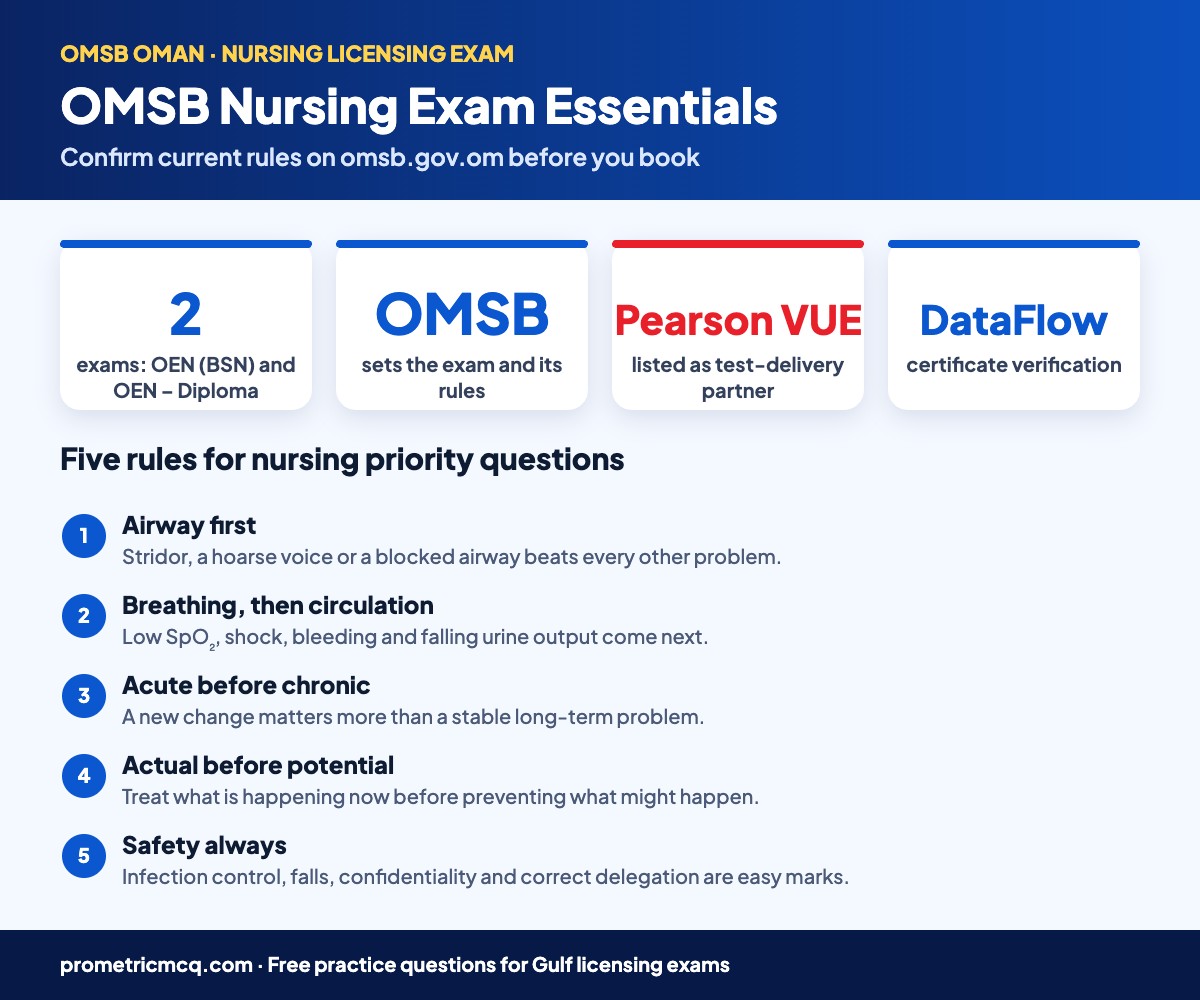
OMSB runs computer-based Occupational Classification (OC) exams that the Ministry of Health and other health institutions in Oman use for licensing. Nurses sit one of two exams depending on their qualification.
| Item | What OMSB says |
|---|---|
| Exam for degree nurses | Omani Examination for Nurses – BSN (OEN) |
| Exam for diploma nurses | Omani Examination for Nursing Diploma (OEN – Diploma) |
| Format | Computer-based multiple-choice exam |
| Where you sit it | OMSB National Test Center (Innovation Park Muscat) or Pearson VUE test centres worldwide |
| Registration | Pearson VUE – OMSB page |
| Certificate verification | DataFlow – OMSB verification |
Source: OMSB – Occupational Classification Testing Section. OMSB publishes the content outline and registration guide for each exam on that page. Question count, timing and pass mark can change, so check the current OEN guide before you book.
Prometric or Pearson VUE? Why the Name Is Confusing
For years Gulf licensing exams were called "Prometric exams", and Oman nurses still search for "Oman Prometric exam for nurses". OMSB's own page now lists its National Test Center and Pearson VUE centres for delivery. The exam style is the same either way: clinical scenario MCQs on a computer, under time pressure. Our Pearson VUE vs Prometric guide explains the differences in booking and test-day rules.
What the OEN Tests
- Adult health nursing: cardiovascular, respiratory, renal, endocrine, gastrointestinal and peri-operative care.
- Maternal and newborn nursing: antenatal assessment, labour, postpartum complications and newborn care.
- Paediatric nursing: growth and development, immunisation, dehydration and childhood emergencies.
- Pharmacology and medication safety: high-alert drugs, dose calculation and adverse effects.
- Professional practice: ethics, consent, infection control, documentation and leadership.
Free OMSB Nursing Mock Test: 22 Case-Based Questions with Answers
These are original questions written by PrometricMCQ in the style of the Oman nursing exam: short clinical scenarios that ask for the priority action, the safest response or the correct interpretation. Allow 26 minutes for all 22 questions. OMSB does not publish a pass mark on the page we checked, so treat 60% (14 out of 22) as a working benchmark, not an official cut score.
Question 1
A 54-year-old man has an underwater-seal chest drain after a pneumothorax. While he is walking to the bathroom, the tubing disconnects from the drainage bottle. He is talking normally, SpO₂ 95%. What is the nurse's immediate action?
Answer: A
Explanation: Submerging the tube end in sterile water restores an underwater seal at once, so air cannot be drawn into the chest, and a new sterile system is then connected. Clamping a drain that is still bubbling can cause a tension pneumothorax. Removing the drain is a medical decision, and coughing does not fix an open system.
High-yield takeaway: Disconnected chest drain: recreate the water seal; do not clamp routinely.
Question 2
A 66-year-old woman is 15 minutes into a red cell transfusion. She develops rigors and back pain. Temperature 39.0 °C (baseline 36.8 °C), pulse 124/min, BP 88/50 mmHg. What is the priority action?
Answer: C
Explanation: Fever, rigors, back pain and hypotension early in a transfusion suggest an acute haemolytic or septic reaction. The transfusion is stopped immediately, the IV line is kept open with saline through a new giving set, the patient and unit details are rechecked and the doctor is called urgently. Slowing, finishing or continuing the unit gives more of the harmful blood.
High-yield takeaway: Severe transfusion reaction: stop, keep the vein open with saline and escalate.
Question 3
The nurse receives handover on four patients. Which patient should be assessed first?
Answer: D
Explanation: Hoarseness and noisy breathing (stridor) after a bee sting suggest airway swelling from anaphylaxis, an immediate threat to life, so airway comes first. An SpO₂ of 89% may be within the target range for COPD, post-operative pain needs attention but is not life-threatening, and a glucose of 12.4 mmol/L needs review but is not an emergency.
High-yield takeaway: Prioritise with ABC: an airway problem always comes first.
Question 4
A 45-year-old woman is 1 day after a total thyroidectomy. She reports tingling around her mouth and in her fingers, and tapping over the facial nerve causes twitching of her mouth. What should the nurse suspect and do?
Answer: B
Explanation: Perioral tingling and a positive Chvostek sign after thyroidectomy suggest hypocalcaemia from parathyroid injury or removal. The nurse should check calcium urgently, inform the doctor and have IV calcium gluconate ready, as severe hypocalcaemia can cause tetany, laryngospasm and arrhythmias. These signs are not explained by anxiety or hyperkalaemia, and they are not normal.
High-yield takeaway: Post-thyroidectomy tingling and Chvostek sign: think hypocalcaemia.
Question 5
A 79-year-old bed-bound woman has an area of intact skin over her sacrum that stays red when pressed with a finger. There is no blister or broken skin. How should the nurse classify and manage this?
Answer: A
Explanation: Intact skin with non-blanchable redness over a bony prominence is a category (stage) 1 pressure injury. Management is to relieve pressure with a repositioning schedule and a pressure-redistributing surface, protect the skin and reassess regularly. Category 3 involves full-thickness skin loss, normal reactive redness blanches, and moisture lesions are usually in skin folds or the perineum rather than over bone.
High-yield takeaway: Non-blanchable redness on intact skin is a category 1 pressure injury: offload now.
Question 6
A 72-year-old man has had a fine-bore nasogastric tube inserted for feeding after a stroke. Before starting the first feed, how should the nurse confirm that the tube is in the stomach?
Answer: C
Explanation: Accepted methods are testing the pH of aspirate against the policy threshold or, if no suitable aspirate is obtained, an X-ray reviewed by a competent person. The "whoosh" test and the bubble test are unreliable and have led to feeds being given into the lungs. Starting the feed before confirming placement risks aspiration pneumonia, especially after stroke, when coughing may be absent.
High-yield takeaway: Never feed via an NG tube until placement is confirmed by pH or X-ray.
Question 7
An 84-year-old woman is found on the floor beside her bed at night. She is conscious and says she slipped. What is the nurse's first action?
Answer: D
Explanation: After a fall, the patient is assessed where she lies for airway, breathing, consciousness, head injury and fractures (such as a shortened, rotated leg) before deciding how to move her safely, often with lifting equipment. Lifting her immediately can worsen an injury. The incident is reported after she is safe, and sedatives increase the risk of further falls.
High-yield takeaway: After a fall, assess for injury before moving the patient.
Question 8
A 70-year-old man has diarrhoea and a positive Clostridioides difficile toxin test. Which infection control measure is most important for staff?
Answer: B
Explanation: C. difficile spores are not reliably killed by alcohol hand rub, so hands must be washed with soap and water, and contact precautions (gloves, apron, single room with its own toilet where possible) are used. It is not spread by the airborne route, so a respirator is not required. Precautions continue while he has diarrhoea, not just until treatment starts.
High-yield takeaway: C. difficile: soap and water hand washing, because alcohol does not kill spores.
Question 9
A 36-year-old man is admitted with a 6-week cough, night sweats and weight loss. Sputum smear shows acid-fast bacilli. What precautions should the nurse put in place?
Answer: A
Explanation: Smear-positive pulmonary tuberculosis spreads by airborne droplet nuclei, so the patient needs a single negative-pressure room, and staff wear fit-tested FFP3 or N95 respirators. Standard or contact precautions do not protect against airborne spread, and a surgical mask is not adequate protection for staff.
High-yield takeaway: Pulmonary TB needs airborne precautions: negative-pressure room and a respirator.
Question 10
A nurse sustains a needlestick injury from a used needle after taking blood from a patient. What is the most appropriate immediate action?
Answer: C
Explanation: First aid is to let the wound bleed gently, wash it with soap and running water and cover it, then report immediately so the risk can be assessed and post-exposure prophylaxis started promptly if needed. Sucking, scrubbing or using harsh antiseptics can damage tissue, and waiting until the end of the shift delays time-sensitive treatment.
High-yield takeaway: Needlestick: bleed, wash, cover and report straight away.
Question 11
An 18-month-old boy has had vomiting and diarrhoea for 2 days. His mouth is dry and he has had fewer wet nappies. Pulse 150/min, capillary refill 3 seconds. Which additional finding should prompt the nurse to escalate urgently?
Answer: D
Explanation: A reduced level of consciousness in a dehydrated child is a red flag for severe dehydration or shock and needs urgent medical review and usually IV fluids. A child who cries with tears or is thirsty and drinking is less likely to be severely dehydrated, and the number of stools alone does not indicate severity.
High-yield takeaway: In a dehydrated child, drowsiness is a red flag for shock.
Question 12
A 2-year-old girl with a temperature of 39.4 °C has a generalised tonic-clonic seizure on the ward. It started 2 minutes ago. What should the nurse do?
Answer: B
Explanation: During a seizure, the nurse keeps the child safe, places her on her side once possible to protect the airway, gives oxygen if needed, times the seizure and calls for help, as emergency medication is usually given if it lasts beyond 5 minutes. Restraining limbs causes injury, nothing should be put in the mouth, and cold baths are unsafe and do not stop seizures.
High-yield takeaway: Seizure first aid: protect, side position, time it; nothing in the mouth.
Question 13
Four children attend an immunisation clinic for the MMR vaccine. Which child should not receive it today?
Answer: C
Explanation: MMR is a live vaccine and is contraindicated in children with severe immunosuppression, such as during chemotherapy. A mild illness without fever is not a reason to delay. MMR can be given safely to children with egg allergy, and a pregnant household contact is not a contraindication because vaccine viruses are not transmitted.
High-yield takeaway: Live vaccines are contraindicated in severe immunosuppression.
Question 14
A woman is 6 hours after a vaginal birth. Her uterine fundus is soft, 2 cm above the umbilicus and displaced to the right. Her lochia is heavier than expected. She has not passed urine since the birth. What is the nurse's first action?
Answer: A
Explanation: A soft fundus that is high and displaced to one side, with heavier bleeding, is typical of a full bladder preventing the uterus from contracting. The first action is to help her void (or catheterise if she cannot), massage the fundus if it remains soft and reassess. Uterotonics or surgery are considered if bleeding continues, and waiting 4 hours risks haemorrhage.
High-yield takeaway: High, deviated, boggy fundus after birth: think full bladder first.
Question 15
A 71-year-old man with COPD and a history of carbon dioxide retention is breathless with an exacerbation. SpO₂ is 85% on air. Which oxygen prescription is most appropriate?
Answer: D
Explanation: Patients with COPD at risk of hypercapnic respiratory failure need controlled oxygen, usually via a 24% or 28% Venturi mask, with a target of 88–92% and an arterial or capillary blood gas to check carbon dioxide. High-flow oxygen aiming for 100% can worsen hypercapnia, but withholding oxygen from a hypoxic patient is dangerous. Oxygen should always be given to a prescribed target.
High-yield takeaway: COPD with CO₂ retention: controlled oxygen to 88–92%.
Question 16
A 68-year-old woman with heart failure is being discharged. Which instruction about daily weights is correct?
Answer: B
Explanation: Daily weights, taken at the same time each morning after passing urine, are the earliest sign of fluid retention; a rise of around 2 kg over 2–3 days should be reported so treatment can be adjusted. Monthly weights or waiting for ankle swelling detect worsening too late, and increasing fluids would make fluid overload worse.
High-yield takeaway: Heart failure: weigh daily and report rapid weight gain.
Question 17
A caller says he is the brother of a 40-year-old patient admitted yesterday and asks for her diagnosis and test results. The patient has not given any instructions about sharing information. What should the nurse do?
Answer: C
Explanation: Patient information is confidential, and it should not be shared without the patient's consent, even with close family. The nurse can explain this politely, take a message and ask the patient what she would like shared and with whom. Disclosing results or letting a relative read the notes breaches confidentiality.
High-yield takeaway: Share information only with the patient's consent, even with family.
Question 18
A registered nurse is caring for several patients with a nursing assistant. Which task is most appropriate to delegate to the nursing assistant?
Answer: A
Explanation: Routine tasks with predictable outcomes in stable patients, such as recording vital signs, can be delegated, and the registered nurse remains accountable for reviewing the results. Initial assessment, IV medicine administration and patient education need a registered nurse's knowledge and judgement and cannot be delegated to a nursing assistant.
High-yield takeaway: Delegate predictable tasks in stable patients; keep assessment, IV medicines and teaching.
Question 19
A 76-year-old woman has been admitted with an acute ischaemic stroke. She is alert and asks for a cup of tea and her usual tablets. What should the nurse do first?
Answer: D
Explanation: Dysphagia is common after stroke and may not be obvious, so patients stay nil by mouth, including oral medicines, until a swallow screen is performed by a trained person, with referral to speech and language therapy if it is failed. Giving food, drinks, thickened fluids or crushed tablets before screening risks aspiration pneumonia.
High-yield takeaway: After stroke, no food, fluids or oral medicines until the swallow has been screened.
Question 20
A 70 kg man is 1 day after a bowel resection. His urine output has been 20 mL/h for the past 3 hours. Pulse 108/min, BP 104/62 mmHg. What should the nurse do?
Answer: B
Explanation: A urine output below 0.5 mL/kg/h (35 mL/h for a 70 kg patient) for several hours, with tachycardia and a falling BP, suggests hypovolaemia or early acute kidney injury and needs prompt escalation. Waiting allows deterioration, oral fluids may not be appropriate after bowel surgery, and removing the catheter loses accurate monitoring.
High-yield takeaway: Urine output below 0.5 mL/kg/h is an early warning sign: escalate.
Question 21
A 59-year-old man with type 2 diabetes and reduced sensation in his feet is being taught foot care. Which statement shows he has understood the teaching?
Answer: C
Explanation: People with diabetic neuropathy may not feel injuries, so daily inspection of the feet, including between the toes (using a mirror if needed), is key to preventing ulcers. Hot soaks risk burns, walking barefoot risks unnoticed wounds, and cutting corns at home can cause infection; these should be treated by a podiatrist.
High-yield takeaway: Diabetic foot care: inspect daily, protect the feet and never self-treat corns.
Question 22
A 64-year-old woman is starting warfarin for atrial fibrillation. Which advice about diet is correct?
Answer: A
Explanation: Vitamin K in green leafy vegetables affects warfarin, so the aim is a consistent intake rather than avoidance; sudden large changes alter the INR. Avoiding greens completely is unnecessary, and deliberately varying intake makes the INR unstable. Patients should also report bleeding and check before starting new medicines, including over-the-counter painkillers.
High-yield takeaway: Warfarin: consistent vitamin K intake, regular INR checks and report bleeding.
How to Score Your Mock Test
| Your score (out of 22) | What it means | Next step |
|---|---|---|
| 18–22 | Ready for full-length practice | Take timed full mocks every week. |
| 14–17 | Borderline | Revise the topics behind each wrong answer, especially priority questions. |
| 0–13 | Needs a study plan | Follow the 4-week plan below before more mocks. |
How to Register for the OMSB Nursing Exam
- Check the content outline. Download the OEN or OEN – Diploma outline and registration guide from the OMSB testing page.
- Prepare your documents. Nursing degree or diploma, transcripts, registration licence, good-standing certificate and experience letters. Names must match your passport.
- Book the exam. Register through Pearson VUE's OMSB page and choose a centre and date.
- Complete verification. OMSB uses DataFlow for certificate verification. See our DataFlow verification guide to avoid delays.
- Sit the exam and follow up. Results and the next licensing steps come from OMSB and your employer or the Ministry of Health.
4-Week Study Plan for the OMSB Nursing Exam
- Week 1: fundamentals, infection control, medication safety and drug calculations. 40 questions a day.
- Week 2: adult health by body system, with one timed 50-question set every second day.
- Week 3: maternity, newborn and paediatrics, plus ethics and leadership.
- Week 4: full timed mocks, then targeted revision of weak areas only.
For more detail on eligibility and documents, read our complete guide to the Oman exam for nurses and practise with our nursing MCQs package.
FAQs: OMSB Oman Nursing Exam
What is the official name of the Oman nursing licensing exam?
OMSB lists two nursing exams: the Omani Examination for Nurses – BSN (OEN) and the Omani Examination for Nursing Diploma (OEN – Diploma).
Is the Oman nursing exam a Prometric exam?
Many candidates call it the Oman Prometric exam, but OMSB's testing page lists the OMSB National Test Center in Muscat and Pearson VUE centres worldwide for delivery.
Do I need DataFlow verification for OMSB?
OMSB uses DataFlow for certificate verification. Start it early, because verification depends on your university and employers responding.
Where can I find the OEN syllabus?
The content outline for each OC exam, including the OEN, is linked from the OMSB Occupational Classification Testing page.
Are these the real OMSB exam questions?
No. Real exam questions are confidential. These questions are written by PrometricMCQ to match the style and topics of the Oman nursing exam.
How many questions are in the OMSB nursing exam, and how long is it?
OMSB publishes the details for each exam in its registration guide, so check the current OEN guide. An older Prometric OMSB FAQ described 70 MCQs in 2 hours for most exams (some with 100 MCQs in 2.5 hours), but this may be out of date.
How many attempts are allowed?
The older Prometric OMSB FAQ said candidates could sit up to 3 attempts per calendar year. Rules can change, so confirm the current attempt limit with OMSB before you book.
What is the pass mark for the OMSB nursing exam?
OMSB does not publish a pass mark on the testing page we checked. Aim to score comfortably above 60% in timed practice so that you have a margin on exam day.
Which topics should I revise first?
Start with priority and safety questions (airway, deterioration, infection control and medication safety), because they appear across every area. Then work through adult health by body system, followed by maternity and paediatrics.
How should I use this mock test?
Take it once under timed conditions, then read every explanation, including for questions you got right. Write down the topic behind each mistake and revise those topics before your next mock.
Conclusion
The OMSB nursing exam tests safe clinical judgement across adult, maternal and child health. Use this free mock to find your gaps, follow the 4-week plan, and practise full timed mocks before booking. Also try our free QCHP Qatar nursing mock test.

The PrometricMCQ editorial team writes independent guides for healthcare professionals preparing for Gulf licensing exams. Editorial policy