In this guide
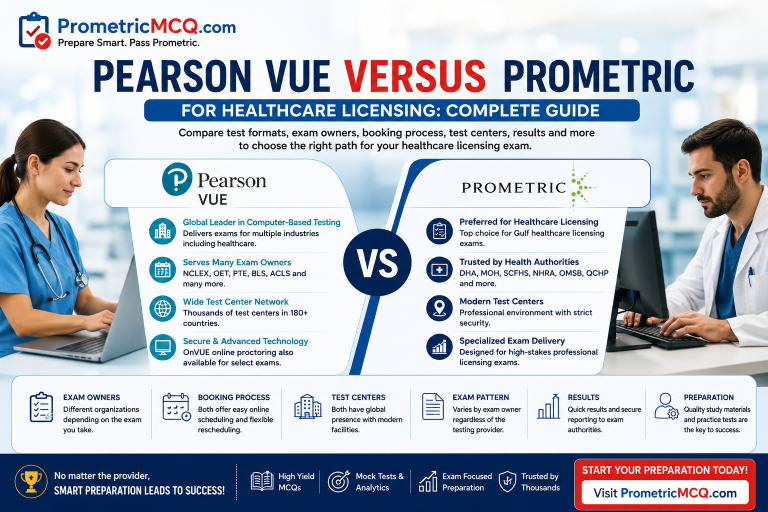
General practitioners moving to Abu Dhabi need a licence from the Department of Health – Abu Dhabi (DOH, formerly HAAD), which includes a computer-based licensing assessment delivered by Pearson VUE, not Prometric. This free DOH GP mock test gives you 24 case-based clinical vignettes with answers and explanations, plus the licensing steps. The clinical content overlaps heavily with the Prometric exam used by DHA and other Gulf authorities, so your preparation carries over.
Reviewed by Dr Samer Hadad · Last reviewed 4 November 2026. DOH sets the exam format, pass mark and attempt rules in its Professional Qualification Requirements; confirm them on doh.gov.ae and in your TAMM application before booking.
DOH GP Licence at a Glance
| Step | What happens |
|---|---|
| Eligibility | Check DOH's Professional Qualification Requirements for your degree, internship and recent experience |
| Application | Apply on TAMM with UAE Pass |
| Verification | DataFlow primary source verification of your documents |
| Assessment | Computer-based MCQ exam at a Pearson VUE test centre (still called the "HAAD exam") |
| Licence | Eligibility letter, then licence activation with an Abu Dhabi employer |
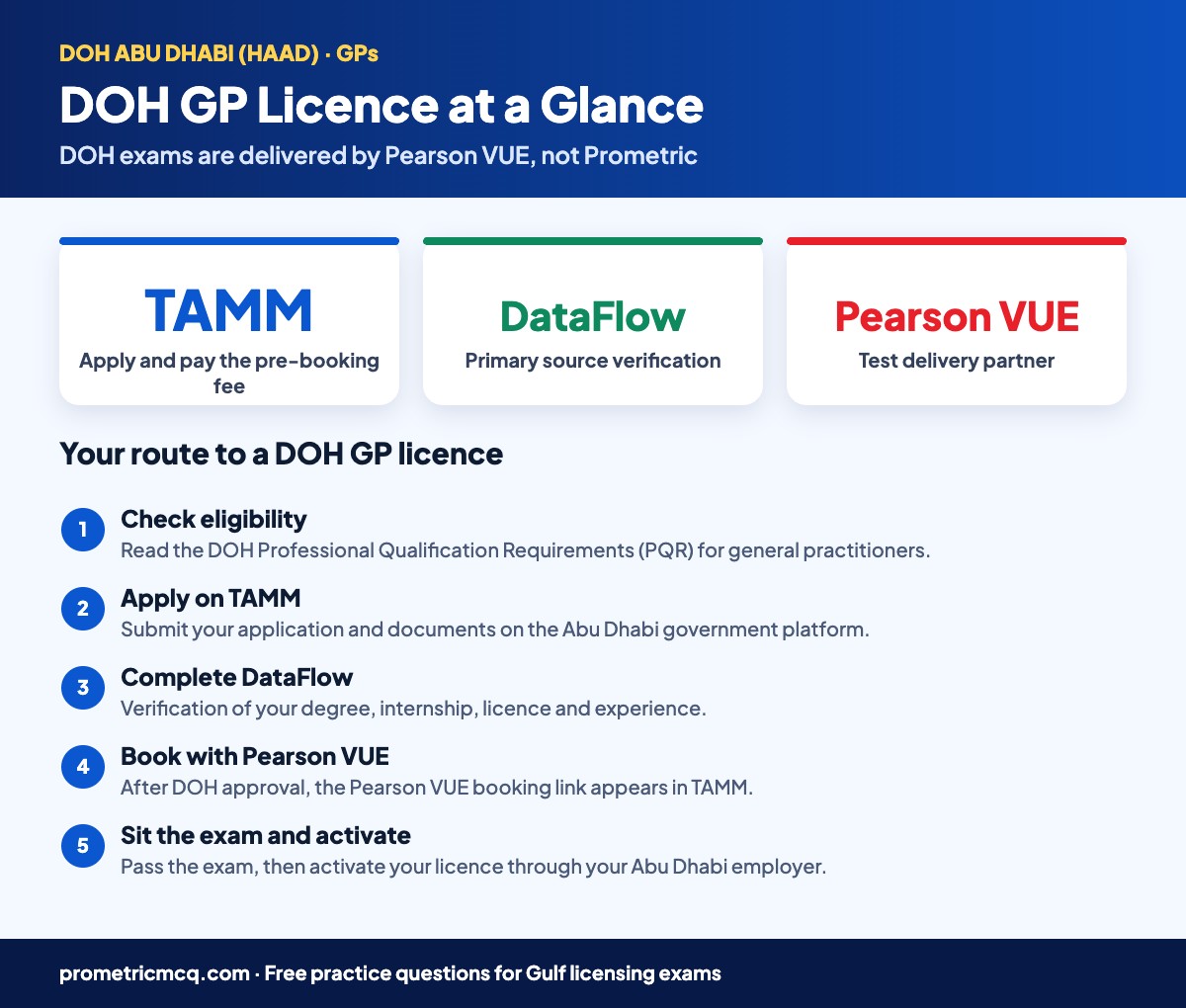
DOH uses Pearson VUE, not Prometric. Many doctors search for the "DOH Prometric exam", but once DOH approves your application you pay the pre-booking fee in TAMM and the Pearson VUE booking link appears there. DOH does not publish the pass mark or attempt rules on the pages we checked, so confirm them in your TAMM application before booking.
What the DOH GP Exam Tests
- Internal medicine and emergencies: a major focus for GPs.
- Primary care: screening, vaccination, chronic disease follow-up and prescribing.
- Paediatrics, obstetrics and gynaecology.
- Surgery, ENT, ophthalmology, dermatology and psychiatry basics.
- Ethics and UAE practice standards.
[pmcq_cta title="Thousands of GP MCQs for UAE exams" text="DOH, DHA and MOH-style clinical vignettes with explanations and timed mocks. Instant access after payment." button="Get the GP MCQs Package" url="https://www.prometricmcq.com/general-practitioner-mcqs/"]
Free DOH Abu Dhabi GP Mock Test: 24 Case-Based Questions with Answers
The questions cover internal medicine, emergencies, paediatrics, women's health, surgery, ENT, eyes, skin and mental health, each as a short clinical vignette with one best answer. Choose Practice mode to see the explanation after each question, or Exam mode to answer all 24 against a 29-minute timer. DOH does not publish its pass mark on the pages we checked, so the 60% pass line here is a practice benchmark only.
[pmcq_quiz title="Free DOH GP Mock Test – 24 Questions" pass="60" minutes="29" button="Get GP MCQs – Instant Access" url="https://www.prometricmcq.com/general-practitioner-mcqs/"]
Question 1
A 28-year-old woman with asthma has been wheezy for 2 days. She cannot complete sentences, RR 28/min, pulse 115/min, SpO2 94% on air and peak flow 40% of her best. What is the most appropriate immediate treatment?
- A. IV aminophylline as the first drug
- B. Nebulised salbutamol (with ipratropium) plus oral prednisolone
- C. A chest X-ray before any treatment
- D. Oral montelukast and review tomorrow
Answer: B
Explanation: These features indicate acute severe asthma. Give oxygen to keep saturations in the target range, high-dose nebulised short-acting beta-2 agonist (often with ipratropium) and systemic corticosteroids promptly. IV aminophylline is a later option, imaging must not delay treatment, and montelukast has no role in an acute attack.
High-yield takeaway: Acute severe asthma: oxygen, nebulised salbutamol, steroids, then reassess.
Question 2
A 72-year-old man with pneumonia is confused. Urea 8.5 mmol/L, RR 32/min and BP 85/50 mmHg. What is his CURB-65 score?
- A. 3
- B. 2
- C. 4
- D. 5
Answer: D
Explanation: One point each for confusion, urea above 7 mmol/L, respiratory rate of 30 or more, low blood pressure (systolic below 90 or diastolic 60 or less) and age 65 or over gives 5. A score of 3 or more indicates severe pneumonia needing hospital care and consideration of critical care.
High-yield takeaway: CURB-65: confusion, urea >7, RR ≥30, low BP, age ≥65; 3+ is severe.
Question 3
A 34-year-old woman has weight loss, heat intolerance, tremor and palpitations. She has a smooth, diffusely enlarged thyroid and bilateral proptosis. TSH is suppressed and free T4 is raised. Which is the most likely diagnosis?
- A. Graves disease
- B. Toxic multinodular goitre
- C. Primary hypothyroidism
- D. Subacute (De Quervain) thyroiditis
Answer: A
Explanation: Hyperthyroidism with a diffuse goitre and eye signs such as proptosis is typical of Graves disease, an autoimmune condition driven by TSH-receptor antibodies. Toxic multinodular goitre is nodular and lacks eye disease, hypothyroidism has a high TSH, and subacute thyroiditis causes a painful, tender thyroid.
High-yield takeaway: Hyperthyroid plus diffuse goitre plus eye signs: Graves disease.
Question 4
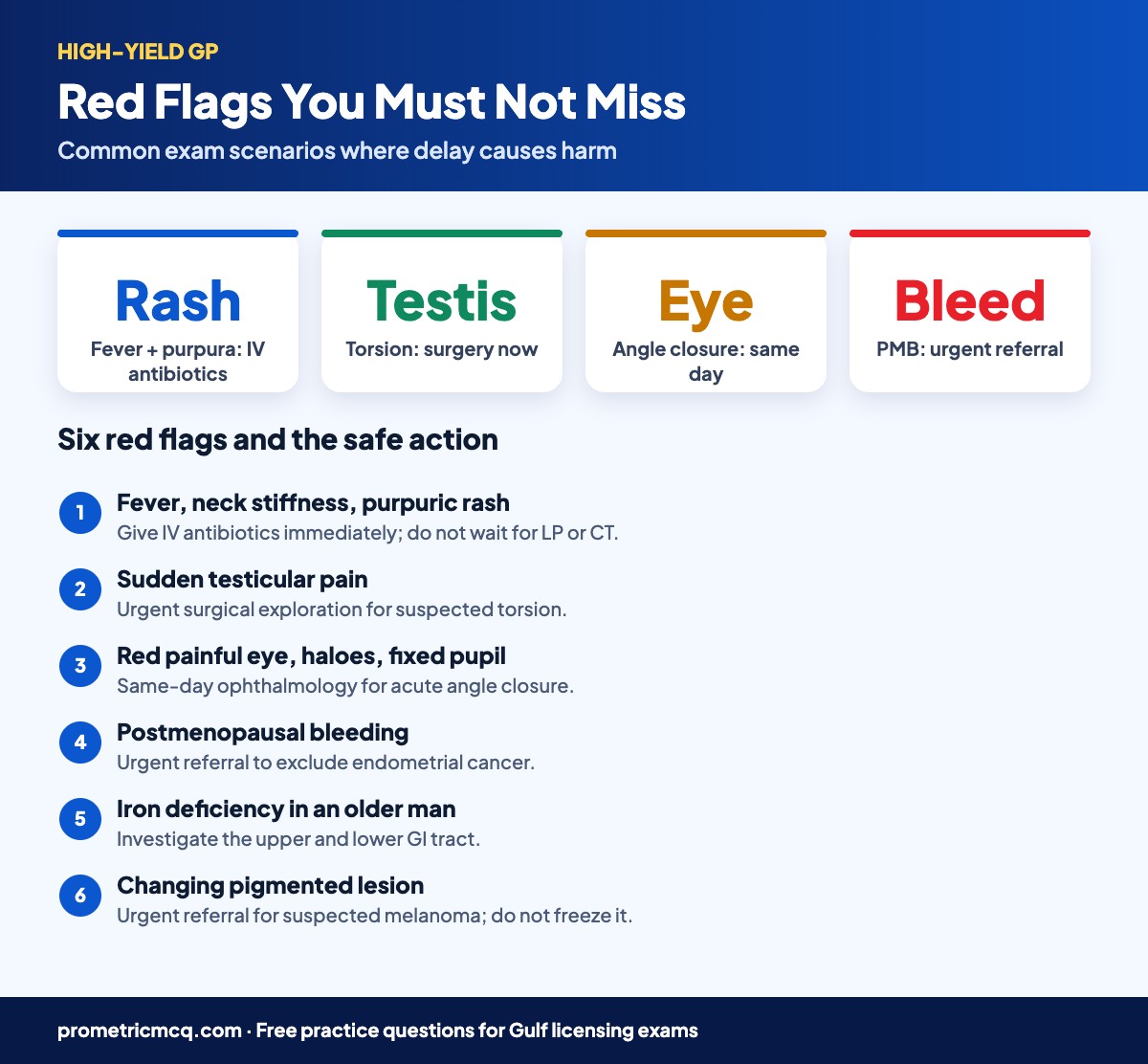
A 19-year-old student is brought to the emergency department with fever, severe headache, neck stiffness and a non-blanching purpuric rash. BP 100/60 mmHg. Blood cultures have been taken. What is the next step?
- A. Wait for the lumbar puncture result before antibiotics
- B. Arrange a CT head scan before giving any antibiotics
- C. Give IV ceftriaxone immediately
- D. Start oral amoxicillin and observe
Answer: C
Explanation: Suspected meningococcal disease is an emergency, and IV antibiotics such as ceftriaxone must be given immediately, without waiting for imaging or lumbar puncture. Delay increases mortality, and oral antibiotics are inadequate.
High-yield takeaway: Suspected meningococcal sepsis: IV antibiotics now; do not wait for LP or CT.
Question 5
A 66-year-old man has tiredness for 3 months. Hb 92 g/L, MCV 72 fL and ferritin is low. He has no visible bleeding and no gastrointestinal symptoms. What is the most appropriate next step?
- A. Refer for upper and lower gastrointestinal investigation
- B. Start oral iron and review in 6 months
- C. Give dietary advice only
- D. Arrange a blood transfusion
Answer: A
Explanation: Unexplained iron-deficiency anaemia in an older man must be assumed to be caused by gastrointestinal blood loss, including colorectal or gastric cancer, until proven otherwise. He needs referral for upper and lower GI investigation, with iron replacement alongside. Treating without investigating could miss a cancer, and he does not need a transfusion.
High-yield takeaway: Iron deficiency in a man or postmenopausal woman: investigate the GI tract.
Question 6
A 55-year-old man taking bendroflumethiazide wakes with a hot, red, very painful and swollen first metatarsophalangeal joint. If the joint were aspirated, what would microscopy most likely show?
- A. Positively birefringent rhomboid crystals
- B. Gram-positive cocci in clusters
- C. Negatively birefringent needle-shaped crystals
- D. No crystals and no organisms
Answer: C
Explanation: Acute first MTP arthritis in a man on a thiazide (which raises urate) is typical of gout, shown by negatively birefringent, needle-shaped monosodium urate crystals. Positively birefringent rhomboid crystals indicate calcium pyrophosphate disease (pseudogout), and organisms would suggest septic arthritis.
High-yield takeaway: Gout: negatively birefringent needles; pseudogout: positively birefringent rhomboids.
Question 7
An 18-month-old boy has had a runny nose for 2 days and now has a barking cough and hoarse voice that are worse at night. He has mild stridor only when crying, no drooling and is alert. Which treatment is most appropriate?
- A. Nebulised salbutamol
- B. A single dose of oral dexamethasone
- C. IV antibiotics
- D. Examination of the throat with a tongue depressor
Answer: B
Explanation: A barking cough with stridor after a coryzal illness is croup, usually viral. A single dose of oral dexamethasone reduces symptoms and the need for admission. Salbutamol does not help upper airway obstruction, antibiotics are not indicated, and throat examination should be avoided if epiglottitis is a possibility.
High-yield takeaway: Croup: oral dexamethasone; salbutamol and antibiotics do not help.
Question 8
A 9-month-old boy has episodes of inconsolable crying in which he draws up his legs, with vomiting between episodes. He has passed a stool that looks like redcurrant jelly, and a sausage-shaped mass is felt in the abdomen. Which investigation is most appropriate?
- A. Barium meal
- B. Stool culture
- C. No investigation; reassure that this is colic
- D. Abdominal ultrasound
Answer: D
Explanation: Intermittent colicky pain, vomiting, redcurrant jelly stool and an abdominal mass suggest intussusception. Ultrasound is the investigation of choice, and air or contrast enema reduction is often possible. A barium meal looks at the upper gut, stool culture delays diagnosis, and dismissing it as colic risks bowel ischaemia.
High-yield takeaway: Redcurrant jelly stool and a sausage-shaped mass: intussusception; ultrasound.
Question 9
A 62-year-old woman, whose periods stopped 3 years ago, has had two episodes of vaginal bleeding this month. She is not taking HRT. What is the most appropriate management?
- A. Reassure her that this is due to vaginal atrophy
- B. Start hormone replacement therapy
- C. Urgent gynaecology referral for transvaginal ultrasound and endometrial assessment
- D. Review again if bleeding continues for 6 months
Answer: C
Explanation: Postmenopausal bleeding must be investigated urgently to exclude endometrial cancer, usually with transvaginal ultrasound of endometrial thickness and endometrial sampling when indicated. Atrophy is a common cause but is a diagnosis of exclusion, and starting HRT or waiting delays diagnosis.
High-yield takeaway: Postmenopausal bleeding: urgent referral to exclude endometrial cancer.
Question 10
A 24-year-old woman had unprotected intercourse 4 days (96 hours) ago. She is otherwise well and does not want to become pregnant. Which is the most effective emergency contraception?
- A. A copper intrauterine device
- B. Levonorgestrel 1.5 mg orally
- C. No option is effective after 72 hours
- D. Start the combined pill today
Answer: A
Explanation: A copper IUD is the most effective emergency contraception and can be inserted up to 5 days after unprotected intercourse (or within 5 days of the earliest expected ovulation). Levonorgestrel is licensed up to 72 hours and is less effective, ulipristal is an oral option up to 120 hours, and the combined pill is not emergency contraception.
High-yield takeaway: Emergency contraception: copper IUD is most effective, up to 5 days.
Question 11
A 45-year-old woman has 12 hours of constant right upper quadrant pain, fever of 38.4 °C and tenderness that stops her breathing in when the right upper quadrant is palpated. Which investigation is most appropriate first?
- A. Plain abdominal X-ray
- B. Upper GI endoscopy
- C. Serum amylase alone
- D. Abdominal ultrasound
Answer: D
Explanation: Fever, right upper quadrant pain and a positive Murphy's sign suggest acute cholecystitis, and ultrasound is the first-line investigation to show gallstones, wall thickening and pericholecystic fluid. Plain X-rays miss most gallstones, endoscopy does not image the gallbladder, and amylase alone does not confirm the diagnosis.
High-yield takeaway: Suspected cholecystitis: ultrasound first.
Question 12
A 15-year-old boy woke 2 hours ago with sudden severe left testicular pain and vomiting. The left testis is high-riding and very tender, and the cremasteric reflex is absent. What is the next step?
- A. Doppler ultrasound and review the next day
- B. Urgent surgical exploration
- C. Antibiotics for epididymitis
- D. Analgesia and observation
Answer: B
Explanation: Sudden testicular pain with a high-riding testis and absent cremasteric reflex is testicular torsion until proven otherwise. Urgent surgical exploration is needed, because testicular survival falls with every hour of delay. Imaging must not delay surgery, and treating it as epididymitis risks losing the testis.
High-yield takeaway: Suspected testicular torsion: urgent surgical exploration; do not delay for imaging.
Question 13
A 40-year-old man has a nosebleed from the right nostril that started 10 minutes ago. He is alert, pulse 88/min and BP 136/84 mmHg. Which first-aid advice is correct?
- A. Tilt the head back and pinch the bridge of the nose
- B. Pinch the bony upper part of the nose for 2 minutes
- C. Lie flat with the legs raised
- D. Sit forward and pinch the soft part of the nose for 10–15 minutes
Answer: D
Explanation: Sitting forward stops blood running into the throat, and firm pressure on the soft, cartilaginous part of the nose compresses the anterior bleeding point (Little's area) for 10–15 minutes without release. Tilting back causes swallowing of blood, pressure on the bony bridge is ineffective, and lying flat worsens aspiration risk.
High-yield takeaway: Epistaxis: lean forward, pinch the soft part of the nose for 10–15 minutes.
Question 14
A 65-year-old woman has a painful red right eye, blurred vision with haloes around lights, headache and vomiting. The cornea is hazy and the pupil is fixed and mid-dilated. Which is the most likely diagnosis?
- A. Bacterial conjunctivitis
- B. Acute angle-closure glaucoma
- C. Anterior uveitis
- D. Subconjunctival haemorrhage
Answer: B
Explanation: Severe eye pain, haloes, vomiting, a hazy cornea and a fixed mid-dilated pupil are classic of acute angle-closure glaucoma, an ophthalmic emergency needing same-day treatment to lower intraocular pressure. Conjunctivitis does not affect vision or the pupil, uveitis causes a small pupil and photophobia, and subconjunctival haemorrhage is painless.
High-yield takeaway: Red painful eye with a fixed mid-dilated pupil and haloes: acute angle closure.
Question 15
A 46-year-old man has a pigmented lesion on his back that his wife says has grown over 3 months. It is 8 mm across with an irregular border and several shades of brown and black. What is the most appropriate management?
- A. Urgent suspected-cancer referral to dermatology
- B. Cryotherapy in the clinic
- C. Reassure him that it is a seborrhoeic keratosis
- D. Review it again in a year
Answer: A
Explanation: A changing lesion with asymmetry, an irregular border, colour variation and a diameter over 6 mm meets the ABCDE warning features for melanoma, so he needs urgent referral for assessment and excision. Destroying it with cryotherapy prevents histology, and reassurance or delayed review risks missing a melanoma.
High-yield takeaway: Changing pigmented lesion with ABCDE features: urgent referral; never freeze it.
Question 16
A 35-year-old woman has had low mood, poor sleep, loss of interest and poor concentration for 2 months, affecting her work. She has no suicidal thoughts, no history of mania and is not pregnant. If medication is chosen, which is the usual first-line option?
- A. Amitriptyline
- B. Phenelzine
- C. An SSRI such as sertraline
- D. Diazepam
Answer: C
Explanation: SSRIs such as sertraline are usually first-line antidepressants because they are effective and safer in overdose than tricyclics. MAOIs such as phenelzine are reserved for specialists, and benzodiazepines do not treat depression. Psychological therapy is an alternative or addition.
High-yield takeaway: Depression needing medication: SSRI first; review early for suicidal thoughts.
Question 17
Ten minutes after eating peanuts, a 30-year-old man develops lip and tongue swelling, wheeze, widespread hives and a BP of 82/48 mmHg. What is the first treatment?
- A. IV adrenaline 1 mg as a rapid bolus
- B. IM adrenaline 0.5 mg (0.5 mL of 1 mg/mL) into the anterolateral thigh
- C. Oral chlorphenamine
- D. SC adrenaline 1 mg into the arm
Answer: B
Explanation: IM adrenaline 0.5 mg into the anterolateral thigh is the first-line treatment for anaphylaxis in adults and can be repeated after 5 minutes. A 1 mg IV bolus is a cardiac arrest dose and can cause fatal arrhythmias in a patient with a pulse, antihistamines are not first line, and the subcutaneous route is less reliable.
High-yield takeaway: Adult anaphylaxis: IM adrenaline 0.5 mg in the thigh, repeat after 5 minutes if needed.
Question 18
A 26-year-old nurse has hepatitis B serology before starting work: HBsAg negative, anti-HBs positive and anti-HBc negative. How should this be interpreted?
- A. Immune because of vaccination
- B. Immune because of past infection
- C. Chronic hepatitis B infection
- D. Acute hepatitis B infection
Answer: A
Explanation: Anti-HBs alone, without anti-HBc, shows immunity from vaccination. Past infection would also give a positive anti-HBc, while chronic or acute infection would show a positive HBsAg.
High-yield takeaway: Anti-HBs only: vaccinated; anti-HBs plus anti-HBc: past infection.
Question 19
An asymptomatic 50-year-old man has an HbA1c of 52 mmol/mol (6.9%), and a repeat test 2 weeks later is 50 mmol/mol (6.7%). How should these results be interpreted?
- A. Normal glucose control
- B. Prediabetes
- C. Type 2 diabetes
- D. Type 1 diabetes
Answer: C
Explanation: An HbA1c of 48 mmol/mol (6.5%) or above, confirmed on a repeat test in an asymptomatic person, diagnoses diabetes. In a 50-year-old without ketosis or rapid weight loss, type 2 diabetes is most likely. Prediabetes lies below this threshold.
High-yield takeaway: HbA1c 48 mmol/mol (6.5%) or more, confirmed: diabetes.
Question 20
A 68-year-old man has heart failure with a reduced ejection fraction of 30%. He takes ramipril, bisoprolol and spironolactone. Which drug should be avoided?
- A. Ramipril
- B. Bisoprolol
- C. Spironolactone
- D. Verapamil
Answer: D
Explanation: Rate-limiting calcium-channel blockers such as verapamil have negative inotropic effects and can worsen heart failure with reduced ejection fraction. Ramipril, bisoprolol and spironolactone are all evidence-based treatments that improve survival in this condition.
High-yield takeaway: HFrEF: avoid verapamil and diltiazem; ACE inhibitor, beta-blocker and MRA help.
Question 21
A 78-year-old woman with stable angina has fatigue, weight gain and constipation. TSH is 28 mU/L and free T4 is low. How should levothyroxine be started?
- A. At a low dose, increased gradually
- B. At a full replacement dose from day one
- C. Carbimazole should be used instead
- D. No treatment is needed at her age
Answer: A
Explanation: Overt hypothyroidism needs levothyroxine, but in older people and those with ischaemic heart disease it is started at a low dose and increased slowly, because a rapid rise in metabolic rate can provoke angina or arrhythmia. Carbimazole treats hyperthyroidism, and leaving overt hypothyroidism untreated is not appropriate.
High-yield takeaway: Older patient or heart disease: start levothyroxine low and go slow.
Question 22
A 76-year-old woman with hypertension is found to have atrial fibrillation. She has no heart failure, diabetes, stroke or vascular disease. What is her CHA2DS2-VASc score?
- A. 2
- B. 3
- C. 5
- D. 4
Answer: D
Explanation: Age 75 or over scores 2, female sex 1 and hypertension 1, giving 4. With this score oral anticoagulation is recommended unless contraindicated, after assessing bleeding risk.
High-yield takeaway: CHA2DS2-VASc: age ≥75 and prior stroke score 2; other factors score 1.
Question 23
A 70-year-old man with lung cancer is confused, thirsty and constipated. He is clinically dehydrated and his adjusted calcium is 3.4 mmol/L. What is the first treatment?
- A. A low-calcium diet
- B. IV furosemide before any fluids
- C. IV 0.9% sodium chloride rehydration
- D. IV calcium gluconate
Answer: C
Explanation: Severe symptomatic hypercalcaemia is treated first with IV 0.9% sodium chloride to correct dehydration and increase renal calcium excretion, followed by an IV bisphosphonate. Loop diuretics are not first line and can worsen dehydration, diet has no immediate effect, and calcium gluconate would make it worse.
High-yield takeaway: Hypercalcaemia: IV saline first, then a bisphosphonate.
Question 24
A 60-year-old man has vomited blood twice and passed black, tarry stools. Pulse 120/min, BP 88/50 mmHg and he is pale and sweaty. What is the priority?
- A. Urgent endoscopy before any resuscitation
- B. Resuscitate: two large-bore cannulas, crossmatch, fluids and blood as needed
- C. Start an oral PPI and discharge
- D. Insert a nasogastric tube and observe
Answer: B
Explanation: He is shocked from an upper GI bleed, so ABC resuscitation comes first: large-bore IV access, bloods including crossmatch, fluids and blood transfusion as needed and urgent senior help. Endoscopy follows once he is resuscitated. Discharge or observation alone is unsafe.
High-yield takeaway: Shocked GI bleed: resuscitate first, then urgent endoscopy.
[/pmcq_quiz]
How to Score Your Mock Test
| Score (out of 24) | Meaning | Next step |
|---|---|---|
| 20–24 | Strong | Move to full-length timed mocks. |
| 15–19 | Borderline | Revise the topics behind every wrong answer, then retake in Exam mode. |
| 0–14 | Needs structured revision | Follow the 5-week plan below before booking. |
Look at which kind of question you missed. Red-flag and emergency errors are the most important to fix, because licensing exams test whether you recognise when a patient cannot wait.
[pmcq_cta title="Practise full-length UAE GP mocks" text="Timed mocks with explanations, built for DOH, DHA and MOH candidates." button="Start Practising Now" url="https://www.prometricmcq.com/general-practitioner-mcqs/"]
5-Week Study Plan for the DOH GP Exam
- Weeks 1–2: internal medicine and emergencies, 50 MCQs a day.
- Week 3: paediatrics, obstetrics and gynaecology.
- Week 4: surgery, ENT, eyes, skin and psychiatry.
- Week 5: full timed mocks and weak-area revision.
Related: free DOH nursing mock test, DHA GP MCQs and Pearson VUE vs Prometric.
FAQs: DOH Abu Dhabi GP Exam
Is the DOH GP exam the same as the HAAD exam?
Yes. HAAD was the former name of the Department of Health – Abu Dhabi, so the exam is still widely called the HAAD exam.
Where is the DOH GP exam held?
The assessment is computer-based at Pearson VUE test centres. The booking link appears in TAMM after DOH approves your application and you pay the pre-booking fee.
Do I need DataFlow for a DOH licence?
Yes. DOH uses DataFlow primary source verification for your degree, internship, licence and experience. Start early, as delays are common.
Are these real DOH exam questions?
No. Real questions are confidential. These are written by PrometricMCQ in the style of UAE GP licensing exams.
Is the DOH exam a Prometric exam?
No. DOH uses Pearson VUE. People often search for the "DOH Prometric exam", but Prometric delivers exams for other authorities such as DHA and DHP Qatar.
What is the DOH GP exam pass mark?
DOH does not publish the pass mark on the pages we checked. Confirm it in your TAMM application or with DOH, and aim to score well above 60% in practice.
How many attempts are allowed?
Attempt rules are not published on the DOH pages we could check, so confirm them with DOH before booking.
Which topics should GPs prioritise?
Internal medicine and emergencies, then paediatrics, women's health and red-flag presentations in surgery, ENT, eyes and skin. Ethics and safe prescribing also matter.
Can I use my DHA or MOHAP licence in Abu Dhabi?
Each authority issues its own licence, and moving between them has its own rules. Check the current DOH requirements before you apply.
How long should I prepare?
The plan above uses 5 weeks of focused revision, but your needs may differ, so take a timed mock early to judge how much time you need.
Conclusion
The DOH GP exam tests safe, guideline-based primary care and emergency decisions. Use this mock to spot gaps, follow the 5-week plan and practise full timed mocks before your Pearson VUE date.
[pmcq_cta title="Ready to pass the DOH Abu Dhabi GP exam?" text="Instant access to thousands of GP MCQs with explanations and timed mocks." button="Get GP MCQs – Instant Access" url="https://www.prometricmcq.com/general-practitioner-mcqs/"]

The PrometricMCQ editorial team writes independent guides for healthcare professionals preparing for Gulf licensing exams. Editorial policy