In this guide
- DOH Abu Dhabi Nursing Exam at a Glance
- DOH vs DHA vs MOH: Which Exam Do You Need?
- What the DOH Nursing Exam Tests
- Free DOH Abu Dhabi Nursing Mock Test: 24 Case-Based Questions with Answers
- How to Score Your Mock Test
- DOH Nursing Licence: Step by Step
- 3-Week Study Plan for the DOH Nursing Exam
- FAQs: DOH Abu Dhabi Nursing Exam
- Conclusion
To work as a registered nurse in Abu Dhabi you need a licence from the Department of Health – Abu Dhabi (DOH), formerly HAAD, and that means passing its computer-based licensing exam. DOH exams are delivered by Pearson VUE, not Prometric, but the clinical style is similar to the Prometric exam used by other Gulf authorities. This free DOH nursing mock test gives you 24 case-based questions with answers and explanations, plus the licensing steps on TAMM and a study plan.
Reviewed by Dr Samer Hadad · Last reviewed 4 November 2026.
DOH Abu Dhabi Nursing Exam at a Glance
| Item | Details |
|---|---|
| Licensing authority | Department of Health – Abu Dhabi (DOH), formerly HAAD |
| Exam type | Computer-based multiple-choice assessment |
| Test delivery | Pearson VUE test centres (often called the "HAAD exam" or "DOH Pearson VUE exam") |
| Where you apply | The Abu Dhabi government services platform TAMM, using UAE Pass |
| Verification | Primary source verification of your degree, licence and experience through DataFlow |
| Who is exempt | DOH publishes exemptions in its Professional Qualification Requirements (PQR); check them before you book |
DOH sets the number of questions, time limit, pass mark and attempt rules, and they can change. Always confirm the current figures in DOH's Professional Qualification Requirements and on your TAMM application before booking.
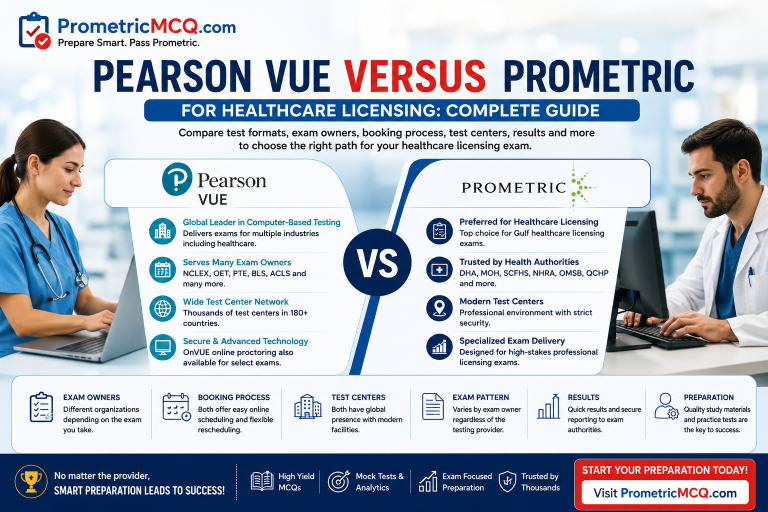
DOH works with Pearson VUE, not Prometric. Many nurses search for the "DOH Prometric exam" or "HAAD Prometric exam", but after DOH approves your application you pay the pre-booking fee in TAMM and the Pearson VUE booking link appears there. Our Pearson VUE vs Prometric guide explains the difference on exam day.
DOH vs DHA vs MOH: Which Exam Do You Need?
The UAE has three health regulators. DOH licenses Abu Dhabi, the DHA licenses Dubai, and the MOHAP covers the northern emirates. Apply to the authority where your job is. Clinical content overlaps heavily, so the same nursing knowledge prepares you for all three.
What the DOH Nursing Exam Tests
- Medical-surgical nursing: cardiac, respiratory, neurological, renal and endocrine care.
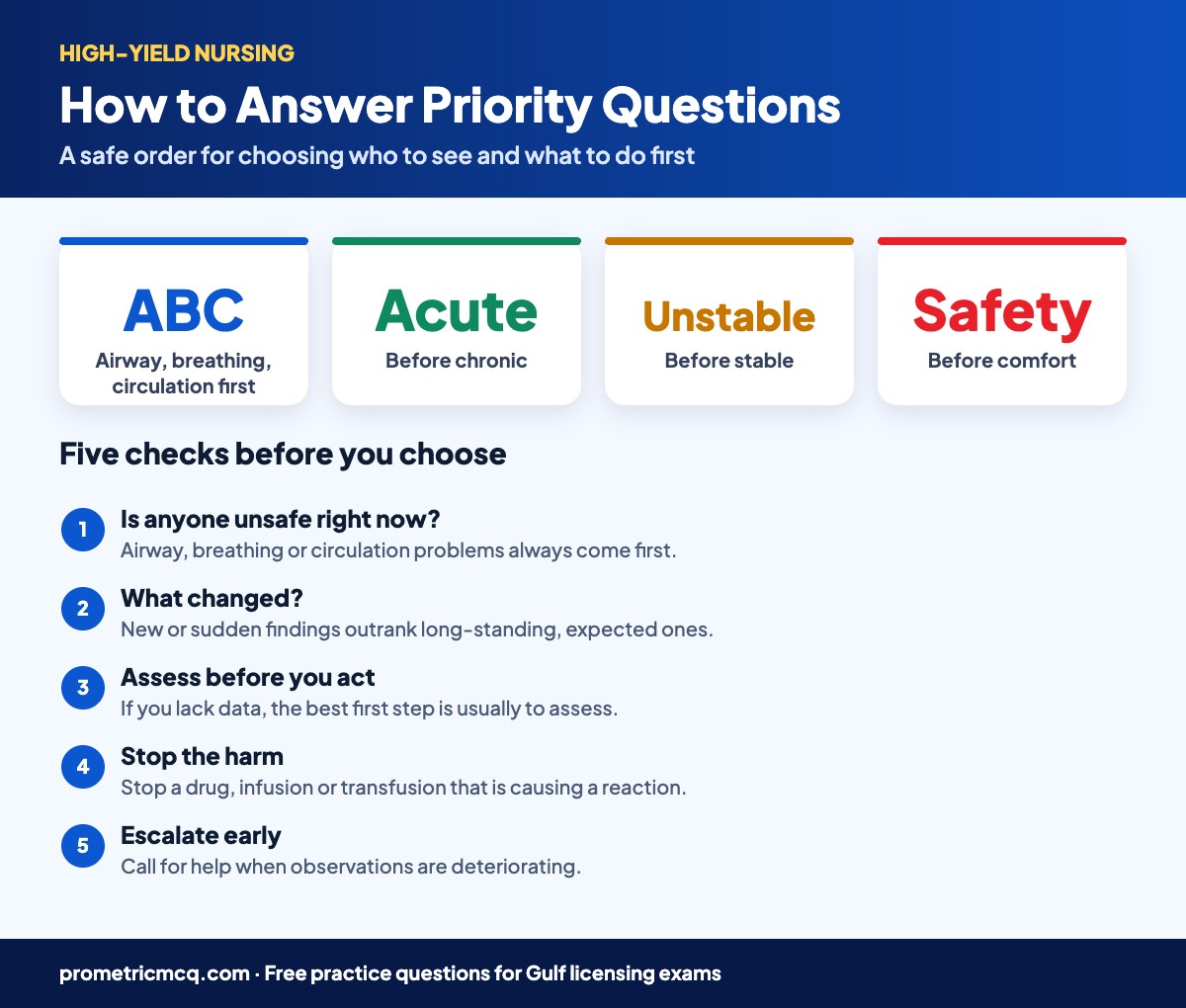
- Critical thinking and prioritisation: who to see first, what to do first, and when to escalate.
- Maternal, newborn and paediatric care.
- Pharmacology: high-alert medicines, antidotes and calculations.
- Safety and professional practice: infection control, patient identification, consent, documentation and UAE practice standards.
[pmcq_cta title="Preparing for the DOH (HAAD) exam?" text="Practise thousands of UAE-style nursing MCQs with explanations and timed mocks. Instant access after payment." button="Get the Nursing MCQs Package" url="https://www.prometricmcq.com/nursing-mcqs/"]
Free DOH Abu Dhabi Nursing Mock Test: 24 Case-Based Questions with Answers
These questions follow the style of UAE nursing licensing exams: a short clinical case, four plausible options and one best answer. They cover prioritisation, emergencies, medication safety, infection control and calculations. Choose Practice mode to see the explanation after each question, or Exam mode to answer all 24 against a 29-minute timer. DOH does not publish its pass mark on the pages we checked, so the 60% pass line here is a practice benchmark only.
[pmcq_quiz title="Free DOH Nursing Mock Test – 24 Questions" pass="60" minutes="29" button="Get Nursing MCQs – Instant Access" url="https://www.prometricmcq.com/nursing-mcqs/"]
Question 1
A nurse on a surgical ward receives handover on four patients. Which patient should she assess first?
- A. A 58-year-old 1 day after abdominal surgery who is newly restless with SpO2 88% on air
- B. A 70-year-old with a chronic leg ulcer asking for a dressing change
- C. A 45-year-old with diabetes whose pre-lunch glucose is 9.8 mmol/L
- D. A 30-year-old after appendicectomy asking for analgesia, pain 4/10
Answer: A
Explanation: New restlessness with low oxygen saturation after surgery suggests hypoxia, an airway and breathing problem that can deteriorate quickly. The others are stable: a routine dressing, a mildly raised glucose and moderate pain can safely wait a few minutes.
High-yield takeaway: Prioritise by ABC: an acute breathing problem comes before stable needs.
Question 2
A 66-year-old man with type 2 diabetes on insulin is sweaty, shaky and mildly confused before lunch. Capillary glucose is 2.8 mmol/L. He is alert enough to swallow safely. What should the nurse do first?
- A. Give his usual insulin dose with lunch
- B. Ask the doctor to prescribe IV 50% dextrose
- C. Give 15–20 g of fast-acting oral carbohydrate and recheck in 10–15 minutes
- D. Recheck the glucose in 1 hour
Answer: C
Explanation: A conscious patient who can swallow should be treated with fast-acting oral carbohydrate, such as glucose tablets or juice, then rechecked after 10–15 minutes and given a longer-acting snack once recovered. Insulin would worsen the hypoglycaemia, IV glucose is for patients who cannot swallow, and waiting an hour is unsafe.
High-yield takeaway: Conscious hypoglycaemia: fast-acting oral glucose, recheck in 10–15 minutes.
Question 3
A 74-year-old woman with chronic kidney disease has a serum potassium of 6.8 mmol/L. Her ECG shows tall, peaked T waves. Oral potassium chloride is charted for this morning. What is the nurse's priority?
- A. Give the potassium chloride as charted
- B. Attach a cardiac monitor, withhold potassium and escalate urgently
- C. Encourage potassium-rich foods such as bananas
- D. Recheck the potassium level tomorrow
Answer: B
Explanation: Severe hyperkalaemia with ECG changes can cause fatal arrhythmias. The nurse should withhold any potassium, place the patient on a cardiac monitor and escalate immediately so emergency treatment such as IV calcium can be given. The other options add potassium or delay care.
High-yield takeaway: Hyperkalaemia with ECG changes: monitor, stop potassium, escalate now.
Question 4
Fifteen minutes into a red cell transfusion, a 50-year-old man develops rigors, a temperature of 39.0 °C, low back pain and a fall in BP from 128/80 to 92/56 mmHg. What is the nurse's first action?
- A. Slow the transfusion and recheck observations in 15 minutes
- B. Give paracetamol and continue the transfusion
- C. Remove the cannula to stop any further blood entering
- D. Stop the transfusion and keep the IV line open with 0.9% sodium chloride
Answer: D
Explanation: Fever, rigors, back pain and hypotension early in a transfusion suggest an acute haemolytic reaction. Stop the transfusion immediately, keep IV access with saline through a new giving set, call the doctor and return the unit and giving set to the blood bank. Continuing or slowing it is dangerous, and IV access is needed for treatment.
High-yield takeaway: Suspected transfusion reaction: stop the blood, keep the IV line open, escalate.
Question 5
Five minutes after an IV antibiotic is started, a 38-year-old woman develops stridor, wheeze, widespread urticaria and a BP of 80/50 mmHg. The infusion has been stopped and help called. Which drug should be given first?
- A. IM adrenaline into the anterolateral thigh
- B. An oral antihistamine
- C. IV hydrocortisone
- D. A salbutamol nebuliser alone
Answer: A
Explanation: This is anaphylaxis, and IM adrenaline (0.5 mg for an adult, as 0.5 mL of 1 mg/mL) is the first-line, life-saving drug, repeated after 5 minutes if needed. Antihistamines and steroids are not first line and act too slowly, and salbutamol does not treat airway swelling or shock.
High-yield takeaway: Anaphylaxis: IM adrenaline first, everything else second.
Question 6
A nurse is about to give oral digoxin to a 78-year-old man with atrial fibrillation. His apical pulse, counted for a full minute, is 52/min. What should the nurse do?
- A. Give the dose and recheck the pulse in an hour
- B. Give half the dose
- C. Withhold the dose and report to the prescriber
- D. Give the dose with food to reduce side effects
Answer: C
Explanation: An apical pulse below 60/min in an adult is a common threshold for withholding digoxin and informing the prescriber, because bradycardia can signal toxicity. The nurse must not alter the dose independently, and food does not change the risk.
High-yield takeaway: Check the apical pulse before digoxin; withhold and report if below 60/min.
Question 7
A 69-year-old woman taking warfarin for atrial fibrillation has an INR of 6.2. She has no bleeding and her observations are normal. What should the nurse do?
- A. Give tonight's warfarin dose as scheduled
- B. Withhold the warfarin and inform the prescriber
- C. Give IV vitamin K without waiting for an order
- D. Double the next dose to keep the INR stable
Answer: B
Explanation: An INR well above the usual target raises the risk of bleeding, so the warfarin should be withheld and the prescriber informed for a management plan, which may include vitamin K. Nurses do not give vitamin K without a prescription, and continuing or increasing warfarin is unsafe.
High-yield takeaway: High INR: withhold warfarin, check for bleeding, inform the prescriber.
Question 8
A 60-year-old man on an IV unfractionated heparin infusion develops heavy bleeding from his surgical wound. The infusion has been stopped. Which antidote should the nurse prepare?
- A. Vitamin K
- B. Naloxone
- C. Flumazenil
- D. Protamine sulfate
Answer: D
Explanation: Protamine sulfate reverses unfractionated heparin. Vitamin K reverses warfarin, naloxone reverses opioids and flumazenil reverses benzodiazepines.
High-yield takeaway: Heparin: protamine; warfarin: vitamin K; opioids: naloxone.
Question 9
A 55-year-old woman using a morphine PCA after surgery is very drowsy and hard to rouse. Her respiratory rate is 7/min, pupils are pinpoint and SpO2 is 89% on air. What is the priority?
- A. Stop the PCA, support her breathing and give naloxone as prescribed
- B. Encourage deep breathing and leave the PCA running
- C. Give flumazenil to reverse sedation
- D. Increase the PCA dose because she may be in pain
Answer: A
Explanation: Drowsiness, a slow respiratory rate and pinpoint pupils indicate opioid toxicity. Stop the opioid, open the airway, give oxygen and support ventilation, give naloxone per protocol and call for help. Flumazenil reverses benzodiazepines, not opioids, and continuing or increasing the PCA is dangerous.
High-yield takeaway: Opioid toxicity: stop the opioid, support breathing, give naloxone.
Question 10
A 72-year-old man with a urinary tract infection has a temperature of 38.9 °C, pulse 118/min, BP 86/50 mmHg, respiratory rate 26/min and new confusion. What is the priority?
- A. Start oral antibiotics and recheck in 4 hours
- B. Send a urine dipstick and wait for culture
- C. Escalate as sepsis: blood cultures, IV antibiotics and IV fluids within the hour
- D. Give paracetamol and encourage oral fluids
Answer: C
Explanation: Hypotension, tachycardia, tachypnoea and confusion with a known infection indicate sepsis. Escalate urgently, take blood cultures and lactate, give IV fluids and start broad-spectrum IV antibiotics within the first hour. Oral treatment, waiting for results or treating the fever alone delays life-saving care.
High-yield takeaway: Sepsis: escalate and deliver cultures, IV antibiotics and fluids within 1 hour.
Question 11
A 68-year-old woman on day 3 after a hip replacement suddenly becomes breathless with sharp chest pain on breathing in. Pulse 120/min, SpO2 89% on air, BP 118/74 mmHg. What should the nurse do first?
- A. Walk her to the bathroom to see if she improves
- B. Sit her upright, give oxygen and call for urgent medical review
- C. Massage her calf to relieve any cramp
- D. Give oral analgesia and recheck in 1 hour
Answer: B
Explanation: Sudden breathlessness, pleuritic pain, tachycardia and hypoxia after orthopaedic surgery suggest pulmonary embolism. Sit her up, give oxygen to correct hypoxia and escalate urgently. Mobilising her or massaging the calf could dislodge further clot, and waiting delays treatment.
High-yield takeaway: Post-op sudden breathlessness and hypoxia: think PE; oxygen and urgent review.
Question 12
A 64-year-old man suddenly developed right arm weakness and slurred speech 40 minutes ago. His glucose is 6.2 mmol/L and BP 168/94 mmHg. What is the most appropriate nursing action?
- A. Give oral aspirin immediately
- B. Offer a glass of water to keep him hydrated
- C. Wait 1 hour to see whether the symptoms resolve
- D. Activate the stroke pathway for urgent imaging, record onset time and keep him nil by mouth
Answer: D
Explanation: Sudden focal weakness and speech disturbance suggest acute stroke, which is time-critical. Activate the stroke pathway for urgent brain imaging, document the time last seen well and keep him nil by mouth until a swallow screen. Aspirin must wait until haemorrhage is excluded, drinks risk aspiration, and waiting may cost eligibility for treatment.
High-yield takeaway: Stroke: time is brain; urgent imaging, onset time, nil by mouth.
Question 13
A 40-year-old man is admitted after a fall. He opens his eyes when spoken to, is confused about where he is, and localises to a painful stimulus. What is his Glasgow Coma Scale score?
- A. 11
- B. 12
- C. 13
- D. 10
Answer: B
Explanation: Eyes opening to voice scores 3, confused speech scores 4 and localising to pain scores 5, giving 12 out of 15. Record each component as well as the total so that changes can be tracked.
High-yield takeaway: GCS = eyes (4) + verbal (5) + motor (6); record each part.
Question 14
A 30-year-old man is being observed after a head injury. Over 2 hours his BP rises from 130/80 to 182/90 mmHg, his pulse falls from 84 to 48/min and his breathing becomes irregular. What do these changes indicate?
- A. Hypovolaemic shock
- B. A post-traumatic fever
- C. Rising intracranial pressure
- D. Diabetes insipidus
Answer: C
Explanation: Rising blood pressure with bradycardia and irregular breathing (Cushing's triad) is a late sign of raised intracranial pressure and possible brain herniation, so escalate immediately. Shock causes low BP and tachycardia, fever does not cause this pattern, and diabetes insipidus causes polyuria.
High-yield takeaway: Head injury plus high BP, low pulse and irregular breathing: raised ICP; escalate now.
Question 15
A 22-year-old woman with type 1 diabetes has vomiting and abdominal pain. Glucose is 28 mmol/L, blood ketones 5.2 mmol/L, venous pH 7.10 and potassium 5.0 mmol/L. BP 98/60 mmHg. Which treatment is started first?
- A. An IV insulin bolus before any fluids
- B. IV 0.9% sodium chloride
- C. Oral fluids only
- D. IV sodium bicarbonate
Answer: B
Explanation: Diabetic ketoacidosis causes severe dehydration, so IV 0.9% sodium chloride is started first, followed by a fixed-rate insulin infusion and careful potassium monitoring. Insulin without fluids can worsen hypotension and lower potassium dangerously, oral fluids are inadequate, and bicarbonate is not routine.
High-yield takeaway: DKA: fluids first, then fixed-rate insulin, with close potassium checks.
Question 16
An adult has partial-thickness burns covering the whole of the right arm and the entire front of the trunk. Using the rule of nines, what percentage of total body surface area is burned?
- A. 18%
- B. 36%
- C. 27%
- D. 9%
Answer: C
Explanation: In adults, each arm is 9% and the front of the trunk is 18%, giving 27%. The rule of nines guides fluid resuscitation and referral; superficial (erythema-only) burns are not included in the calculation.
High-yield takeaway: Adult rule of nines: arm 9%, front of trunk 18%, back 18%, each leg 18%.
Question 17
A 45-year-old man has an underwater-seal chest drain inserted for a pneumothorax. Which finding shows that the drain system is working as expected?
- A. The water level in the tube rises and falls with breathing
- B. The drainage bottle is kept on the bed above chest level
- C. The tube is routinely clamped when he walks to the toilet
- D. There is no movement of the water level at any time
Answer: A
Explanation: Swinging (tidalling) of the water level with respiration shows the drain is patent and in the pleural space. The bottle must stay below chest level to prevent backflow, routine clamping risks tension pneumothorax, and absent swinging may mean a blocked or kinked tube or lung re-expansion, which needs review.
High-yield takeaway: Chest drain: bottle below the chest, look for swinging, do not clamp routinely.
Question 18
A 76-year-old woman has profuse diarrhoea and a positive test for Clostridioides difficile. Which infection-control measure is most appropriate?
- A. Alcohol hand rub only, as it kills all organisms
- B. Standard precautions with no gloves or apron
- C. A single room with contact precautions and hand washing with soap and water
- D. Airborne precautions with an N95 respirator only
Answer: C
Explanation: C. difficile spores are not reliably killed by alcohol hand rub, so hands must be washed with soap and water. She needs a single room (ideally with its own toilet), gloves and apron, and environmental cleaning with a sporicidal agent. It is spread by contact, not through the air.
High-yield takeaway: C. difficile: single room, contact precautions, soap and water, not alcohol gel.
Question 19
A 34-year-old man has a 3-week cough, night sweats, weight loss and haemoptysis. Pulmonary tuberculosis is suspected. Which precautions should be used?
- A. Droplet precautions with a surgical mask for staff
- B. Airborne precautions in a negative-pressure room with an FFP2/N95 respirator
- C. Standard precautions only
- D. Contact precautions with gloves and apron
Answer: B
Explanation: Pulmonary TB spreads by airborne droplet nuclei, so the patient needs an airborne-isolation (negative-pressure) room where available and staff need a fit-tested respirator. A surgical mask is worn by the patient when outside the room. Droplet, contact or standard precautions alone are not enough.
High-yield takeaway: Suspected pulmonary TB: airborne precautions and a fit-tested respirator.
Question 20
During a skin check, a nurse finds an area of intact skin over the sacrum of an 82-year-old bedbound woman that is red and does not blanch when pressed. How is this pressure injury classified?
- A. Stage (category) 3
- B. Unstageable
- C. Stage (category) 2
- D. Stage (category) 1
Answer: D
Explanation: Intact skin with non-blanchable redness is a stage 1 pressure injury. Stage 2 involves partial-thickness skin loss such as a blister or shallow ulcer, stage 3 is full-thickness skin loss, and unstageable means the base is hidden by slough or eschar. Relieve pressure and reposition regularly.
High-yield takeaway: Non-blanchable redness on intact skin: stage 1; relieve pressure now.
Question 21
On the day after a total thyroidectomy, a 42-year-old woman reports tingling around her mouth and in her fingers. When the BP cuff is inflated, her hand goes into spasm. What is the most likely cause?
- A. Hypocalcaemia from parathyroid injury
- B. Hypercalcaemia
- C. Hypokalaemia
- D. Thyroid storm
Answer: A
Explanation: Perioral tingling and carpal spasm with the BP cuff (Trousseau's sign) after thyroid surgery suggest hypocalcaemia from parathyroid damage or removal. Check calcium urgently and escalate, as IV calcium may be needed. Hypercalcaemia and hypokalaemia do not cause tetany, and thyroid storm causes fever and tachycardia.
High-yield takeaway: Tingling and spasm after thyroidectomy: check calcium urgently.
Question 22
A 79-year-old man with heart failure is receiving IV fluids. He becomes breathless with fine crackles at both lung bases, a raised JVP and SpO2 90% on air. What should the nurse do first?
- A. Increase the IV rate to maintain hydration
- B. Lie him flat to rest
- C. Encourage extra oral fluids
- D. Stop the infusion, sit him upright, give oxygen and escalate
Answer: D
Explanation: These signs suggest fluid overload and pulmonary oedema. Stop the infusion, sit him upright to ease breathing, give oxygen and call the doctor, who may prescribe a diuretic. More fluid worsens it, and lying flat increases breathlessness.
High-yield takeaway: Fluid overload: stop fluids, sit up, oxygen, escalate.
Question 23
A 70-year-old woman with swallowing difficulty is prescribed paracetamol 1 g orally. The stock is paracetamol oral suspension 250 mg in 5 mL. What volume should the nurse give?
- A. 20 mL
- B. 10 mL
- C. 5 mL
- D. 40 mL
Answer: A
Explanation: Volume = (dose required ÷ stock strength) × stock volume = (1,000 mg ÷ 250 mg) × 5 mL = 20 mL. Convert grams to milligrams first, and check the total daily dose and any liver risk factors before giving it.
High-yield takeaway: Volume = what you want ÷ what you have × volume it comes in.
Question 24
A doctor prescribes 1,000 mL of 0.9% sodium chloride to run over 8 hours by infusion pump. At what rate should the nurse set the pump?
- A. 100 mL/h
- B. 150 mL/h
- C. 80 mL/h
- D. 125 mL/h
Answer: D
Explanation: Rate = volume ÷ time = 1,000 mL ÷ 8 h = 125 mL/h. Check the calculation independently and monitor the patient for signs of fluid overload during the infusion.
High-yield takeaway: Pump rate (mL/h) = total volume ÷ hours.
[/pmcq_quiz]
How to Score Your Mock Test
| Score (out of 24) | What it means | Next step |
|---|---|---|
| 20–24 | Strong clinical reasoning | Move to full timed mocks. |
| 15–19 | Borderline | Study the topic behind every wrong answer, then retake in Exam mode. |
| 0–14 | Needs structured revision | Follow the study plan below before more mocks. |
Look at the pattern of your mistakes as well as the score. Errors in priority and safety questions usually mean you need a better answering method, not more facts; errors in drug and calculation questions need focused practice.
DOH Nursing Licence: Step by Step
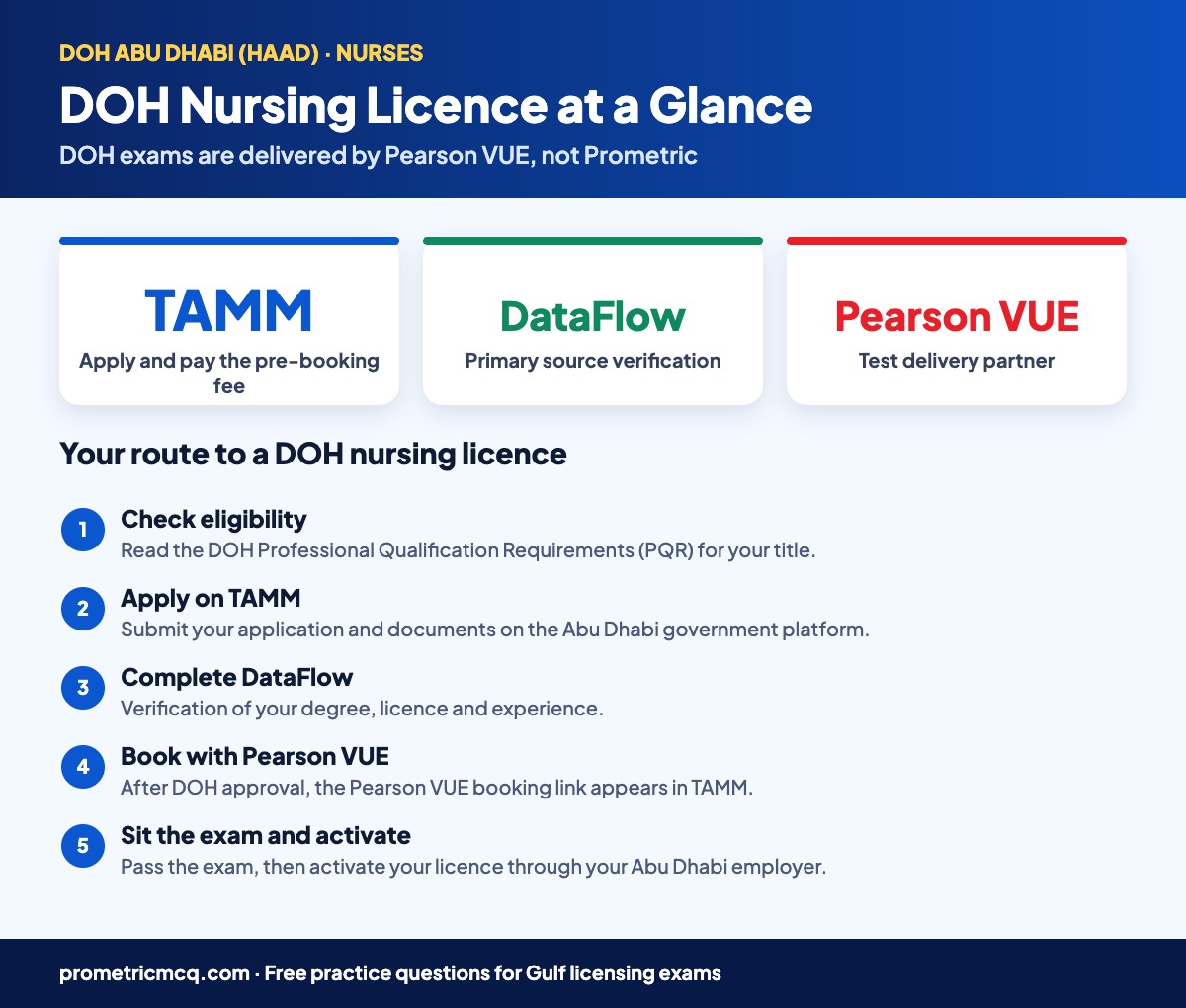
- Check eligibility in DOH's Professional Qualification Requirements (PQR): qualification, registration and recent experience.
- Apply on TAMM with UAE Pass and upload your documents.
- Complete DataFlow verification of your degree, licence and experience. Our DataFlow guide lists the documents and common delays.
- Book and sit the exam at a Pearson VUE centre once DOH approves you.
- Receive your licence eligibility and activate the licence through your Abu Dhabi employer.
[pmcq_cta title="Practise the way the DOH exam feels" text="Timed mocks, explained answers and a progress tracker, on any device." button="Start Practising Now" url="https://www.prometricmcq.com/nursing-mcqs/"]
3-Week Study Plan for the DOH Nursing Exam
- Week 1: safety, infection control, patient identification, pharmacology and calculations.
- Week 2: adult health by system, with ABG and electrolyte practice.
- Week 3: maternal, newborn and paediatric care, then two full timed mocks.
See also our Pearson VUE vs Prometric guide, the free DHA nursing mock test and the DHA vs MOH comparison for nurses.
FAQs: DOH Abu Dhabi Nursing Exam
Is the DOH exam the same as the HAAD exam?
Yes. HAAD (Health Authority – Abu Dhabi) is the old name of the Department of Health – Abu Dhabi, so candidates still call it the HAAD exam.
Is the DOH nursing exam Prometric or Pearson VUE?
DOH uses Pearson VUE, not Prometric. After DOH approval you pay the pre-booking fee in TAMM, and the Pearson VUE booking link appears there.
Where do I apply for a DOH nursing licence?
Applications go through the Abu Dhabi government platform TAMM, using UAE Pass, followed by DataFlow verification of your documents.
Can I use my DHA or MOH licence in Abu Dhabi?
Each authority issues its own licence. Transfers between authorities have their own rules, so check the current DOH requirements before applying.
Are these the real DOH exam questions?
No. Real exam questions are confidential. These questions are written by PrometricMCQ to match the style of UAE nursing licensing exams.
What is the DOH nursing exam pass mark?
DOH does not publish its pass mark on the pages we checked. Confirm the current requirement in your TAMM application or with DOH, and aim to score well above 60% in practice.
How many attempts do I get at the DOH exam?
Attempt rules are not published on the DOH pages we could check. Confirm them with DOH before booking, and treat every attempt as if it were your last.
Which topics should DOH nursing candidates prioritise?
Prioritisation, medication safety, infection control and adult medical-surgical care. Practise calculations until they are quick and accurate.
Do I need DataFlow before the DOH exam?
DOH requires primary source verification of your qualifications and experience, usually through DataFlow. Start it early because delays are common.
How long should I prepare for the DOH nursing exam?
It depends on your experience and how recently you studied. Use a full mock early to find your gaps, then plan your revision around them.
Conclusion
The DOH nursing exam rewards safe priorities, solid pharmacology and calm time management. Use this free mock to measure where you stand, follow the plan and practise full timed mocks before booking your Pearson VUE date.
[pmcq_cta title="Ready to pass the DOH Abu Dhabi nursing exam?" text="Instant access to thousands of nursing MCQs with explanations and timed mocks." button="Get Nursing MCQs – Instant Access" url="https://www.prometricmcq.com/nursing-mcqs/"]

The PrometricMCQ editorial team writes independent guides for healthcare professionals preparing for Gulf licensing exams. Editorial policy