


In this guide
- DHA Midwifery Exam: Key Facts
- What the DHA Midwifery Exam Focuses On
- Free DHA Midwife Mock Test: 20 Case-Based Questions with Answers
- How to Score Your Mock Test
- 3-Week Study Plan for the DHA Midwife Exam
- Common Mistakes in DHA Midwifery Questions
- FAQs: DHA Midwife Exam
- Conclusion: Make Emergency Drills Automatic
Midwives who want to work in Dubai need a Dubai Health Authority (DHA) licence and must pass the DHA licensing assessment, often called the DHA Prometric exam. This free DHA midwife mock test gives you 20 case-based questions on labour, obstetric emergencies, postnatal and newborn care, with answers and explanations for every option.
Reviewed by Dr Samer Hadad · Last reviewed 4 November 2026. DHA sets the exam format and pass rules; confirm them in your DHA licensing account before booking.
DHA Midwifery Exam: Key Facts
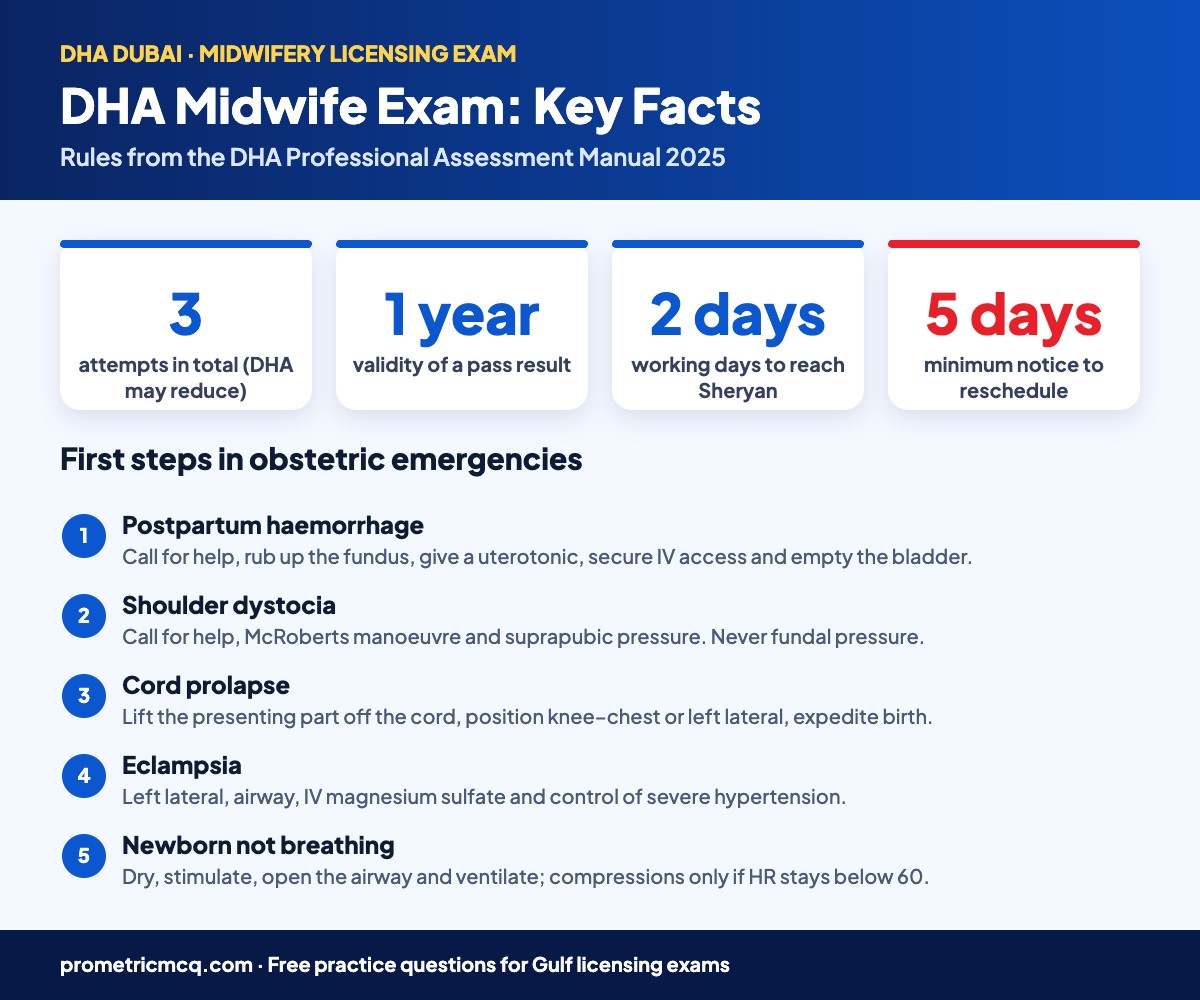
The rules below come from the DHA Professional Assessment Manual 2025. DHA does not publish the number of questions or a fixed pass percentage for each category, so check your own exam details in Sheryan before you book.
| Item | What DHA states |
|---|---|
| Format | Computer-based test delivered by Prometric at test centres |
| Eligibility | Sheryan generates a DHA CBT Eligibility ID; you then book and pay by card on the Prometric DHA page |
| Pass mark | No single published percentage; the result is based on correct answers and domain weighting |
| Attempts | 3 attempts in total (DHA may reduce this); after 3 fails, you cannot reapply for 2 years |
| Results | Reach Sheryan within 2 working days; a pass is valid for 1 year |
| Rescheduling | At least 5 calendar days before the exam (Prometric fee applies); fees are non-refundable, including for no-shows |
On exam day, arrive 30 minutes early with a passport that matches the name in Sheryan exactly; there is a fingerprint check. If your names do not match, contact DHA at least 5 days before the exam. For the full application route, see our DHA exam eligibility guide and the DHA DataFlow guide.
What the DHA Midwifery Exam Focuses On
| Area | Typical topics |
|---|---|
| Antenatal care | Screening, gestational diabetes, rhesus status, pre-eclampsia, antepartum haemorrhage |
| Labour and birth | Stages of labour, CTG interpretation, third-stage management, preterm labour |
| Obstetric emergencies | Postpartum haemorrhage, shoulder dystocia, cord prolapse, eclampsia, abruption |
| Postnatal and newborn | Sepsis, breastfeeding problems, perinatal mental health, newborn resuscitation, jaundice |
| Professional practice | Consent, informed refusal, documentation and escalation |
Most questions describe a woman or baby and ask for the priority action. The safest answer usually calls for help and treats the immediate threat first, then escalates to the obstetric or neonatal team.
[pmcq_cta title="DHA Midwifery MCQs with explanations" text="Practise DHA-style midwifery questions in timed mocks. Instant access after payment." button="Get DHA Midwifery MCQs" url="https://www.prometricmcq.com/dha-midwifery-nurse-exam-mcqs/"]
Free DHA Midwife Mock Test: 20 Case-Based Questions with Answers
These are original questions written in the style of the DHA midwifery exam. Allow 24 minutes for all 20 questions. Commit to one answer before you check, then read every explanation, because the reasons the wrong options are wrong are often tested too. Aim for at least 12 out of 20 (60%) as a working benchmark; DHA itself does not publish a single pass percentage.
[pmcq_quiz title="Free DHA Midwife Mock Test – 20 Questions" pass="60" minutes="24" button="Get DHA Midwifery MCQs" url="https://www.prometricmcq.com/dha-midwifery-nurse-exam-mcqs/"]
Question 1
A 30-year-old woman had a vaginal birth 20 minutes ago and the placenta is complete. She now has heavy, continuous bleeding, with an estimated loss of 900 mL. The uterus is soft and above the umbilicus. Pulse 118/min, BP 96/60 mmHg. What is the midwife's immediate action?
- A. Prepare her for a hysterectomy
- B. Wait 30 minutes to see if bleeding settles
- C. Call for help, rub up the fundus and give a uterotonic
- D. Give oral iron and recheck her Hb tomorrow
Answer: C
Explanation: Uterine atony is the commonest cause of postpartum haemorrhage, and the first steps are to call for help, massage the fundus to stimulate a contraction and give a uterotonic such as oxytocin, while securing IV access and emptying the bladder. Waiting allows life-threatening blood loss. Surgery is a later step if medical measures fail, and oral iron does nothing for active bleeding.
High-yield takeaway: PPH with a soft uterus: call for help, rub up a contraction and give a uterotonic.
Question 2
During a vaginal birth, the baby's head delivers but then retracts against the perineum (the "turtle sign"), and the shoulders do not deliver with the next contraction and gentle traction. The midwife has called for help. What is the first manoeuvre?
- A. McRoberts manoeuvre, with suprapubic pressure if needed
- B. Firm fundal pressure on the uterus
- C. Strong downward lateral traction on the head
- D. Immediately cut the umbilical cord
Answer: A
Explanation: Shoulder dystocia is managed by calling for help and performing McRoberts manoeuvre (hyperflexing the mother's hips onto her abdomen), with suprapubic pressure to rotate the anterior shoulder. Fundal pressure worsens impaction and risks uterine rupture. Excessive or lateral traction causes brachial plexus injury, and the cord should not be cut before the body is delivered.
High-yield takeaway: Shoulder dystocia: help, McRoberts and suprapubic pressure; never fundal pressure.
Question 3
A woman at 39 weeks in labour has an artificial rupture of membranes with the cervix 6 cm dilated. Loops of cord are now visible at the introitus and the fetal heart rate drops to 80 bpm. What is the most appropriate action?
- A. Push the cord back into the uterus and continue labour
- B. Ask her to push to speed up the birth
- C. Wait until full dilatation, then assess again
- D. Call for help, lift the presenting part off the cord and prepare for urgent birth
Answer: D
Explanation: Cord prolapse with fetal bradycardia is an obstetric emergency. The midwife calls for help, relieves compression by manually elevating the presenting part or positioning the woman knee–chest or left lateral with her head down, keeps handling of the cord to a minimum and prepares for the quickest safe birth, usually a category 1 caesarean at this dilatation. Replacing the cord, pushing at 6 cm or waiting are all unsafe.
High-yield takeaway: Cord prolapse: relieve pressure on the cord and expedite birth; do not handle or replace it.
Question 4
A 24-year-old at 36 weeks with pre-eclampsia has a generalised tonic-clonic seizure on the antenatal ward. Help has been called, she has been placed in the left lateral position and her airway is supported. Which drug should be given to control the seizure and prevent further seizures?
- A. IV diazepam as a continuous infusion
- B. IV magnesium sulfate loading dose, then infusion
- C. IV phenytoin loading dose
- D. Oral labetalol 200 mg
Answer: B
Explanation: Magnesium sulfate is the drug of choice for eclampsia: a 4 g IV loading dose over 5–15 minutes, followed by a maintenance infusion, with a further dose for recurrent seizures. It is more effective than diazepam or phenytoin at preventing further seizures. Labetalol treats severe hypertension, which must also be controlled, but it does not stop seizures.
High-yield takeaway: Eclampsia: magnesium sulfate is first-line for seizures; control BP separately.
Question 5
A woman with severe pre-eclampsia has been on a magnesium sulfate infusion for 10 hours. She is now drowsy, her respiratory rate is 9/min and her patellar reflexes are absent. Urine output has been 15 mL/h for 4 hours. What is the most appropriate action?
- A. Increase the infusion rate to prevent eclampsia
- B. Give IV naloxone 400 micrograms
- C. Stop the infusion and prepare IV calcium gluconate
- D. Continue the infusion and recheck reflexes in 4 hours
Answer: C
Explanation: Loss of reflexes, respiratory depression and drowsiness are signs of magnesium toxicity, made more likely by oliguria because magnesium is excreted by the kidneys. Stop the infusion, call for help, support breathing and give the antidote, 10 mL of 10% calcium gluconate IV slowly. Increasing or continuing the infusion worsens toxicity, and naloxone reverses opioids, not magnesium.
High-yield takeaway: Magnesium toxicity: stop the infusion and give IV calcium gluconate.
Question 6
A woman at 40 weeks is in active labour on an oxytocin infusion. The CTG shows a baseline of 150 bpm, variability below 5 bpm for 50 minutes and late decelerations with over half of contractions. Her BP is 118/72 mmHg. What is the most appropriate action?
- A. Stop the oxytocin, reposition her and escalate urgently to the obstetrician
- B. Increase the oxytocin to shorten the labour
- C. Continue routine monitoring and review in 1 hour
- D. Record the CTG as normal and continue care
Answer: A
Explanation: Recurrent late decelerations with reduced variability are a pathological (abnormal) CTG suggesting fetal hypoxia. The midwife should start intrauterine resuscitation (stop oxytocin, move her to the left lateral position, correct hypotension if present) and escalate immediately so the obstetrician can decide on further assessment or expedited birth. Increasing oxytocin worsens hypoxia, and routine monitoring ignores a dangerous trace.
High-yield takeaway: Late decelerations plus reduced variability: intrauterine resuscitation and urgent escalation.
Question 7
A 31-year-old woman with gestational hypertension (BP 152/100 mmHg) has just given birth vaginally. The midwife is about to manage the third stage actively. Which uterotonic is most appropriate?
- A. Ergometrine 500 micrograms IM
- B. Ergometrine–oxytocin combination IM
- C. No uterotonic, because she is hypertensive
- D. Oxytocin 10 IU IM
Answer: D
Explanation: Oxytocin 10 IU IM is the recommended uterotonic for active management of the third stage. Ergometrine, alone or combined with oxytocin, causes vasoconstriction and can trigger a dangerous rise in BP, so it is avoided in hypertension and pre-eclampsia. Withholding a uterotonic increases the risk of postpartum haemorrhage.
High-yield takeaway: Third stage with hypertension: oxytocin, never ergometrine.
Question 8
Four days after an emergency caesarean section, a woman has fever and rigors. Temperature 38.7 °C, pulse 120/min, BP 98/58 mmHg, respiratory rate 24/min. Her lochia is offensive and her uterus is tender. What is the most appropriate management?
- A. Oral paracetamol and review at the next postnatal visit
- B. Escalate as sepsis: blood cultures and IV antibiotics within 1 hour
- C. Send a high vaginal swab and wait for the result before treating
- D. Advise her to stop breastfeeding until the fever settles
Answer: B
Explanation: Fever, tachycardia, tachypnoea and borderline hypotension after caesarean birth with offensive lochia suggest maternal sepsis from endometritis. She needs urgent escalation, blood cultures and broad-spectrum IV antibiotics within the first hour, fluids and close monitoring. Paracetamol only masks fever, waiting for swab results delays treatment, and breastfeeding can usually continue.
High-yield takeaway: Postpartum fever with abnormal observations is sepsis until proven otherwise: treat within 1 hour.
Question 9
A term baby is born pale and floppy and is not breathing. After drying, stimulation and keeping her warm for 30 seconds, she is still not breathing and her heart rate is 80 bpm. What is the next step?
- A. Open the airway and start bag-mask ventilation (inflation breaths) in air
- B. Start chest compressions at a ratio of 3:1
- C. Give IV adrenaline through an umbilical line
- D. Continue drying and stimulating for another 2 minutes
Answer: A
Explanation: In newborn life support, a baby who is not breathing after drying and stimulation needs the airway opened and effective lung inflation with bag-mask ventilation, starting in air for a term baby. Most newborns respond to ventilation alone. Chest compressions start only if the heart rate stays very low (below 60 bpm) despite effective ventilation, and adrenaline comes later still. Prolonged stimulation wastes vital time.
High-yield takeaway: Newborn resuscitation: ventilation is the priority; compressions only if HR stays below 60 with good ventilation.
Question 10
A breastfed baby is noticed to be jaundiced at 18 hours of age. He is feeding well, temperature 36.8 °C. The mother is blood group O positive. What is the most appropriate action?
- A. Reassure the parents that this is physiological jaundice
- B. Advise placing the baby in sunlight at home
- C. Arrange an urgent serum bilirubin and medical review
- D. Stop breastfeeding and give formula for 48 hours
Answer: C
Explanation: Jaundice in the first 24 hours of life is always pathological until proven otherwise (for example haemolysis from ABO incompatibility, which is possible with a group O mother) and needs an urgent serum bilirubin and medical review. Physiological jaundice appears after 24 hours. Sunlight is not a safe treatment, and stopping breastfeeding is not indicated.
High-yield takeaway: Jaundice under 24 hours old is never physiological: measure serum bilirubin urgently.
Question 11
On day 3 after birth, a first-time mother says breastfeeding is very painful and both nipples are cracked. The baby feeds for short periods and seems unsettled. Temperature 36.9 °C, and both breasts are soft with no redness. What is the most appropriate first action?
- A. Advise her to switch to formula until the nipples heal
- B. Start oral antibiotics for a presumed infection
- C. Limit each feed to 5 minutes per side
- D. Observe a full feed and help correct positioning and attachment
Answer: D
Explanation: Sore, cracked nipples in the first days are most often caused by poor positioning and attachment, so the midwife should watch a whole feed and support a deep latch. Stopping breastfeeding is not needed and reduces milk supply. There are no signs of infection, and limiting feed times does not fix attachment and can lead to engorgement and poor weight gain.
High-yield takeaway: Nipple pain in early breastfeeding: observe a feed and fix attachment first.
Question 12
Ten days after birth, a breastfeeding woman has a painful, red, wedge-shaped area on her left breast and flu-like symptoms. Temperature 38.2 °C, pulse 92/min. There is no fluctuant mass. What is the most appropriate advice?
- A. Stop feeding from the left breast until it settles
- B. Continue breastfeeding or expressing from the affected breast, with analgesia
- C. Apply a tight breast binder to reduce milk production
- D. Stop breastfeeding completely and start formula
Answer: B
Explanation: Mastitis is managed by effective milk removal: continuing to breastfeed or express from the affected side, with rest, fluids and analgesia, and antibiotics if symptoms do not improve within 12–24 hours of effective milk removal or she becomes more unwell. Stopping feeding from that breast causes milk stasis and raises the risk of abscess. Binding the breasts or stopping breastfeeding is unnecessary and can worsen the condition. A fluctuant mass would suggest an abscess needing ultrasound.
High-yield takeaway: Mastitis: keep the milk flowing from the affected breast; it is safe for the baby.
Question 13
A 33-year-old woman books at 10 weeks in her second pregnancy. Her BMI is 34 kg/m² and her first baby weighed 4.6 kg. She has never had diabetes. Which test is most appropriate to screen for gestational diabetes?
- A. A 75 g oral glucose tolerance test at 24–28 weeks
- B. Urine dipstick for glucose at every visit only
- C. HbA1c at 36 weeks of pregnancy
- D. No test, because she has no symptoms
Answer: A
Explanation: Obesity and a previous macrosomic baby are risk factors for gestational diabetes, and the standard screening test is a 75 g oral glucose tolerance test at 24–28 weeks. Urine glucose is unreliable in pregnancy. HbA1c is not a valid screening test for gestational diabetes and 36 weeks is too late to act, while gestational diabetes is usually symptom-free.
High-yield takeaway: Screen for gestational diabetes with a 75 g OGTT at 24–28 weeks.
Question 14
A 27-year-old woman in her first pregnancy is RhD negative. At 28 weeks, her antibody screen is negative and she has had no bleeding or trauma. The baby's father is RhD positive. What should the midwife offer?
- A. Anti-D only if she has vaginal bleeding later in pregnancy
- B. No anti-D, because this is her first pregnancy
- C. Routine antenatal anti-D prophylaxis
- D. Anti-D only after the birth, whatever the baby's group
Answer: C
Explanation: RhD-negative women who are not sensitised are offered routine antenatal anti-D prophylaxis in the third trimester, because silent fetomaternal haemorrhage can cause sensitisation even without a recognised event. Extra anti-D is also given after sensitising events and after birth if the baby is RhD positive. Sensitisation in a first pregnancy affects future babies, so first pregnancies are not exempt.
High-yield takeaway: Unsensitised RhD-negative women: routine antenatal anti-D, plus doses after sensitising events.
Question 15
A woman at 33 weeks has sudden painless, bright red vaginal bleeding of about 200 mL. Her uterus is soft and non-tender, and the fetus is in a breech presentation with a high presenting part. Fetal heart rate 145 bpm. Which is the most likely diagnosis?
- A. Placental abruption
- B. Placenta praevia
- C. Uterine rupture
- D. A cervical ectropion
Answer: B
Explanation: Painless bright red bleeding with a soft, non-tender uterus and a high or abnormal presenting part is typical of placenta praevia. A digital vaginal examination must be avoided until ultrasound has shown where the placenta lies. Abruption usually causes pain and a tense, tender uterus; uterine rupture causes pain and fetal compromise, usually in labour; an ectropion does not cause bleeding of this volume.
High-yield takeaway: Painless bleeding plus soft uterus suggests praevia: no digital vaginal examination.
Question 16
One hour after a vaginal birth with active management of the third stage, the placenta has not delivered. The woman's blood loss is 300 mL, the uterus is contracted and her observations are stable. What is the most appropriate action?
- A. Apply fundal pressure to push the placenta out
- B. Pull firmly on the cord without waiting for a contraction
- C. Leave the placenta in place until the next morning
- D. Secure IV access and arrange manual removal in theatre
Answer: D
Explanation: A placenta not delivered within the expected time after active management is a retained placenta, which raises the risk of haemorrhage and infection. The midwife should secure IV access, take bloods, inform the obstetrician and prepare for manual removal under anaesthesia. Fundal pressure and uncontrolled cord traction risk uterine inversion or cord snapping, and leaving it overnight is unsafe.
High-yield takeaway: Retained placenta: IV access, escalate and manual removal; never force it.
Question 17
Five days after birth, a 29-year-old woman's partner says she has not slept for 2 nights, is talking rapidly and believes the baby has been swapped. She seems confused and is hearing voices. She has no previous mental illness. What is the most appropriate action?
- A. Reassure them that these are the "baby blues"
- B. Give sleep hygiene advice and review in 2 weeks
- C. Arrange urgent same-day psychiatric assessment
- D. Advise her partner to take over all night feeds only
Answer: C
Explanation: Sudden confusion, delusions and hallucinations in the first weeks after birth suggest postpartum psychosis, a psychiatric emergency with risk to mother and baby. She needs urgent same-day psychiatric assessment, usually admission to a mother and baby unit, and should not be left alone with the baby. Baby blues are mild, short-lived low mood without psychotic features, and delaying review is dangerous.
High-yield takeaway: Postpartum psychosis is an emergency: same-day psychiatric assessment.
Question 18
A woman in labour at 41 weeks is advised continuous CTG monitoring because of meconium-stained liquor. After a clear explanation, she declines and asks for intermittent auscultation. She has capacity. What should the midwife do?
- A. Respect her decision, document the discussion and inform the obstetrician
- B. Apply the CTG anyway because it is in the baby's best interests
- C. Ask her husband to give consent on her behalf
- D. Stop providing care until she agrees
Answer: A
Explanation: A woman with capacity can decline any intervention, even when it is recommended for her baby. The midwife should make sure she understands the risks, respect her choice, offer the best alternative (intermittent auscultation), document the discussion clearly and inform the obstetrician. Monitoring without consent is assault, a partner cannot consent for a capable adult, and withdrawing care is never acceptable.
High-yield takeaway: Informed refusal by a capable woman must be respected and documented.
Question 19
A 26-year-old woman at 29 weeks has regular painful contractions, and her cervix is 4 cm dilated. Membranes are intact and there are no signs of infection. The obstetric team expects birth within the next day. Which treatment best improves outcomes for the baby?
- A. Tocolysis to delay birth for 2 weeks
- B. Antenatal corticosteroids and magnesium sulfate for neuroprotection
- C. Immediate caesarean section
- D. Discharge with advice to rest
Answer: B
Explanation: In established preterm labour at this gestation, antenatal corticosteroids reduce neonatal respiratory distress and death, and magnesium sulfate reduces the risk of cerebral palsy. Tocolysis, if used, is short-term, mainly to allow steroids and transfer, not to delay birth for weeks. Caesarean section is not indicated by prematurity alone, and discharge is unsafe at 4 cm.
High-yield takeaway: Preterm birth expected: give steroids, and magnesium sulfate for neuroprotection at early gestations.
Question 20
A 34-year-old woman at 35 weeks has sudden, constant severe abdominal pain and a small amount of dark vaginal bleeding. Her uterus is hard and tender. Pulse 115/min, BP 100/60 mmHg. The fetal heart rate is 95 bpm. What is the most appropriate action?
- A. Perform a speculum examination and send her home if the bleeding is minor
- B. Give analgesia and repeat the CTG in 2 hours
- C. Start an oxytocin infusion to speed up labour
- D. Call for help, start IV access and bloods, and escalate for urgent birth
Answer: D
Explanation: Constant pain, a hard tender uterus and fetal bradycardia point to placental abruption, where visible bleeding often underestimates the true loss. She needs emergency help, large-bore IV access, bloods including cross-match and clotting, resuscitation and urgent obstetric review for immediate birth. Sending her home or delaying assessment risks maternal and fetal death, and oxytocin is not the treatment.
High-yield takeaway: Abruption: visible blood underestimates the loss; resuscitate and expedite birth.
[/pmcq_quiz]
How to Score Your Mock Test
| Your score (out of 20) | What it means | What to do next |
|---|---|---|
| 16–20 | Strong, safe decision-making. | Move to full timed mocks. |
| 12–15 | Reasonable, but with gaps. | Revise emergencies, CTG and postnatal care. |
| 0–11 | More revision needed. | Follow the 3-week plan below, then retest. |
[pmcq_cta title="Practise full DHA midwifery mocks" text="Timed mocks with explanations, focused on obstetric emergencies and safe practice." button="Start Practising Now" url="https://www.prometricmcq.com/dha-midwifery-nurse-exam-mcqs/"]
3-Week Study Plan for the DHA Midwife Exam
- Week 1: antenatal care: screening, gestational diabetes, rhesus prophylaxis, hypertensive disorders and bleeding in pregnancy.
- Week 2: labour and emergencies: CTG categories, the third stage, PPH, shoulder dystocia, cord prolapse and eclampsia. Say each drill out loud from memory until it is automatic.
- Week 3: postnatal and newborn care: sepsis, breastfeeding, perinatal mental health, newborn life support and jaundice, then full timed mocks.
Midwives who have worked mainly in one area, such as the labour ward, should spend extra time on the areas they see less often. For broader practice, try our free DHA nursing mock test, read the DHA guide for obstetricians and gynaecologists for the medical side of obstetric care, or browse the midwifery MCQs package.
Common Mistakes in DHA Midwifery Questions
- Acting alone in an emergency. Calling for help is part of the first step in PPH, shoulder dystocia, cord prolapse and eclampsia.
- Choosing a dangerous "quick fix". Fundal pressure in shoulder dystocia, ergometrine in hypertension and a digital examination in suspected praevia are classic wrong answers.
- Under-reading the observations. Postpartum tachycardia and fever mean sepsis or bleeding until proven otherwise.
- Calling early-onset jaundice physiological. Jaundice in the first 24 hours always needs urgent investigation.
- Overriding an informed refusal. A woman with capacity can decline monitoring or treatment; respect it, offer alternatives and document.
FAQs: DHA Midwife Exam
Do midwives take a separate DHA exam from nurses?
DHA licenses midwives as a separate professional category, and the assessment focuses on midwifery practice. Check the exact category and exam assigned to you in Sheryan before you prepare.
What is the pass mark for the DHA midwifery exam?
DHA does not publish a single pass percentage. According to the DHA Professional Assessment Manual, the result is based on the number of correct answers and the weighting of each domain, so aim to score well across all areas.
How many attempts do I get?
DHA allows 3 attempts in total, and it may reduce this number. After 3 failed attempts, you cannot reapply for 2 years, so prepare thoroughly before your first sitting.
How do I book the DHA midwife exam?
Once your application is approved, Sheryan generates a DHA CBT Eligibility ID. You then book your date on the Prometric DHA page and pay by card.
How long is a DHA exam pass valid?
A pass is valid for 1 year from the result date. Results reach Sheryan within 2 working days, so complete the rest of your licensing steps within that year.
Can I reschedule or cancel my DHA exam?
Yes, but you must do it at least 5 calendar days before the exam, and a Prometric fee applies. Exam fees are non-refundable, including if you do not attend.
What topics matter most in the DHA midwifery exam?
Obstetric emergencies, labour management, CTG interpretation, postnatal complications and newborn care are core areas. Professional practice, such as consent and escalation, also features in many scenario questions.
What should I bring on exam day?
Bring your passport, and make sure the name matches your Sheryan record exactly; if it does not, contact DHA at least 5 days before. Arrive 30 minutes early for check-in and the fingerprint check.
Are these real DHA exam questions?
No. Real exam questions are confidential. These questions are written by PrometricMCQ in the style of the DHA midwifery exam and reviewed for clinical accuracy.
Where do I confirm the DHA exam format and rules?
Check your DHA licensing account in Sheryan and the official DHA website. Rules can change, so confirm them before you book.
Conclusion: Make Emergency Drills Automatic
The DHA midwifery exam rewards fast, safe action in emergencies and sound judgement in everyday care. Use this mock to find your gaps, rehearse the emergency drills until they are automatic and finish with full timed mocks. For the latest official rules, check the Dubai Health Authority website.
[pmcq_cta title="Ready to pass the DHA midwifery exam?" text="Instant access to DHA midwifery MCQs with explanations and timed mocks." button="Get DHA Midwifery MCQs – Instant Access" url="https://www.prometricmcq.com/dha-midwifery-nurse-exam-mcqs/"]

The PrometricMCQ editorial team writes independent guides for healthcare professionals preparing for Gulf licensing exams. Editorial policy