In this guide
Pharmacists heading to Dubai need a Dubai Health Authority (DHA) licence, and the DHA assessment is the step most candidates worry about. This free DHA pharmacist mock test gives you 23 case-based questions with answers and explanations, focused on the calculations, interactions, counselling and medication-safety points that decide your Prometric exam result, plus the DHA rules you need before booking.
Reviewed by Dr Samer Hadad · Last reviewed 4 November 2026. Exam format and pass rules come from DHA and can change; confirm them in your DHA licensing account before booking.
How This Mock Fits Your DHA Pharmacist Preparation
We already cover the most common DHA pharmacist topics, the DHA pharmacy syllabus and tricky DHA calculations. This page is the practice step: answer under time, then use the explanations to see why each option is right or wrong.
| Area | What DHA pharmacist questions usually test |
|---|---|
| Therapeutics | First-line choices for hypertension, diabetes, asthma, infections and anticoagulation |
| Safety | Interactions, contraindications, pregnancy and lactation, high-alert drugs |
| Calculations | Doses by weight, dilutions, infusion rates and renal dosing |
| Practice | Counselling, storage, dispensing rules and professional ethics |
DHA Pharmacist Exam Rules at a Glance
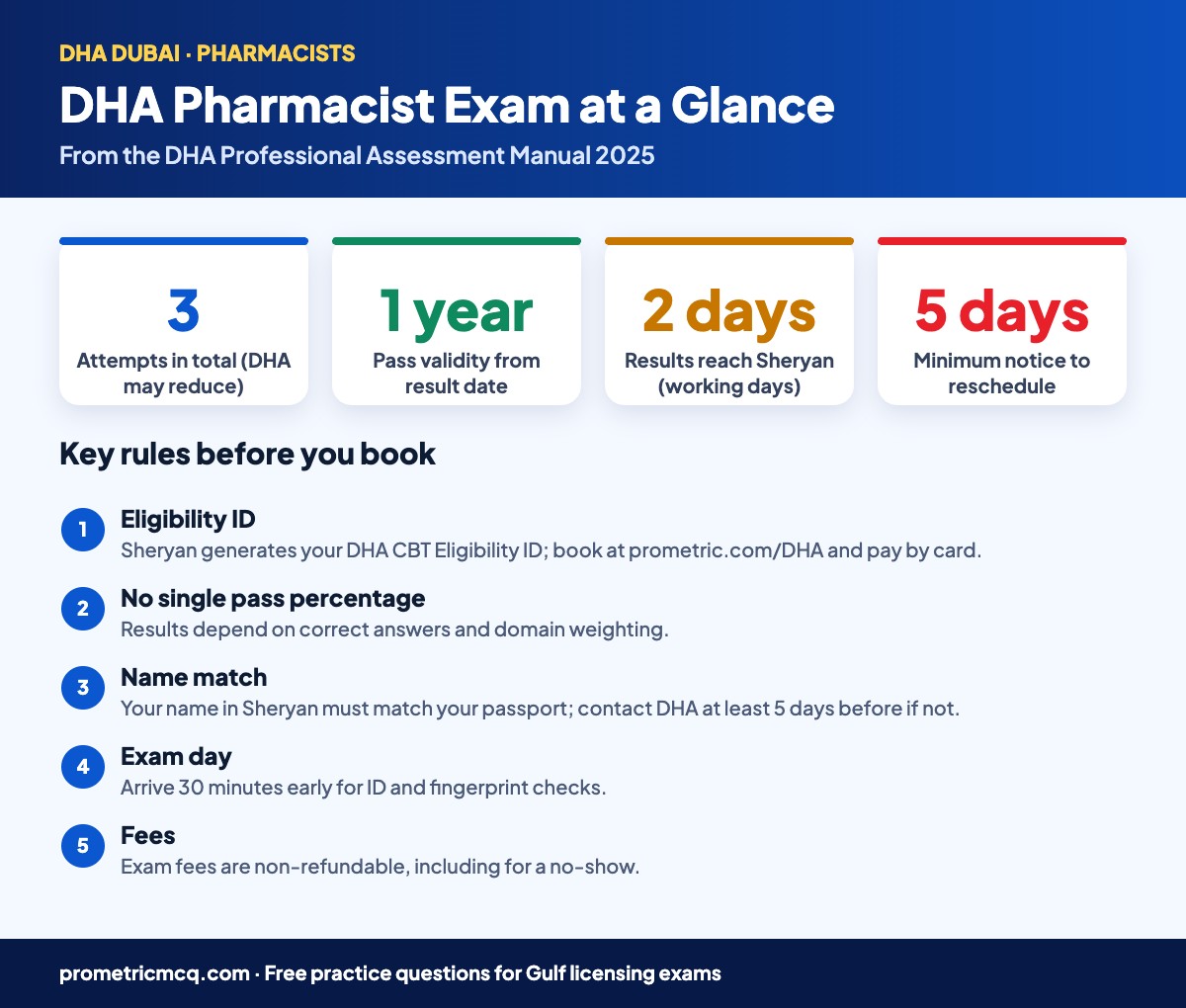
The DHA computer-based test is delivered by Prometric at test centres. These rules come from DHA's Professional Assessment Manual 2025; confirm them in Sheryan and on the DHA website before you book.
| Item | What DHA states |
|---|---|
| Eligibility | Sheryan generates a "DHA CBT Eligibility ID"; book at prometric.com/DHA and pay by card |
| Pass mark | No single published percentage; the result is based on correct answers and domain weighting |
| Attempts | 3 in total (DHA may reduce this); after 3 fails, reapplication is blocked for 2 years; no time restriction between attempts |
| Results and validity | CBT results reach Sheryan within 2 working days; a pass is valid for 1 year from the result date |
| Rescheduling | At least 5 calendar days before the exam (Prometric fee applies); exam fees are non-refundable, including for a no-show |
| Exam day | Name in Sheryan must match your passport; arrive 30 minutes early for fingerprint and ID checks |
[pmcq_cta title="DHA Pharmacist MCQs with explanations" text="Practise thousands of DHA-style pharmacist questions in timed mocks. Instant access after payment." button="Get DHA Pharmacist MCQs" url="https://www.prometricmcq.com/dha-pharmacist-exam-mcqs/"]
Free DHA Pharmacist Mock Test: 23 Case-Based Questions with Answers
Each question is a short practice scenario with one best answer. Choose Practice mode to see the explanation after each question, or Exam mode to answer all 23 against a 28-minute timer. DHA does not publish a single pass percentage, so the 60% pass line here is a practice benchmark only.
[pmcq_quiz title="Free DHA Pharmacist Mock Test – 23 Questions" pass="60" minutes="28" button="Get DHA Pharmacist MCQs – Instant Access" url="https://www.prometricmcq.com/dha-pharmacist-exam-mcqs/"]
Question 1
A 68-year-old man on long-term warfarin for atrial fibrillation (stable INR 2.4) is prescribed clarithromycin 500 mg twice daily for a chest infection. What is the most likely consequence of this combination?
- A. A fall in INR and a higher risk of stroke
- B. No clinically important interaction
- C. A rise in INR and a higher risk of bleeding
- D. Reduced absorption of clarithromycin
Answer: C
Explanation: Clarithromycin inhibits warfarin metabolism and can raise the INR, increasing bleeding risk. If the combination cannot be avoided, the INR should be checked within a few days of starting and the patient counselled about bleeding signs. A fall in INR would be expected with enzyme inducers such as rifampicin, not with clarithromycin.
High-yield takeaway: Macrolides such as clarithromycin raise the INR in patients on warfarin.
Question 2
A nurse asks the ward pharmacist to check a gravity infusion: 1,000 mL of 0.9% sodium chloride over 8 hours using a giving set with a drop factor of 20 drops/mL. What drip rate is needed?
- A. 42 drops/min
- B. 31 drops/min
- C. 63 drops/min
- D. 21 drops/min
Answer: A
Explanation: Drops/min = volume (mL) × drop factor ÷ time (min) = 1,000 × 20 ÷ 480 = 41.7, so about 42 drops/min. Converting hours to minutes first avoids the most common error.
High-yield takeaway: Drops/min = mL × drop factor ÷ minutes.
Question 3
A 59-year-old woman takes simvastatin 40 mg at night. She is prescribed a 7-day course of clarithromycin. What is the most appropriate advice?
- A. Stop simvastatin during the clarithromycin course and restart afterwards
- B. Double the simvastatin dose during the course
- C. Continue both, as there is no interaction
- D. Take simvastatin in the morning instead
Answer: A
Explanation: Clarithromycin strongly inhibits CYP3A4, which raises simvastatin levels and the risk of myopathy and rhabdomyolysis, so the combination is contraindicated. Withholding simvastatin for the short course is the usual approach. Doubling or simply re-timing the dose does not remove the interaction.
High-yield takeaway: Simvastatin plus a strong CYP3A4 inhibitor: withhold the statin for the course.
Question 4
A doctor asks how many milligrams of adrenaline are in 0.3 mL of adrenaline 1 in 1,000 solution. What is the answer?
- A. 3 mg
- B. 0.3 mg
- C. 0.03 mg
- D. 30 mg
Answer: B
Explanation: 1 in 1,000 means 1 g in 1,000 mL, which is 1 mg/mL. So 0.3 mL contains 0.3 mg. Ratio strengths are a frequent source of tenfold errors, so always convert to mg/mL.
High-yield takeaway: 1 in 1,000 = 1 mg/mL; 1 in 10,000 = 0.1 mg/mL.
Question 5
A 72-year-old woman takes oral methotrexate 15 mg once weekly for rheumatoid arthritis. She brings a new prescription for trimethoprim for a urinary tract infection. What is the main concern?
- A. Reduced effect of methotrexate
- B. Hypoglycaemia
- C. Increased risk of QT prolongation
- D. Increased risk of bone marrow suppression
Answer: D
Explanation: Trimethoprim is a folate antagonist and also reduces methotrexate excretion, so the combination can cause severe, sometimes fatal, bone marrow suppression. The pharmacist should contact the prescriber to choose an alternative antibiotic. The combination does not reduce methotrexate effect, and hypoglycaemia and QT prolongation are not the key risks.
High-yield takeaway: Methotrexate plus trimethoprim risks serious myelosuppression: avoid.
Question 6
A 10 mL ampoule of potassium chloride 15% w/v is being checked. Taking the molecular weight of KCl as 74.5, approximately how many millimoles of potassium does it contain?
- A. 10 mmol
- B. 15 mmol
- C. 20 mmol
- D. 40 mmol
Answer: C
Explanation: 15% w/v means 15 g per 100 mL, so 10 mL contains 1.5 g (1,500 mg). 1,500 ÷ 74.5 ≈ 20 mmol of KCl, which provides about 20 mmol of potassium. Concentrated potassium is a high-alert medicine and must always be diluted before infusion.
High-yield takeaway: mmol = mg ÷ molecular weight; concentrated KCl is high-alert.
Question 7
A 34-year-old woman with chronic hypertension takes lisinopril 10 mg daily. A pregnancy test is positive at 6 weeks. Which antihypertensive is most appropriate to switch to?
- A. Continue lisinopril throughout pregnancy
- B. Labetalol
- C. Losartan
- D. Spironolactone
Answer: B
Explanation: ACE inhibitors and angiotensin receptor blockers are associated with fetal renal damage and other harms and should be stopped and replaced once pregnancy is confirmed. Labetalol is a recommended first-line antihypertensive in pregnancy (nifedipine and methyldopa are alternatives). Losartan is an ARB, and spironolactone has anti-androgenic effects and is not used for hypertension in pregnancy.
High-yield takeaway: Stop ACE inhibitors and ARBs in pregnancy; labetalol is first-line.
Question 8
An 80 kg patient is prescribed dobutamine 5 micrograms/kg/min. The syringe contains 250 mg in 50 mL. At what rate should the syringe pump run?
- A. 4.8 mL/h
- B. 48 mL/h
- C. 2.4 mL/h
- D. 9.6 mL/h
Answer: A
Explanation: Dose = 5 × 80 = 400 micrograms/min = 24 mg/h. Concentration = 250 mg ÷ 50 mL = 5 mg/mL. Rate = 24 ÷ 5 = 4.8 mL/h. Converting micrograms per minute to milligrams per hour is the key step.
High-yield takeaway: micrograms/kg/min → mg/h (× weight × 60 ÷ 1,000) → ÷ mg/mL.
Question 9
A 27-year-old woman who is 9 weeks pregnant has symptoms of a lower urinary tract infection. She has no drug allergies and normal kidney function. Which antibiotic is most appropriate from this list?
- A. Trimethoprim
- B. Ciprofloxacin
- C. Doxycycline
- D. Cefalexin
Answer: D
Explanation: Cefalexin is considered safe in pregnancy and is a suitable choice for a lower UTI. Trimethoprim is a folate antagonist and is avoided in the first trimester, fluoroquinolones such as ciprofloxacin are generally avoided in pregnancy, and tetracyclines such as doxycycline affect fetal teeth and bones.
High-yield takeaway: UTI in early pregnancy: avoid trimethoprim, quinolones and tetracyclines.
Question 10
A 30-year-old woman with asthma is starting a beclometasone inhaler twice daily. Which counselling point helps prevent a common local side effect?
- A. Use it only when wheezy
- B. Rinse the mouth with water after each use
- C. Take it with food
- D. Stop it once symptoms improve
Answer: B
Explanation: Inhaled corticosteroids can cause oral thrush and hoarseness, which are reduced by rinsing the mouth after use (and using a spacer with a metered-dose inhaler). They are preventers, so they are taken regularly, not only when wheezy, and should not be stopped when symptoms improve.
High-yield takeaway: Inhaled steroids: use regularly and rinse the mouth afterwards.
Question 11
A 55-year-old man with type 2 diabetes has a BP of 148/92 mmHg on repeated readings and a urine albumin:creatinine ratio of 35 mg/mmol. eGFR is 72 mL/min/1.73 m². Which antihypertensive is most appropriate first?
- A. Atenolol
- B. Hydrochlorothiazide
- C. An ACE inhibitor such as ramipril
- D. Doxazosin
Answer: C
Explanation: In diabetes with albuminuria, an ACE inhibitor (or an ARB if not tolerated) is first-line because it lowers BP and reduces protein leakage, slowing kidney disease. Kidney function and potassium are checked after starting. Beta-blockers, thiazides and alpha-blockers lower BP but lack the same kidney-protective effect as first choice here.
High-yield takeaway: Diabetes with albuminuria: ACE inhibitor or ARB first.
Question 12
A breastfeeding mother of a 3-week-old baby needs pain relief after a dental extraction. Which analgesic is most appropriate?
- A. Codeine
- B. Paracetamol
- C. Aspirin
- D. Tramadol
Answer: B
Explanation: Paracetamol (with ibuprofen if needed) is preferred while breastfeeding. Codeine is avoided because some mothers are ultra-rapid metabolisers, producing high morphine levels in breast milk that can harm the infant. Aspirin is avoided because of the theoretical risk of Reye's syndrome, and tramadol is not first choice.
High-yield takeaway: Breastfeeding analgesia: paracetamol or ibuprofen; avoid codeine.
Question 13
A 74-year-old woman with type 2 diabetes takes metformin 1 g twice daily. Her latest eGFR is 25 mL/min/1.73 m², confirmed on repeat. What should the pharmacist recommend?
- A. Continue the same dose
- B. Stop metformin and review her diabetes treatment
- C. Increase metformin to improve control
- D. Switch to the modified-release form at the same dose
Answer: B
Explanation: Metformin is contraindicated when eGFR is below 30 mL/min/1.73 m² because of the risk of lactic acidosis, so it should be stopped and her treatment reviewed. The dose should already be reviewed (usually reduced) when eGFR falls below 45. Continuing, increasing or switching formulation does not remove the risk.
High-yield takeaway: Stop metformin when eGFR is below 30.
Question 14
A prescription on a medical ward reads: "Potassium chloride 20 mmol IV bolus now". What should the pharmacist do?
- A. Supply it as written
- B. Supply it with advice to inject slowly over 2 minutes
- C. Contact the prescriber; potassium must be diluted and given by controlled infusion
- D. Supply it but halve the dose
Answer: C
Explanation: Concentrated potassium chloride given as an IV bolus can cause fatal cardiac arrest. Potassium must be given diluted, as a controlled infusion at a rate set by local policy, ideally from pre-mixed bags. The prescription must be corrected with the prescriber.
High-yield takeaway: Never give IV potassium as a bolus.
Question 15
A 78-year-old man on digoxin 125 micrograms daily for atrial fibrillation is started on amiodarone. What is the most appropriate action regarding his digoxin?
- A. Reduce the digoxin dose and monitor for toxicity and levels
- B. Double the digoxin dose
- C. No change is needed
- D. Switch digoxin to the IV route
Answer: A
Explanation: Amiodarone increases digoxin levels, so the digoxin dose is usually reduced (often by about half) when amiodarone is started, with monitoring for bradycardia, nausea, visual changes and plasma levels. Increasing the dose or making no change risks toxicity, and the IV route does not avoid the interaction.
High-yield takeaway: Amiodarone raises digoxin levels: reduce the digoxin dose and monitor.
Question 16
A doctor writes an insulin prescription by hand. Which way of writing the dose is safest?
- A. "10U"
- B. "10 IU"
- C. "10.0 units"
- D. "10 units"
Answer: D
Explanation: Writing "units" in full prevents "U" being misread as a zero (turning 10 into 100), and trailing zeros such as "10.0" can be misread as 100. "IU" can also be misread. Clear, unabbreviated dosing is a basic medication safety rule.
High-yield takeaway: Write "units" in full; no trailing zeros.
Question 17
A 70-year-old man with heart failure takes lisinopril, spironolactone and a potassium chloride supplement. His serum potassium is 5.9 mmol/L, with no ECG changes. What is the most appropriate recommendation?
- A. Add a further potassium-sparing diuretic
- B. Continue all medicines and recheck in 3 months
- C. Increase the lisinopril dose
- D. Stop the potassium supplement and review the spironolactone dose urgently with the prescriber
Answer: D
Explanation: ACE inhibitors and spironolactone both raise potassium, and adding a supplement makes hyperkalaemia more likely. The supplement should be stopped and spironolactone reviewed (often reduced or withheld), with a repeat potassium soon. More potassium-sparing drugs or a higher ACE inhibitor dose would worsen the problem, and waiting 3 months is unsafe.
High-yield takeaway: ACE inhibitor plus spironolactone: avoid potassium supplements and monitor potassium.
Question 18
A 45-year-old man with type 1 diabetes on insulin is started on propranolol for migraine prevention. What should the pharmacist tell him?
- A. It may mask warning signs of hypoglycaemia such as tremor and palpitations
- B. It will raise his blood glucose and he should stop insulin
- C. It has no effect on diabetes
- D. It must be taken with sugar to prevent lows
Answer: A
Explanation: Beta-blockers, especially non-selective ones such as propranolol, can blunt the adrenergic warning signs of hypoglycaemia (tremor, palpitations), although sweating usually persists. He should monitor glucose more closely. He must not stop insulin.
High-yield takeaway: Beta-blockers can mask hypoglycaemia warning signs.
Question 19
A pharmacist needs to prepare 500 mL of a 2% w/v solution from a 20% w/v stock solution. What volume of stock is needed?
- A. 10 mL
- B. 25 mL
- C. 50 mL
- D. 100 mL
Answer: C
Explanation: Use C1V1 = C2V2: 20% × V1 = 2% × 500 mL, so V1 = 1,000 ÷ 20 = 50 mL of stock, made up to 500 mL. 25 mL would give 1%, 100 mL would give 4%, and 10 mL is a tenfold underestimate.
High-yield takeaway: Dilutions: C1V1 = C2V2.
Question 20
A 60-year-old woman taking lisinopril develops sudden swelling of her lips and tongue but is breathing comfortably. What is the correct advice?
- A. Continue lisinopril and take an antihistamine
- B. Halve the lisinopril dose
- C. Seek urgent medical care, stop lisinopril and avoid all ACE inhibitors in future
- D. Switch to another ACE inhibitor such as ramipril
Answer: C
Explanation: Angioedema is a potentially life-threatening ACE inhibitor reaction that can occur even after long use. She needs urgent assessment, and ACE inhibitors must be stopped permanently; switching to another ACE inhibitor carries the same risk. Antihistamines are often ineffective because the mechanism is bradykinin-mediated.
High-yield takeaway: ACE inhibitor angioedema: stop and never rechallenge with any ACE inhibitor.
Question 21
A 25-year-old man is prescribed doxycycline for acne. Which counselling point is correct?
- A. Take it with milk to protect the stomach
- B. Take it at bedtime and lie down straight away
- C. Take it together with iron or antacids
- D. Swallow it with a full glass of water while upright, and protect the skin from the sun
Answer: D
Explanation: Doxycycline can cause oesophageal irritation, so it is taken with plenty of water while upright, not just before lying down. Milk, antacids and iron reduce absorption, so doses should be separated. It can also cause photosensitivity.
High-yield takeaway: Doxycycline: water, upright, separate from minerals, sun protection.
Question 22
The mother of a 10-year-old boy with a feverish viral illness asks whether she can give him aspirin. What is the correct advice?
- A. Yes, aspirin is the preferred antipyretic for children
- B. No; use paracetamol or ibuprofen, as aspirin is linked to Reye's syndrome in children
- C. Yes, but only at night
- D. Only if the fever is above 39 °C
Answer: B
Explanation: Aspirin is avoided in children and adolescents because of its association with Reye's syndrome, a rare but serious illness affecting the liver and brain. Paracetamol or ibuprofen are the appropriate choices for fever and discomfort.
High-yield takeaway: Children: avoid aspirin (Reye's syndrome).
Question 23
A 50-year-old woman on lithium needs a routine serum level. When should the blood sample be taken?
- A. About 12 hours after the last dose
- B. 1 hour after the dose
- C. 30 minutes after the dose
- D. At any time of day
Answer: A
Explanation: Lithium levels are standardised to a sample taken about 12 hours after the last dose, so results can be compared with the target range. Samples taken soon after a dose give falsely high results.
High-yield takeaway: Lithium level: about 12 hours post-dose.
[/pmcq_quiz]
How to Score Your Mock Test
| Score (out of 23) | Meaning | Next step |
|---|---|---|
| 19–23 | Strong | Move to full-length timed mocks. |
| 14–18 | Borderline | Revise every topic you missed, starting with calculations and interactions. |
| 0–13 | Needs structured revision | Follow the plan below before booking. |
Because DHA weights results by domain, a strong total can hide a weak area. Note which topics you missed, not just how many, and make sure no single domain is left behind.
[pmcq_cta title="Practise DHA pharmacist mocks under real timing" text="Timed mocks, explained answers and a progress tracker on any device." button="Start Practising Now" url="https://www.prometricmcq.com/dha-pharmacist-exam-mcqs/"]
3-Week Plan for the DHA Pharmacist Exam
- Week 1: calculations every day (20 a day), cardiovascular and endocrine therapeutics.
- Week 2: infections, respiratory, CNS, pregnancy and lactation, interactions.
- Week 3: pharmacy practice and ethics, then two full timed mocks.
Also read: DHA exam syllabus for pharmacists, DHA vs MOH for pharmacists and our DHA exam hub.
FAQs: DHA Pharmacist Mock Test
Is this the official DHA pharmacist exam?
No. It is a free practice test written by PrometricMCQ in the style of the DHA pharmacist assessment. Real exam questions are confidential.
What is the DHA pharmacist pass mark?
DHA does not publish a single pass percentage. Its assessment manual says the result is based on the number of correct answers and the weighting of each domain.
How many attempts do I get?
Three in total, and DHA may reduce this. After three fails, reapplication is blocked for two years, so book only when your timed mock scores are consistently strong.
How long is a DHA pass valid?
One year from the result date. CBT results reach Sheryan within two working days.
Can I reschedule my DHA exam?
Yes, at least 5 calendar days before the exam, and a Prometric fee applies. Exam fees are non-refundable, including for a no-show.
Which topics should DHA pharmacist candidates prioritise?
Calculations, drug interactions, high-alert medicines, pregnancy and breastfeeding, and patient counselling. These areas link directly to patient safety.
How should I practise calculations?
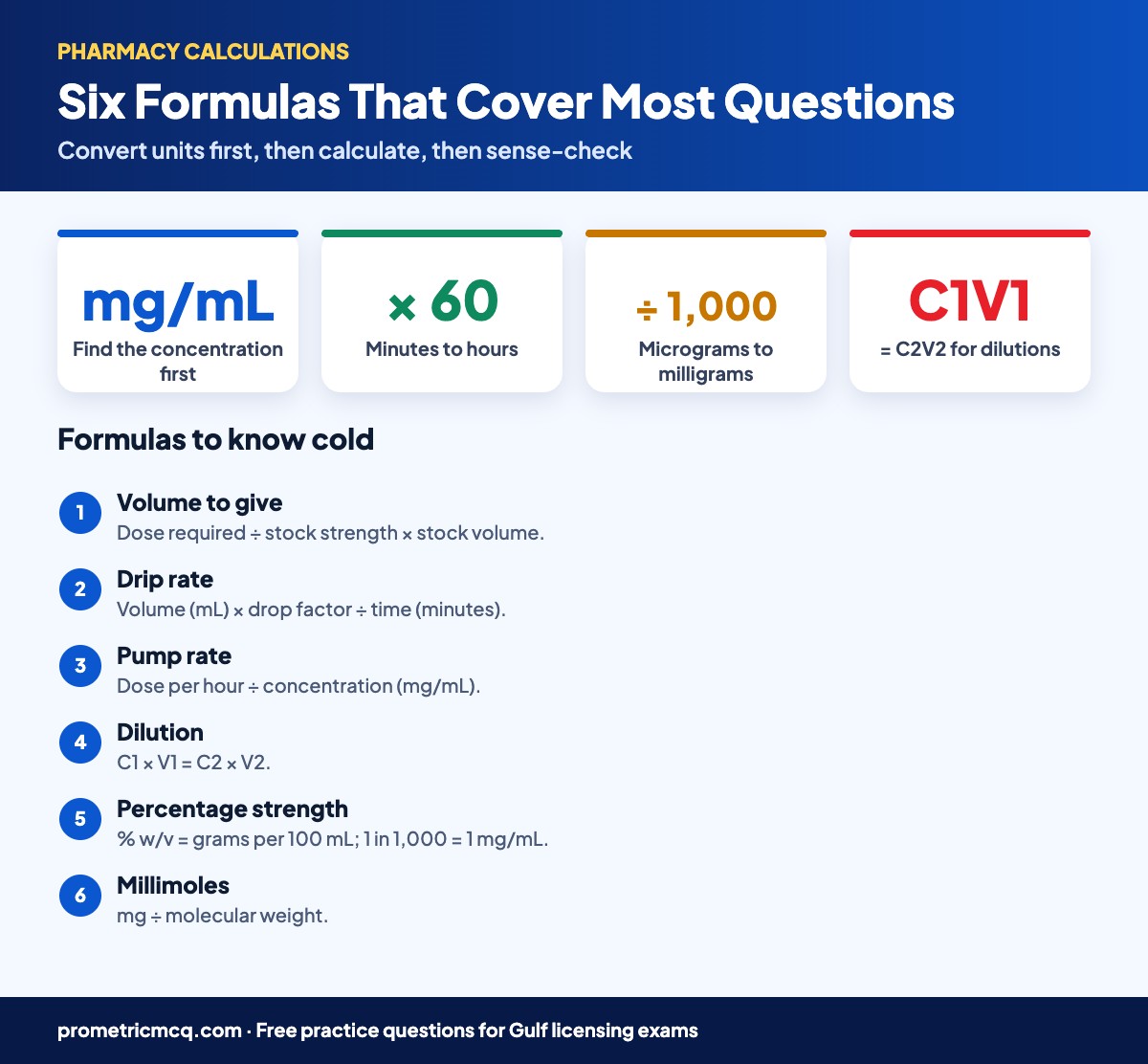
Learn a small set of formulas, convert units before you calculate, and sense-check every answer. Our guide to tricky DHA calculations has more worked examples.
What do I need on exam day?
Your passport, with a name that matches Sheryan. Arrive 30 minutes early for ID and fingerprint checks.
Is the DHA exam harder than the MOHAP exam?
They are scored differently: MOHAP sets a 60% pass mark, while DHA weights domains. Our DHA vs MOH comparison for pharmacists explains the practical differences.
How should I use this mock test?
Take it once in Exam mode, review every explanation, then retake it a week later to check that the concepts have stuck before moving to full-length mocks.
Conclusion
DHA pharmacist questions reward careful calculation and safe interaction checks. Use this free mock to find weak areas, then build speed with full timed practice.
[pmcq_cta title="Ready to pass the DHA pharmacist exam?" text="Instant access to DHA pharmacist MCQs with explanations and timed mocks." button="Get DHA Pharmacist MCQs – Instant Access" url="https://www.prometricmcq.com/dha-pharmacist-exam-mcqs/"]

The PrometricMCQ editorial team writes independent guides for healthcare professionals preparing for Gulf licensing exams. Editorial policy