
In this guide
SCFHS Pharmacy (SPLE) Exam: A Complete Study Guide
For pharmacists seeking to practice within the Kingdom of Saudi Arabia's rapidly advancing healthcare sector, the Saudi Pharmacist Licensure Examination (SPLE) is the ultimate gateway. Administered by the Saudi Commission for Health Specialties (SCFHS), this comprehensive exam is designed to ensure that all practitioners possess the necessary competence to deliver safe, effective, and high-quality pharmaceutical care. It is the single most important step toward obtaining your Saudi SCFHS license.
The SPLE is renowned for its rigor and its broad scope, covering not just clinical pharmacy but also the specific laws, regulations, and public health priorities of Saudi Arabia. Many international pharmacists, despite strong clinical backgrounds, find the exam challenging because they are unprepared for its unique structure and emphasis on local context. A generic review of pharmacy topics is not enough; success demands a targeted, strategic approach that aligns with the official SCFHS blueprint. Our dedicated guide to the Saudi Pharmacist Licensure Examination (SPLE) provides a crucial foundation for this journey.
This complete study guide is your definitive resource for conquering the SPLE. We will provide an exhaustive breakdown of the official exam blueprint, a deep dive into the high-yield topics within each domain, an analysis of the case-based question style with sample questions, and a comprehensive 10-point FAQ to clarify all your doubts. Our mission is to transform your study process from a daunting task into a structured, confident, and successful campaign.
Key Takeaways for the SPLE Exam
- Blueprint is Your Bible: The SPLE is structured around a detailed competency blueprint. Your study plan must be aligned with these official domains and weightings.
- Patient Care is Paramount: Domain 2, focusing on pharmaceutical care and patient safety, constitutes the largest portion of the exam. Mastery here is non-negotiable.
- KSA-Specific Content is Crucial: Questions on Saudi pharmacy law, public health initiatives, and the role of the Saudi Food and Drug Authority (SFDA) are a certainty.
- Calculations Require Perfection: Pharmaceutical calculation questions are spread throughout the exam. Accuracy and speed are essential.
- Aim High: The passing score is determined by a set standard. A consistent practice score of 70-75% is the safest strategy to ensure a comfortable pass.
Deconstructing the SPLE Exam Pattern
A successful study plan begins with a clear understanding of the exam's structure. The SPLE is a comprehensive, computer-based assessment designed to evaluate your readiness for practice.
- Format: Computer-Based Test (CBT) administered at a Prometric center.
- Number of Questions: The exam consists of 300 Multiple-Choice Questions (MCQs).
- Structure: The exam is divided into two parts, each containing 150 questions.
- Duration: You will have 3 hours for each part, for a total of 6 hours of testing time, with a scheduled break in between.
- Content Style: The questions are primarily presented as clinical vignettes or case scenarios that require you to apply your knowledge to make a sound professional judgment.
Approach each SPLE question as a consultation. Identify the patient's problem, consider the relevant clinical and regulatory factors, and then select the single best course of action from the options provided.
The Official SPLE Blueprint: Your Roadmap to Success
Unlike some other exams, the SCFHS provides a detailed blueprint that outlines the main domains and their approximate weightings. Structuring your study plan around this blueprint is the most effective way to prepare. An effective SCFHS exam preparation strategy must be built on this foundation.
| SPLE Competency Domain | Approximate Weighting | High-Yield Topics for Focus |
|---|---|---|
| Domain 1: Basic Biomedical & Pharmaceutical Sciences | ~10-15% | Pharmacology (MOA, side effects), Medicinal Chemistry, Pharmacokinetics (ADME), Pharmaceutics (dosage forms, biopharmaceutics), and basics of Biotechnology. |
| Domain 2: Pharmaceutical Care, Patient & Medication Safety | ~45-55% | This is the largest and most critical domain. It includes therapeutics of all major disease states (Cardiology, Endo, ID, etc.), patient assessment, medication therapy management, patient counseling, and medication safety protocols (e.g., ISMP guidelines). |
| Domain 3: Pharmacy Systems, Public Health & Patient Education | ~20-30% | Drug distribution systems, inventory management, sterile and non-sterile compounding, health promotion, disease prevention, and immunization programs. |
| Domain 4: Social, Behavioral & Administrative Pharmacy Sciences | ~10-15% | Saudi Pharmacy Law and Ethics (Crucial!), communication skills, pharmacy management, pharmacoeconomics, and evidence-based practice. |
Deep Dive into High-Yield SPLE Topics
Let's break down the most critical areas where you should focus your study time for maximum impact.
Domain 2: Mastering Pharmaceutical Care
With over half the exam dedicated to this domain, your clinical knowledge must be sharp, current, and comprehensive.
- Top Chronic Diseases: Be an expert on the latest guidelines for Diabetes (ADA guidelines), Hypertension (AHA/ACC), Dyslipidemia (ACC/AHA), Asthma (GINA), and COPD (GOLD). Know the drug classes, mechanisms, first-line agents, and key counseling points.
- Infectious Diseases: This is a major topic. Focus on principles of antibiotic stewardship, common pathogens, and empiric antibiotic selection for conditions like CAP, UTI, SSTI, and meningitis.
- Cardiology: Beyond hypertension, have a strong grasp of anticoagulation (warfarin management, DOACs), heart failure, and acute coronary syndromes.
- Special Populations: Expect questions related to medication use in pregnancy, lactation, pediatrics, and geriatric patients, as well as dosage adjustments in renal and hepatic impairment.
Domain 4: Conquering Saudi Pharmacy Law and Ethics
This is where international graduates often lose the most points. Do not neglect this area.
- Drug Control: Understand the classification of drugs in KSA (Narcotic, Controlled, Prescription-only, OTC).
- Dispensing Laws: Know the legal requirements for a prescription, rules for refilling, and record-keeping mandates.
- Role of the SFDA: Be aware of the role of the Saudi Food and Drug Authority (SFDA) in drug approval, regulation, and post-marketing surveillance.
- Professional Ethics: Understand the principles of patient confidentiality, informed consent, and professional conduct as expected in the Kingdom.
Essential Skill: Pharmaceutical Calculations
Although not a separate domain, calculation questions are integrated throughout the exam. They are a source of "guaranteed" points if you achieve mastery.
- Practice daily until you are fast and accurate. Key areas include:
- Alligation and Dilution
- Dosage Calculations (mg/kg, BSA)
- IV Flow Rates and Infusion Times
- Parenteral Nutrition (PN) Calculations
- Pharmacokinetic Calculations (e.g., half-life, clearance)
SPLE Sample Questions & In-Depth Rationales
Let's see how these concepts are tested. The best way to prepare is with a high-quality, targeted QBank like our SCFHS Pharmacist Exam MCQs.
Question 1: Domain 2 (Pharmaceutical Care)
A 62-year-old female with a new diagnosis of atrial fibrillation (CHADS2-VASc score = 3) is being started on anticoagulation. She has no history of valvular heart disease and has good renal function. Which of the following is the most appropriate initial therapy?
- Aspirin 81 mg daily
- Warfarin, target INR 2.0-3.0
- Apixaban 5 mg twice daily
- Clopidogrel 75 mg daily
Correct Answer: C
Rationale: This question assesses your knowledge of current stroke prevention guidelines in non-valvular atrial fibrillation (NVAF). For a patient with a CHADS2-VASc score of 2 or greater, oral anticoagulation is indicated. Current international guidelines strongly recommend a Direct Oral Anticoagulant (DOAC) such as apixaban, rivaroxaban, or dabigatran over warfarin as first-line therapy. This is due to their superior safety profile (lower risk of intracranial hemorrhage), predictable pharmacokinetics, and lack of need for routine monitoring. Apixaban 5 mg BID is the standard dose for patients without significant risk factors for bleeding (e.g., age >80, weight <60kg, Cr >1.5).
Why other options are incorrect:
A & D: Antiplatelet therapy (aspirin or clopidogrel) is not considered adequate for stroke prevention in patients with a CHADS2-VASc score of 2 or more.
B: While warfarin is effective, it is no longer the preferred first-line agent over DOACs due to its numerous drug-food interactions, narrow therapeutic index, and burdensome monitoring requirements.
Essential SPLE MCQs with In-Depth Answers
Engage with these sample questions to grasp the exam's complexity. The real learning happens when you analyze the rationale for both the correct and incorrect options. For thousands more questions like these, a dedicated QBank for the SCFHS Pharmacist Exam is indispensable.
MCQ 1: Pharmaceutical Calculations
How many milliliters of a 2% (w/v) stock solution of potassium permanganate are needed to prepare 500 mL of a solution such that 25 mL of it diluted to 100 mL will give a 1:2000 solution?
- 25 mL
- 50 mL
- 75 mL
- 100 mL
Correct Answer: B
Rationale: This is a multi-step calculation that requires working backward.
Step 1: Find the concentration of the final diluted solution. 1:2000 means 1 g in 2000 mL. Concentration = (1 g / 2000 mL) * 100 = 0.05% (w/v).
Step 2: Find the concentration of the intermediate solution. Use the dilution formula C1V1 = C2V2. (C1) * (25 mL) = (0.05%) * (100 mL). C1 = (0.05 * 100) / 25 = 0.2%. So, the solution you prepared was 0.2% (w/v).
Step 3: Find the volume needed from the stock solution. Again, use C1V1 = C2V2. You need to prepare 500 mL of this 0.2% solution from a 2% stock solution. (2%) * (V1) = (0.2%) * (500 mL). V1 = (0.2 * 500) / 2 = 50 mL.
MCQ 2: Pharmacotherapy (Clinical Case)
A 65-year-old male with a history of type 2 diabetes, hypertension, and a previous myocardial infarction is currently taking metformin, lisinopril, and atorvastatin. His A1c is 8.5%, and his blood pressure is 135/85 mmHg. Which of the following medications would be most appropriate to add to his regimen?
- Glimepiride
- Pioglitazone
- Empagliflozin
- Sitagliptin
Correct Answer: C
Rationale: According to the latest international cardiology and diabetes guidelines, SGLT-2 inhibitors (like empagliflozin) are strongly recommended for patients with type 2 diabetes and established atherosclerotic cardiovascular disease (ASCVD), such as a previous MI. Empagliflozin has been proven in large clinical trials (like the EMPA-REG OUTCOME trial) to reduce the risk of cardiovascular death, nonfatal MI, and stroke in this patient population, in addition to its glucose-lowering effects.
Why other options are incorrect:
A: Glimepiride (a sulfonylurea) increases the risk of hypoglycemia and is generally considered weight-neutral or may cause weight gain. It does not offer cardiovascular benefits.
B: Pioglitazone (a TZD) can cause fluid retention and weight gain, and should be used with caution in patients with a history of heart failure or MI.
D: Sitagliptin (a DPP-4 inhibitor) is effective at lowering glucose and is weight-neutral, but it has not demonstrated the same robust cardiovascular benefits as SGLT-2 inhibitors in high-risk patients.
Sample SPLE Pharmacist MCQs with Explanations
Use these sample questions to understand the type of thinking needed for Saudi pharmacist exam preparation.
Sample MCQ 1
A patient on warfarin asks which OTC pain medicine is safest to use without increasing bleeding risk. Which counseling point is best?
- A. Use ibuprofen regularly
- B. Use aspirin with warfarin
- C. Ask the pharmacist/doctor before using NSAIDs; acetaminophen may be preferred within safe limits
- D. Stop warfarin before taking pain medicine
Answer: C
Explanation: Warfarin has important bleeding interactions. NSAIDs and aspirin can increase bleeding risk. The safest exam answer is to avoid unsupervised NSAID/aspirin use and seek professional guidance.
Sample MCQ 2
A child weighs 20 kg. The dose is 10 mg/kg/dose. The suspension is 100 mg/5 mL. What volume is required per dose?
- A. 5 mL
- B. 10 mL
- C. 15 mL
- D. 20 mL
Answer: B
Explanation: Dose = 10 × 20 = 200 mg. Concentration = 100 mg/5 mL = 20 mg/mL. Volume = 200 ÷ 20 = 10 mL.
Sample MCQ 3
Which drug class commonly requires counseling about dry cough as an adverse effect?
- A. ACE inhibitors
- B. Calcium channel blockers
- C. Loop diuretics
- D. Statins
Answer: A
Explanation: ACE inhibitors can cause dry cough due to bradykinin accumulation. This is a classic counseling and adverse-effect topic.
Sample MCQ 4
A patient has CrCl reduction and is prescribed a primarily renally cleared antibiotic. What should the pharmacist check first?
- A. Tablet color
- B. Renal dose adjustment
- C. Brand popularity
- D. Shelf location
Answer: B
Explanation: Renal function affects clearance of many drugs. Dose interval or dose amount may need adjustment to prevent toxicity.
Sample MCQ 5
Which counseling point is most important for metronidazole?
- A. Take with grapefruit only
- B. Avoid alcohol during therapy and for the advised period after
- C. Crush all tablets automatically
- D. Use only at bedtime
Answer: B
Explanation: Metronidazole is commonly associated with alcohol avoidance counseling in exam questions.
Sample MCQ 6
A 1% w/v solution contains how many mg/mL?
- A. 1 mg/mL
- B. 5 mg/mL
- C. 10 mg/mL
- D. 100 mg/mL
Answer: C
Explanation: 1% w/v means 1 g in 100 mL, equal to 1000 mg/100 mL = 10 mg/mL.
Sample MCQ 7
Which parameter is most relevant for monitoring statin-associated muscle toxicity when symptoms appear?
- A. Serum CK
- B. Serum sodium only
- C. Urine glucose only
- D. Visual acuity
Answer: A
Explanation: Muscle pain or weakness with statin therapy may require creatine kinase assessment and clinical review.
Sample MCQ 8
A prescription says one tablet twice daily for 28 days. How many tablets should be dispensed?
- A. 28
- B. 42
- C. 56
- D. 84
Answer: C
Explanation: Twice daily means 2 tablets per day. 2 × 28 = 56 tablets.
Frequently Asked Questions (FAQs) for the SPLE Exam
What is the passing score for the SPLE?
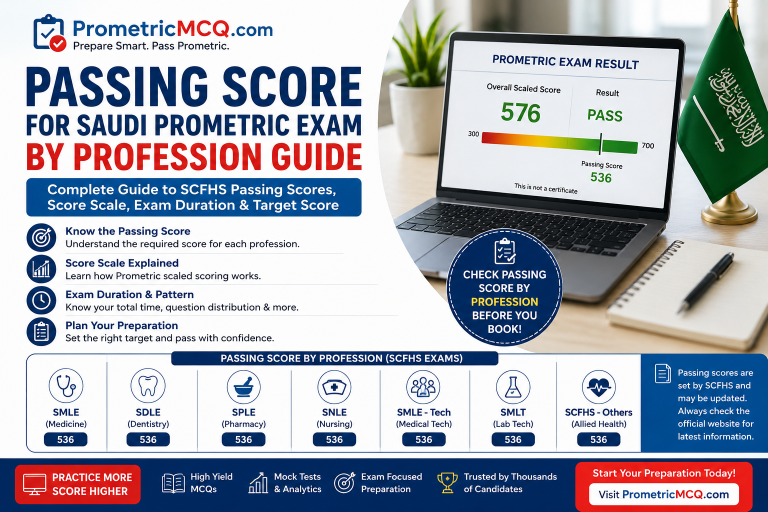
The SCFHS uses a criterion-referenced method, meaning the passing standard is predetermined. They do not publish a specific percentage. However, the widely accepted unofficial passing score is around 600 out of 900 on their scaled score, which roughly translates to needing about 65-70% of the questions correct. Your safest strategy is to aim for 75%+ in your practice tests.
How long should I prepare for the SPLE exam?
For a recent graduate, a dedicated 3-4 months is ideal. For a pharmacist who has been out of school for some time, 4-6 months of consistent study is recommended. This allows enough time to cover the vast syllabus and complete extensive MCQ practice.
What is the DataFlow (PSV) process for the SCFHS?
Primary Source Verification (PSV) by the DataFlow Group is a mandatory step in the licensing process. They verify the authenticity of your qualifications (pharmacy degree, license, experience) directly from the source. It is recommended to start this process early as it can take several weeks or even months. Learn more about the SCFHS DataFlow process here.
How many times can I attempt the SPLE?
Candidates are typically allowed up to four attempts to pass the SPLE. After the second attempt, a waiting period and possibly a training period may be required. Always check the latest policies on the official SCFHS website, as these rules can change.
Are there any specific books I must study for the SPLE?
There is no single "official" book. A successful strategy involves using a combination of resources. Standard international references like Dipiro's Pharmacotherapy, Goodman & Gilman's, and the latest editions of treatment guidelines (ADA, AHA, etc.) are essential for the clinical section. For practice, a high-quality, KSA-focused question bank is the most important resource.
How important is the NAPLEX exam for SPLE preparation?
Studying for the NAPLEX can be very helpful for the clinical and basic science portions of the SPLE, as the core knowledge is similar. However, it will not prepare you for the crucial Saudi-specific law, ethics, and healthcare system questions. You must supplement any international study materials with resources focused on practice in the Kingdom.
Is there negative marking for wrong answers?
No, there is no penalty for incorrect answers on the SPLE. Your score is based only on the number of questions you answer correctly. Therefore, you must answer every single question, even if you have to make an educated guess.
What is the best strategy for the two parts of the exam?
Treat them as two separate exams. During the break, do not dwell on the first part. Take the time to rest, rehydrate, and have a light snack. Reset your mind and approach the second 150 questions with fresh focus. Time management is key for both halves; pace yourself at about one question per minute to leave time for review.
How soon do I get my SPLE results?
Results are typically released within two to six weeks after the exam date. You will be notified via email and can access your results through your account on the SCFHS portal.
What are the next steps after passing the SPLE?
After passing the SPLE and completing your PSV with DataFlow, you need to complete the "Professional Classification and Registration" process with the SCFHS. Once classified as a Pharmacist, you can seek employment. Your employer will then finalize the process to issue your professional license to practice.
Conclusion: Your Blueprint for a Successful Career in KSA
The Saudi Pharmacist Licensure Examination is a rigorous and comprehensive test, but it is a fair one. It provides a clear blueprint for what is expected of a competent pharmacist practicing in the Kingdom. By aligning your study plan with this blueprint, focusing on high-yield clinical and regulatory topics, and dedicating yourself to extensive MCQ practice, you are not just preparing to pass an exam—you are preparing to be an excellent pharmacist in Saudi Arabia. This guide provides the strategy; your dedication will provide the success.

The PrometricMCQ editorial team writes independent guides for healthcare professionals preparing for Gulf licensing exams. Editorial policy